


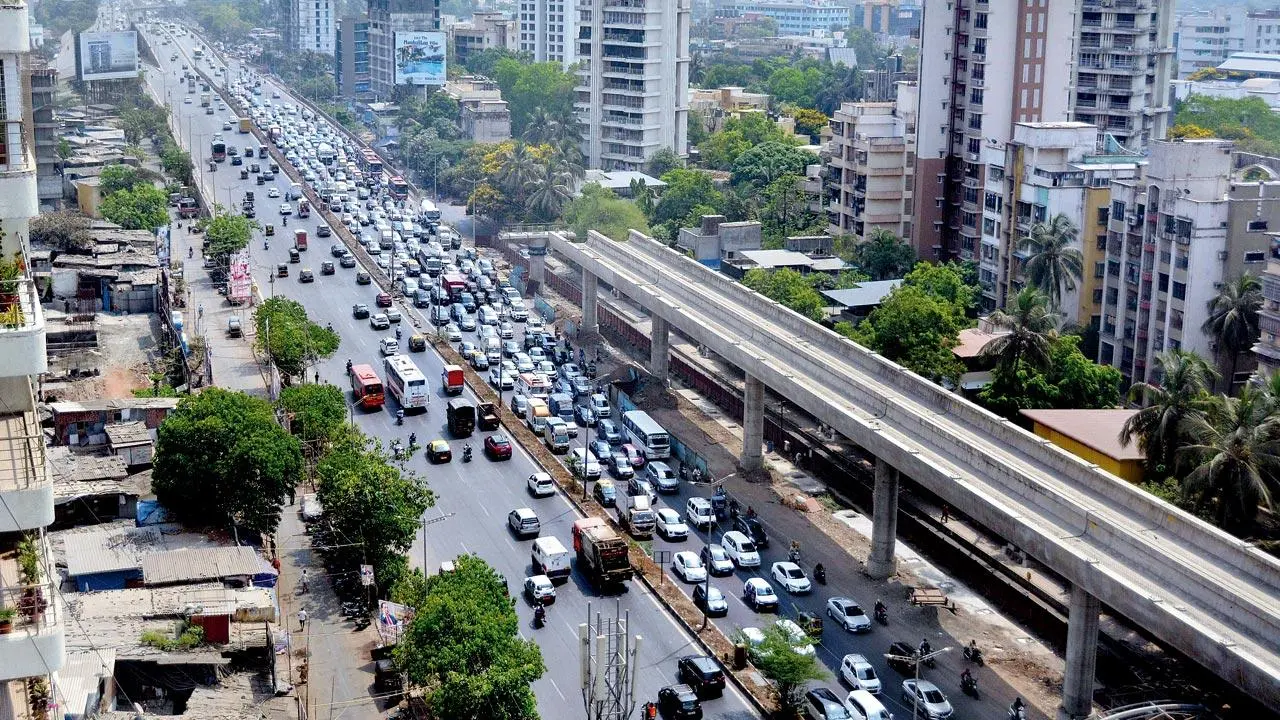
Mumbai’s east-west travel corridor is poised for a significant transformation as the Santacruz Chembur Link Road (SCLR) extension nears completion, offering a long-awaited signal-free connectivity between the Eastern and Western Express Highways.
The final 1.9-km stretch of the 5.4-km corridor is expected to ease persistent traffic congestion at critical intersections like Hans Bhugra Marg and Vakola, boosting daily commuting efficiency and aligning with Mumbai’s push towards a sustainable urban transport ecosystem. The centrepiece of the extension is a 215-metre-long cable-stayed bridge, India’s first with a 100-metre curvature, soaring 25 metres above the Western Express Highway. Engineered using Orthotropic Steel Deck (OSD) technology—previously deployed in the Atal Setu—the structure reflects the city’s transition to advanced, space-optimising transport infrastructure. This engineering innovation not only allows seamless construction in densely built areas but also ensures that vehicular flow on ground-level roads remains largely uninterrupted during and after execution.
Part of the larger “Mumbai in Minutes” programme, the project is designed to reduce travel time by up to 45 minutes for commuters traversing Mumbai’s east-west axis, especially those heading to strategic economic zones such as Bandra Kurla Complex and the international airport. With 3.4 km of the corridor already operational, the final stretch bridges a crucial urban gap that has long hindered efficient cross-city mobility. The SCLR extension also responds directly to the Comprehensive Transportation Study (CTS) conducted by the Mumbai Metropolitan Region Development Authority, which identified an urgent need for robust east-west transport corridors. The existing SCLR, along with the Andheri-Ghatkopar Link Road and Jogeshwari-Vikhroli Link Road, is already operating at near-saturation levels, underscoring the importance of this extension.
Despite the optimism, transport experts continue to raise fundamental concerns. While flyovers and elevated roads offer short-term relief, they argue, they are not long-term substitutes for holistic traffic management. The rise in vehicular ownership, coupled with static road infrastructure, often offsets any benefits gained from such projects over time. Urban planners emphasise the importance of parallel strategies like regulating vehicle density, enhancing public transport ridership, and promoting non-motorised mobility options to prevent future gridlocks. Nevertheless, the SCLR extension marks a noteworthy stride in Mumbai’s pursuit of a cleaner, faster, and more equitable transportation network. By leveraging cutting-edge technology and addressing one of the city’s most pressing infrastructure deficits, the corridor underscores the growing emphasis on green mobility and sustainable city planning. As Mumbai awaits the operationalisation of the corridor in the coming weeks, the project embodies both progress and the persistent complexities of megacity mobility.
Also Read :Pune Bengaluru Expressway to Cut Travel Time by Half
Mumbai to get new link road for faster east west travel soon
