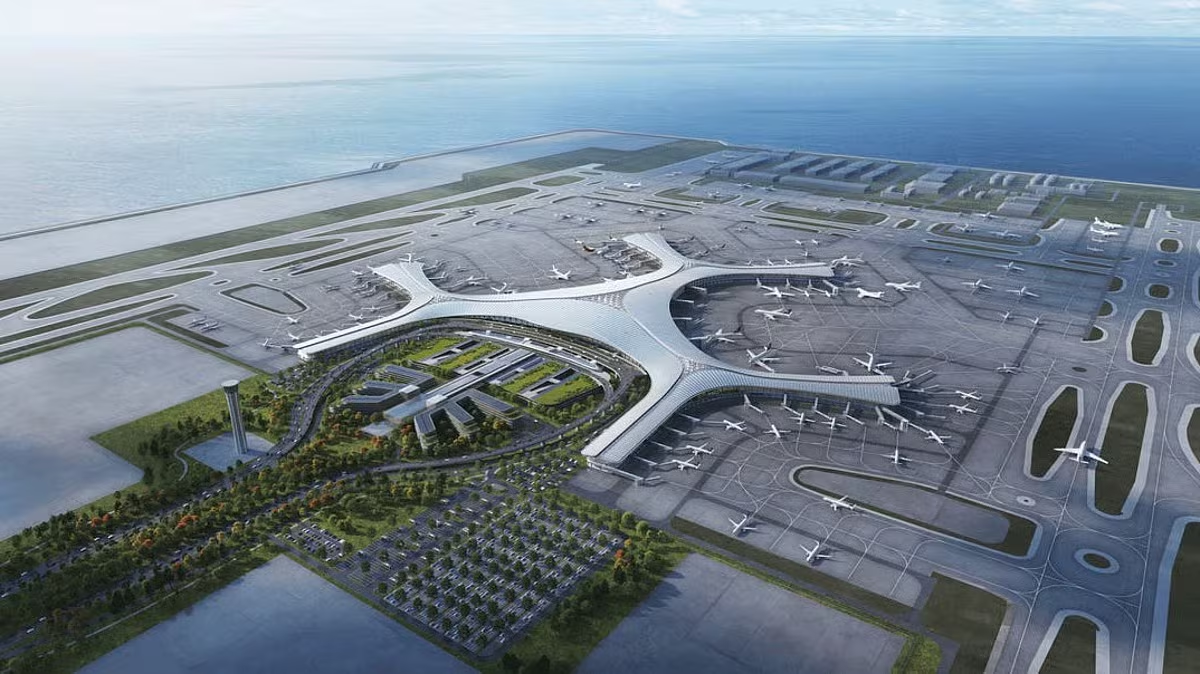
The Maharashtra government has reopened the location debate for Mumbai’s proposed third airport, commissioning a fresh comparative assessment of Virar and Palghar as potential sites. The move signals a recalibration of regional aviation planning at a time when the Mumbai Metropolitan Region (MMR) is preparing for long-term population growth, logistics expansion, and climate-sensitive infrastructure development.
State officials confirmed that technical and urban development experts have been tasked with evaluating both locations before a final decision is taken. The assessment will examine land availability, multimodal connectivity, environmental impact, and the ability of each site to support sustained economic activity over the coming decades. The proposed airport is intended to complement the existing international airport in Mumbai and the under-construction facility in Navi Mumbai. Together, the three airports are expected to anchor a broader northern expansion of the MMR, easing pressure on saturated urban cores while opening new corridors for housing, employment, and freight movement.
Urban planners involved in the process point out that Virar offers proximity to planned coastal and road infrastructure, which could enable faster links to upcoming maritime assets along the western seaboard. Palghar, on the other hand, has long been positioned as a strategic growth zone due to its relatively lower urban density and capacity to absorb large-scale infrastructure with fewer displacement risks. The airport proposal is part of a wider regional strategy that includes a deep-draft port, high-speed rail connectivity, and industrial clusters aimed at decongesting Mumbai while strengthening Maharashtra’s role in national and global supply chains. Officials describe this northern belt as a future metropolitan node that could balance economic growth with more distributed urbanisation.
However, experts caution that the final choice must account for environmental resilience. Both Virar and Palghar sit near ecologically sensitive zones, including coastal wetlands and flood-prone areas. Sustainable site selection, integrated drainage planning, and low-carbon construction will be critical to ensuring that the airport does not exacerbate climate risks already affecting the region.
The decision also carries implications for real estate and civic infrastructure in Vasai-Virar and Palghar districts. A new airport could reshape housing demand, transit-oriented development, and employment patterns, making early coordination with local governments essential. Civic bodies in the region are expected to play a key role in aligning zoning regulations, public services, and gender-inclusive workforce planning with the scale of development envisioned.
For now, the state government maintains that no location has been finalised. The outcome of the comparative study is expected to determine not just where the airport is built, but how equitably and sustainably Mumbai’s next phase of growth is managed. As passenger demand rises and climate pressures intensify, the third airport is increasingly seen as a test case for future-ready urban infrastructure in India’s largest metropolitan region.
Mumbai Third Airport Plan Puts Virar Palghar In Focus