


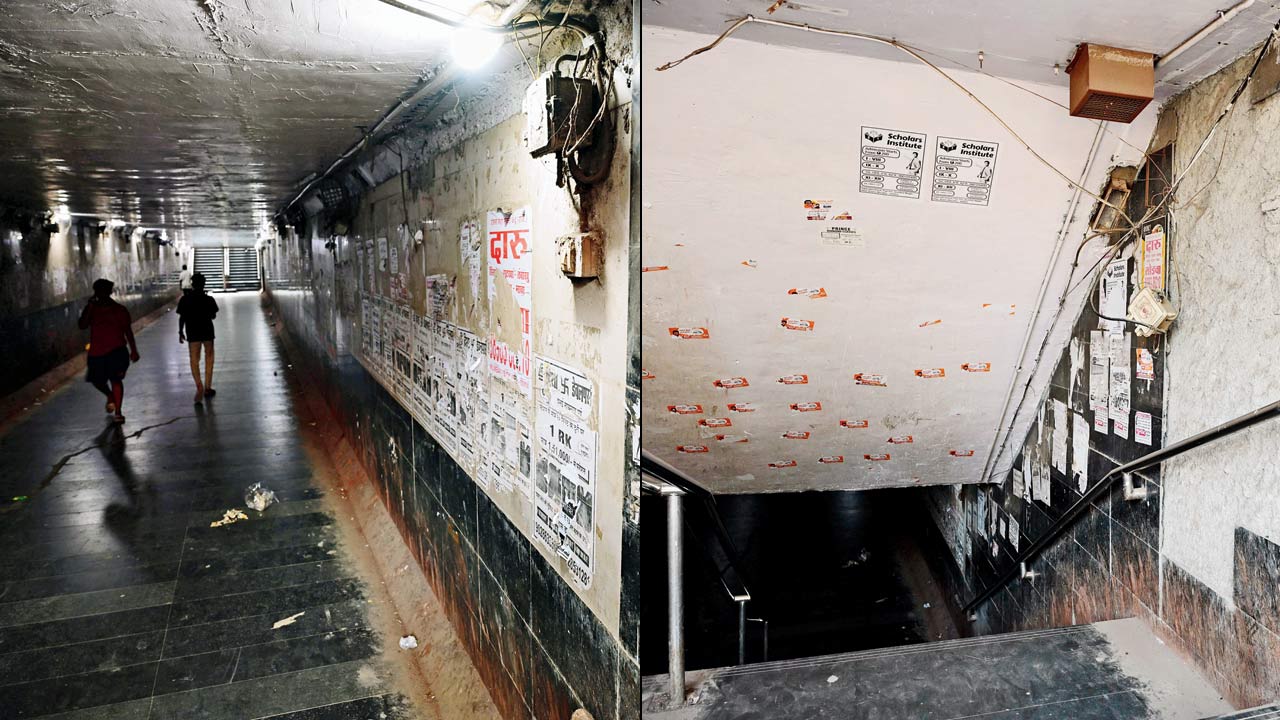
Mumbaikars commuting through the bustling 5 Road Junction near Metro Cinema in South Mumbai are facing growing safety concerns as key pedestrian subway entries remain closed for prolonged periods. With subway entry/exit points 3 and 9 sealed off for weeks, pedestrians—including college students and persons with disabilities—are left with no option but to navigate dangerous vehicular traffic to cross the congested intersection.
The pedestrian subway under this major South Mumbai junction had been widely praised following recent upgrades for providing safe passage amid chaotic traffic. However, the sustained closure of crucial access points has severely undercut its purpose. Entry/exit 9, adjacent to the iconic Metro Cinema, has remained inaccessible for over a month, while gate 3 has been shut for nearly three weeks—both closures linked to ongoing ceiling repairs and maintenance.
The timing of these shutdowns has worsened the commuter experience as the monsoon advances. Rainfall has made road surfaces slick and reduced visibility, intensifying the risk for those forced to dodge fast-moving vehicles in order to reach their destinations. For students attending nearby colleges, the blocked access means a perilous daily sprint through chaotic traffic, with some likening the experience to “playing with their lives.”A visibly frustrated college student who regularly used the now-closed entry gate highlighted how the subway offered a stress-free route from the station to campus. “We trusted the subway to avoid the dangers of road traffic. But now, we’re back to weaving through speeding cars in the rain,” he said.
Pedestrians aren’t the only ones affected. Individuals with limited mobility—who rely on lifts provided at subway entrances—are now left stranded. With the lifts rendered non-functional due to waterlogging in their shafts, those using walking aids or wheelchairs are effectively denied access. One commuter noted that navigating stairs with crutches is not feasible, and road crossing remains the only risky alternative. “No one seems to be addressing the basic infrastructure that allows people like me to commute with dignity and safety,” he said.
A security guard posted at the junction confirmed that the ceiling work inside the subway is ongoing and that water accumulation has disabled the lifts. Despite the growing outcry, there appears to be no official communication regarding timelines for reopening the gates or restoring elevator service.
The 5 Road Junction, officially named Vasudev Balwant Phadke Chowk, is notorious for its heavy traffic and erratic vehicular flow. In such conditions, pedestrian subways are not a luxury but a necessity. The lack of urgency in addressing the repair and operational delays raises broader concerns about the city’s commitment to pedestrian-friendly infrastructure.
As Indian cities strive to evolve into inclusive, accessible, and sustainable urban spaces, situations like this underline the pressing need for consistent upkeep and responsiveness in civic infrastructure. The ability to cross a road safely in one of the country’s most developed cities should not be an act of courage. Ensuring pedestrian safety and accessibility is not just an urban planning requirement—it is a civic imperative.
Also Read : Mumbai Trains Get CCTVs to Boost Safety
