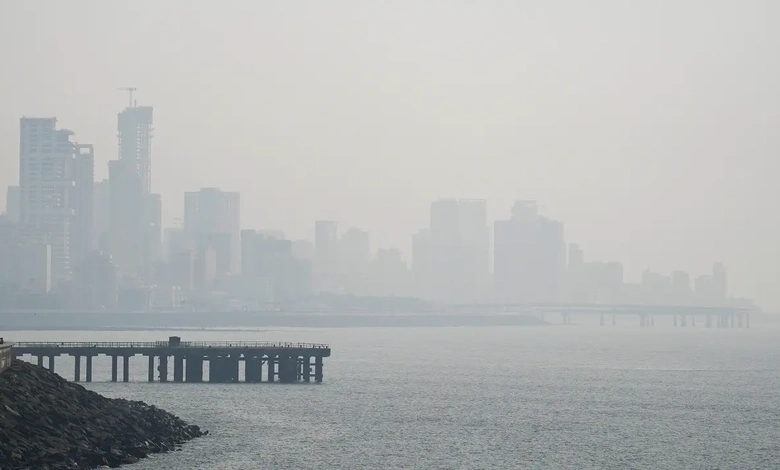
Mumbai began the week under an uneasy mix of cool temperatures and deteriorating air quality as a thick blanket of smog settled over the city on Monday morning. With the overall Air Quality Index (AQI) rising to 326, categorised as severe, the worsening conditions have reignited concerns about the city’s vulnerability to winter pollution episodes and the widening health risks for its residents.
Meteorological officials reported that minimum temperatures fell below 22°C, offering commuters a brief sense of seasonal comfort. Clear skies and a mild early-morning breeze provided the impression of an approaching winter. Yet these benign conditions masked a significant build-up of pollutants that has intensified steadily through November. The light winds, while pleasant, lacked the strength to disperse suspended particulate matter, allowing a dense haze to form across the skyline. The India Meteorological Department (IMD) indicated that temperature patterns are likely to remain stable over the next few days, with daytime highs expected to reach around 34°C. However, officials noted the absence of any immediate atmospheric shift that might ease the pollution load. According to one meteorologist, “The cooling trend and stagnant wind systems are classic triggers for winter inversions, trapping pollutants close to the ground.”
Monday’s AQI readings displayed an alarming spread of severe pollution across industrial pockets, commercial corridors and densely populated neighbourhoods. Chembur recorded the day’s most hazardous levels at 382, signalling deep-severe air quality. High-intensity logistics and traffic hubs such as Santacruz East and the Wadala Truck Terminal followed closely with AQIs of 362 and 355. Major business districts, including Malad and the Bandra Kurla Complex, reported similar readings, confirming the extensive reach of the smog. In the suburbs, conditions were only marginally better. Kandivali East registered an AQI of 163, the lowest in the city, but still firmly within the poor category. Areas such as Jogeshwari, Govandi, Borivali East and Mulund West reported severe values, further underscoring the citywide nature of the problem.
Urban planners point out that such pollution spikes deepen long-standing disparities in environmental exposure. Communities located near industrial clusters or transit-heavy corridors—often lower-income and lacking adequate healthcare access—bear disproportionate health burdens. A senior urban planner noted that “air quality management must go beyond city averages and prioritise neighbourhood-level interventions, especially where residents are most vulnerable.” Industry experts add that prolonged periods of toxic air can undermine productivity, deter talent and complicate Mumbai’s aspirations of shaping a resilient, globally competitive urban economy. While immediate relief appears unlikely, experts recommend enhanced dust control at construction sites, cleaner logistics operations and accelerated transition toward low-emission transport.
As Mumbai’s winter progresses, the persistence of dense smog reinforces the need for integrated, equitable and climate-resilient urban governance. The challenge is not only to clear the air but to ensure that cleaner futures are accessible to all residents.