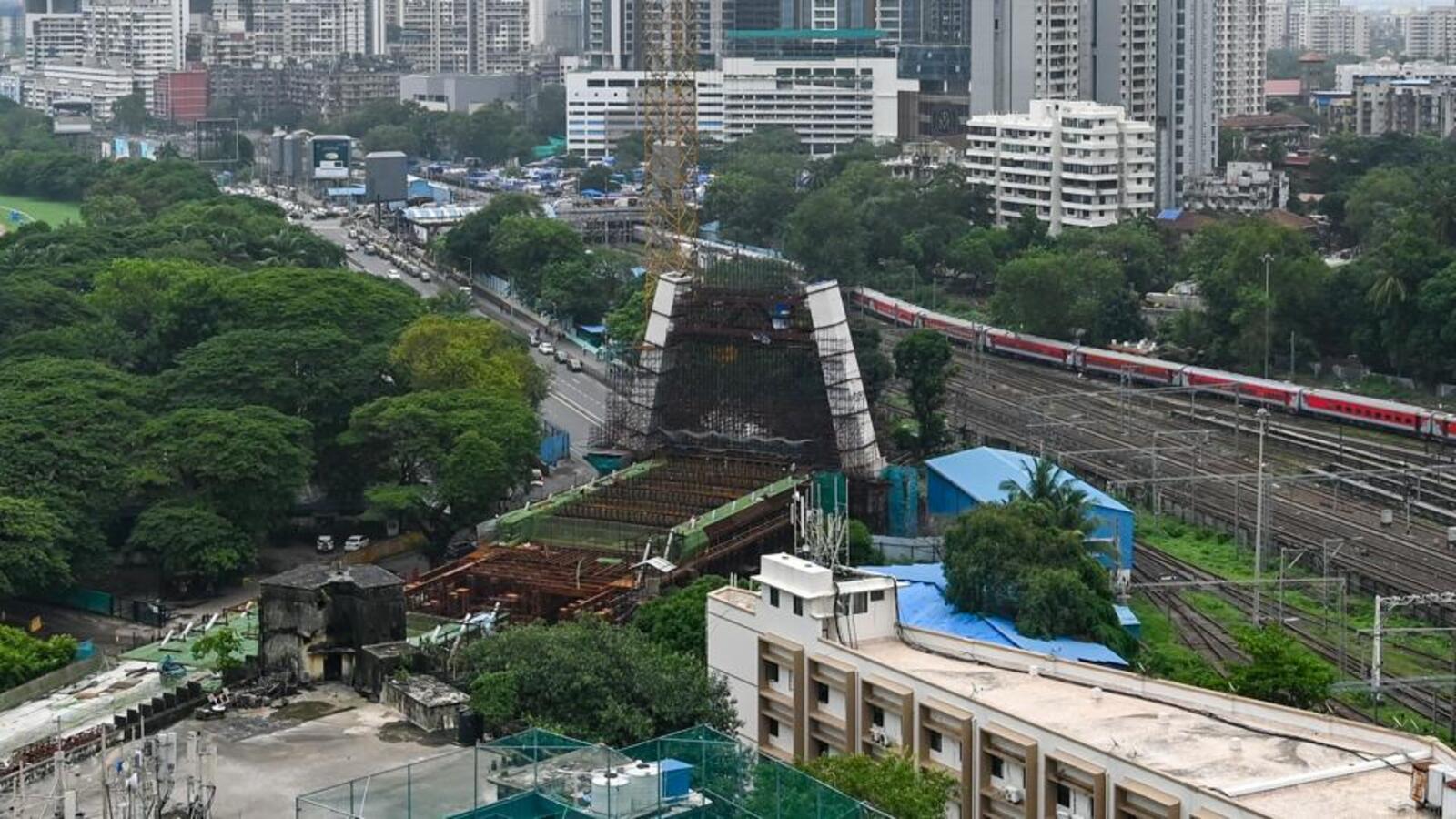
Mumbai is finally advancing on one of the two planned replacement bridges for the ageing Mahalaxmi station railway overbridge, but the second—once equally prioritised—is now facing an indefinite delay. The cable-stayed structure linking KK Marg to Saat Rasta is under construction, while the proposed bridge from Dr E Moses Road remains stalled over massive rehabilitation costs.
The city’s need for new infrastructure was highlighted nearly a decade ago, when structural stress on the British-era Mahalaxmi station bridge was confirmed by IIT Bombay in 2016. The T-shaped bridge, which connects major nodes such as Haji Ali and Worli to Saat Rasta near the Mahalaxmi Race Course, has long been a bottleneck in the city’s transport network. To resolve the traffic saturation, the Brihanmumbai Municipal Corporation (BMC) approved a two-bridge solution, one from KK Marg and the other from Dr E Moses Road—both intended to divert pressure from the central junction. After the approval of work orders in 2020 and multiple delays due to encroachment removal, construction began only on the KK Marg to Saat Rasta ROB. According to the BMC’s own budget presented this year, 35% of that structure is complete. The second ROB, however, remains on the drawing board.
Additional officials confirmed that the second bridge has not been scrapped, but acknowledged that its execution is uncertain. The obstacle: a ₹200 crore bill for relocating buildings and other structures standing in the way—an amount that exceeds the projected cost of the bridge itself. As a result, the civic body has yet to decide whether to proceed with costly rehabilitation or to seek an alternative design solution. The KK Marg ROB, designed as a cable-stayed bridge due to limited space for pillars, has a deadline of October 2026. Two years ago, the project was extended to connect up to the S-bridge in Byculla, expanding its potential impact on regional mobility. But until its twin is revived, the new bridge offers only partial relief.
Daily commuters are unconvinced that one bridge alone can alleviate the burden. A regular user of the area, remarked that the traffic congestion is worsened not only by structural limitations, but by the location of transport stands too close to the junction. According to him, repositioning the bus stops and taxi stands even slightly could prevent the chaos caused by double-parking and erratic U-turns. He also pointed out that while the KK Marg bridge may absorb some of the load, vehicles from Worli and surrounding areas will still depend on the older bridge unless the second planned route via Dr E Moses Road becomes a reality. Architects whose firm originally proposed the idea of twin alternatives to the Mahalaxmi bridge nearly a decade ago, also expressed concern. According to them, the plan initially included underpasses, not bridges. While the BMC has retained the same route alignment proposed in his early 2016 concept, it switched to road-over-bridge designs. In his view, this was a regressive move.
For a bridge to clear railway lines, long approach ramps are needed, which Abraham believes would compromise valuable urban road space and involve felling as many as 250 trees. His argument is not only aesthetic or ecological, but also practical. He asserts that an underpass would avoid land acquisition, be more cost-effective, and preserve ground-level accessibility. he adds that BMC still has the option to implement the underpass for the unbuilt second bridge from Dr E Moses Road to Saat Rasta. His vision goes further than just traffic relief. He advocates repurposing the old Mahalaxmi bridge into a pedestrianised public deck, a green space extension that could enhance connectivity to monorail and metro stations while improving walkability and air quality in one of Mumbai’s densest zones. This plan would also account for numerous pedestrian access points currently poorly integrated into the area’s mobility layout.
The final fate of the current Mahalaxmi bridge remains undecided. While the BMC’s bridge department has hinted at re-girdering, Bangar noted that the decision will ultimately lie with the BMC and the Indian Railways, who jointly manage the infrastructure. The halted progress of the second bridge draws attention to the larger challenges facing Mumbai’s urban infrastructure: balancing engineering ambition with social displacement, design efficiency with environmental impact, and public need with limited budgets. Though the cable-stayed bridge under construction offers hope of partial decongestion, it stops short of delivering the fully connected network originally promised.
At the heart of the issue is a difficult civic choice: either absorb a high financial cost to serve long-term mobility, or alter the plan in favour of lower-impact, more sustainable alternatives. The delay on the second ROB reflects the city’s ongoing struggle with reconciling these pressures under the weight of its own scale. For now, Mumbai proceeds with one bridge, but its mobility future depends on whether the second arm will ever rise—or if the city can reimagine a lighter, greener way forward.