


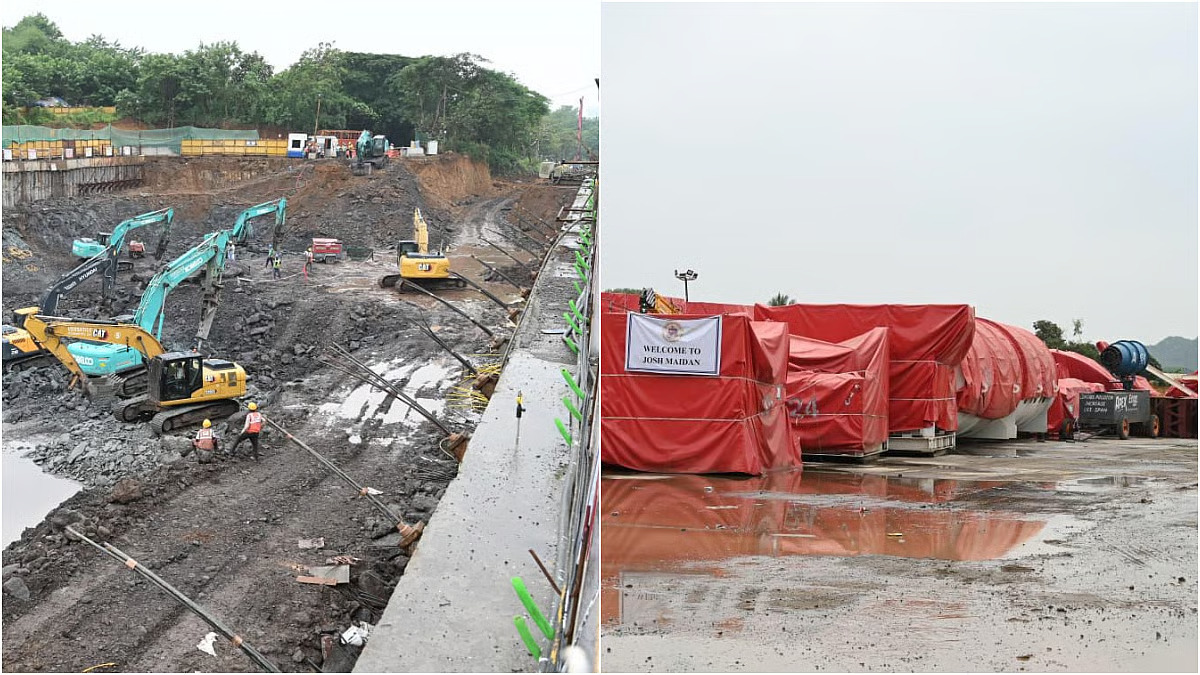
Mumbai’s Goregaon–Mulund Link Road (GMLR) project has achieved a crucial milestone as excavation work for its 5.3-km triple-lane twin tunnel gathers pace at Dadasaheb Phalke Film City, Goregaon. The shaft excavation, covering an area of 100 × 50 metres and reaching 10 metres deep, forms part of the ambitious ₹14,000-crore initiative to connect Mumbai’s western and eastern suburbs through a seamless, signal-free corridor.
City engineers confirmed that the tunnelling work is being executed round-the-clock, with stabilisation measures such as rock anchoring already underway. The full-scale tunnelling is expected to begin by mid-2026 once both Tunnel Boring Machines (TBMs) are assembled and tested. According to officials, this underground section will eventually become the largest tunnel system in the Mumbai Metropolitan Region, setting a new engineering benchmark for urban infrastructure. The 200-metre-long, 50-metre-wide, and 35-metre-deep launching shaft will serve as the entry point for the two TBMs. Components of the first TBM have already arrived at the site, while the second set is scheduled for delivery by the end of 2025. Each tunnel will have an external diameter of 14.42 metres, making the twin tunnels among the widest constructed in India. The design aims to accommodate three lanes in each direction, improving traffic flow and reducing travel congestion across north Mumbai.
An official from the municipal project department noted that the GMLR would be the fourth major east-west connector in the city, after the Santacruz-Chembur Link Road, Jogeshwari-Vikhroli Link Road, and Andheri-Ghatkopar Link Road. “Once operational, it will reduce travel time from Malad to Airoli from 75 minutes to just 25 minutes, offering direct linkage from the Western Express Highway to the Eastern corridor,” the official said. Beyond traffic relief, the project represents a significant step towards creating an integrated and sustainable urban mobility network. Experts emphasise that underground tunnels help reduce surface congestion, air pollution, and noise levels, contributing to cleaner urban environments. As the city prepares for a net-zero transition, such infrastructure projects highlight how large-scale engineering can coexist with environmental responsibility when designed thoughtfully.
Phase 3(B) of the GMLR, costing ₹6,500 crore, includes the 1.22 km triple-lane box tunnel near Film City and the 5.3 km twin tunnels running beneath Sanjay Gandhi National Park. With interconnections every 300 metres and advanced ventilation systems, the corridor is planned to ensure safety, energy efficiency, and smooth operation once completed by December 2028.
Also Read: MMRDA To Spend ₹98.55 Crore On Housing For Worli Shivdi Redevelopment
