


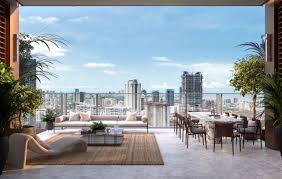
High above Mumbai’s dense urban fabric, a newly completed duplex residence is drawing attention for how it reinterprets luxury living within a vertical city. Designed by Studio Tattva under the direction of its principal architect, the 8,000 sq ft home occupies the upper floors of a high-rise tower overlooking the Arabian Sea. Beyond its scale, the project signals how Mumbai’s luxury living segment is evolving toward wellness integration, intelligent systems and contextual design.
The residence belongs to a business family seeking privacy and spatial fluidity within the constraints of high-rise development. The design team reorganised the entry orientation in line with Vastu principles, aligning the threshold to cardinal directions a move increasingly common among affluent homeowners blending tradition with contemporary architecture. Internally, the home references Mumbai’s historic Art Deco district through curved profiles, metallic trims and geometric motifs. Rather than overt ornamentation, these elements are embedded in furniture frames, staircase detailing and ceiling transitions. A sculptural spiral staircase encircling a capsule lift becomes the visual anchor, connecting the double-height living space to the upper level while maintaining openness. The spatial strategy prioritises light and ventilation critical in a city grappling with rising temperatures and air quality concerns. Expansive glazing frames coastal views, while centralised climate control and air filtration systems regulate indoor conditions. Industry observers note that such integrated systems are fast becoming standard in premium urban residences, reflecting demand for controlled microclimates in dense metropolitan environments.
Bedrooms are configured as independent suites with walk-in wardrobes and automated temperature and curtain controls. The master bathroom, finished in imported marble, has received recognition at the GROHE Bath & Design Award 2025, highlighting the growing intersection between global design standards and Indian residential projects. Wellness facilities form a substantial component of the layout. A dedicated yoga studio, sauna and massage room are complemented by a ballet practice area and a 30-seat private theatre equipped with a high-fidelity sound system. Such amenities illustrate how luxury living in Mumbai is shifting from display-driven opulence to experience-led environments that support recreation and wellbeing within the home. Sustainability features, though subtle, are embedded in the project. Water-efficient sanitary systems, controlled HVAC zoning and a recovery mechanism for spa facilities aim to reduce resource intensity. Designers also emphasised passive daylighting to limit artificial lighting loads during daytime hours. Urban development analysts suggest that high-rise duplexes like this represent a broader trend in Mumbai’s premium housing market: vertical estates that combine privacy, automation and curated design narratives. As land scarcity pushes development skyward, interior architecture increasingly carries the burden of creating identity and comfort.
In a metropolis defined by speed and density, such residences attempt to carve out moments of calm while remaining embedded in the city’s architectural lineage. The project underscores how Mumbai’s luxury living sector is balancing aspiration with context merging heritage references, smart technology and wellness infrastructure within the constraints of vertical urban growth.
Also Read: Jammu Kashmir Nomadic Housing Faces Transition
Mumbai Skyline Home Blends Design and Wellness
