


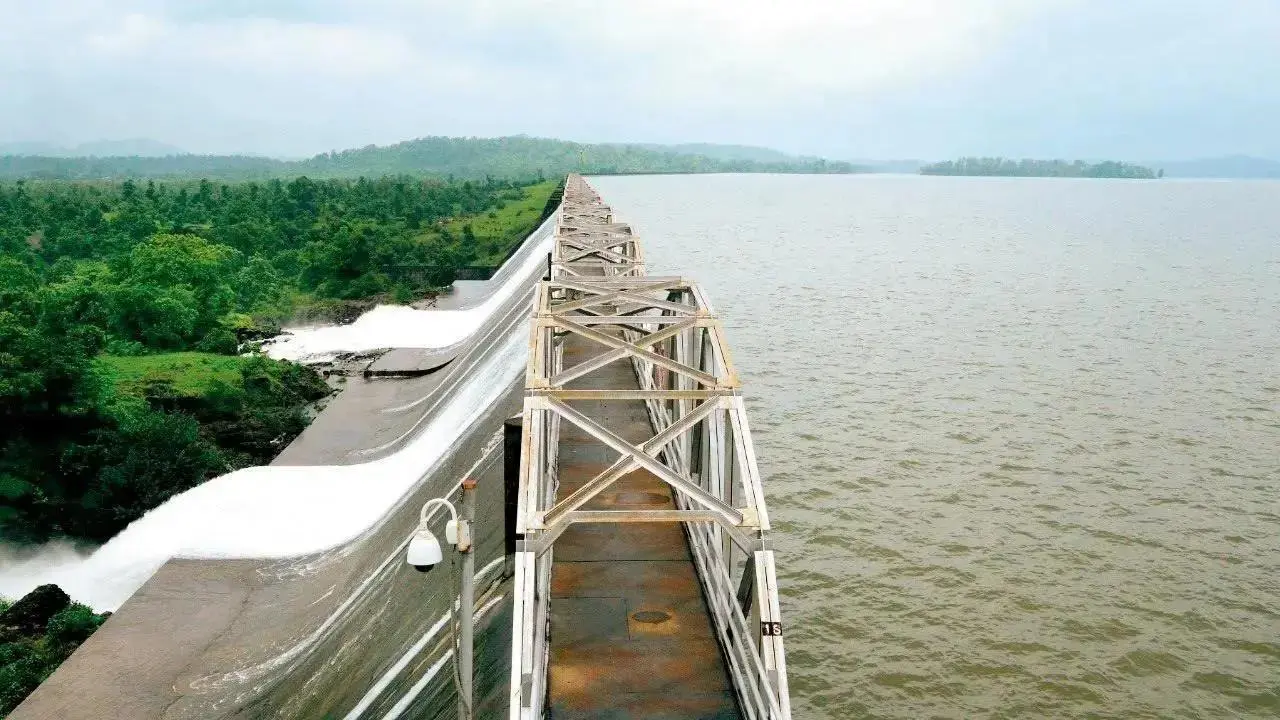
Mumbai’s water security received a major boost this monsoon, with the seven reservoirs that supply the city now filled to 98 per cent of their combined capacity. Civic officials confirmed that the available stock will sustain demand until the onset of the next monsoon season, ensuring stability for over 13 million residents and industrial users alike.
Three of the lakes—Modak Sagar, Tulsi and Vihar—have reached 100 per cent capacity, while Upper Vaitarna and Tansa are at 98 per cent. Middle Vaitarna is currently at 97.40 per cent and Bhatsa at 97.55 per cent. Together, the seven reservoirs now hold 14.18 lakh million litres (ML) of water, slightly below last year’s 14.20 lakh ML recorded at this time, but substantially higher than the levels in 2023. According to officials, Mumbai requires a stock of 14.47 lakh ML by October 1 to comfortably meet its annual demand. While this year’s reserves are just shy of that mark, the shortfall is unlikely to affect supply, with daily distribution standing at 3,950 ML. “The available reserves can sustain requirements for the next 358 days,” a senior official explained, underlining that no cuts are anticipated in the near term.
The robust inflow into catchment areas reflects one of the wettest phases of this year’s monsoon. Torrential rainfall in late July and August significantly replenished lakes across Thane, Palghar and Nashik districts, which serve as the primary catchment areas. For a city that has faced recurring anxieties over water scarcity in past decades, this level of storage provides both relief and strategic breathing room. Yet, the data also reveals an important nuance. While present levels are healthier than in 2023, they remain marginally lower than last year’s benchmark. Experts stress that this underlines the importance of continued conservation measures, especially with climate variability altering monsoon patterns. “Sustainability cannot be guaranteed on rainfall alone. Mumbai needs to augment supply through desalination, rainwater harvesting and reduced wastage,” noted a senior water management expert.
The Brihanmumbai Municipal Corporation (BMC), which oversees supply, is already advancing its ₹4,000 crore desalination project, expected to add 200 ML daily capacity in the next few years. Officials have also been pushing societies to adopt greywater recycling systems to reduce dependency on fresh water. For now, the near-capacity storage signals a year of uninterrupted supply, offering relief to households and businesses alike. However, the long-term challenge remains building resilience in a city that depends so heavily on rainfall-fed reservoirs. As Mumbai continues to expand, the path to water security will rest on both engineering and environmental stewardship.
Also Read : Amazon Introduces Quick 10 Minute Delivery In Mumbai Competing With Zepto Blinkit
