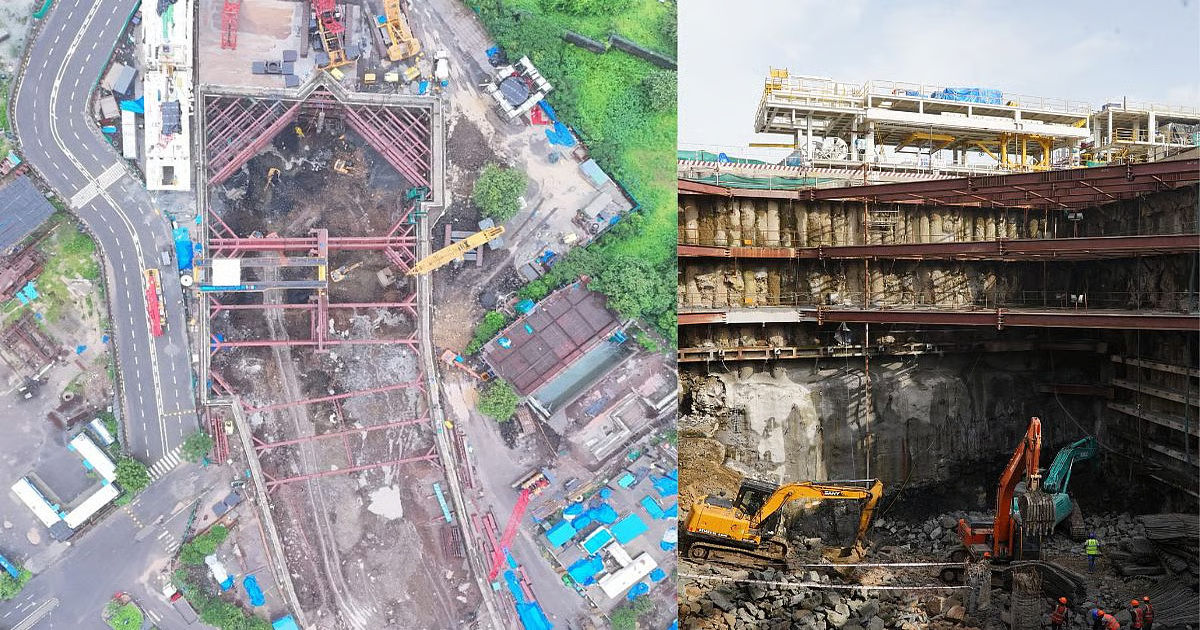
Mumbai’s long-planned underground road link between Orange Gate and Marine Drive is moving into a decisive phase, with tunnelling activity expected to begin in December 2025. Officials overseeing the development confirmed that equipment mobilisation and assembly work are currently under way, marking a significant milestone for what will become the city’s first urban tunnel constructed nearly 40 metres below ground level. The 9.5-kilometre link is designed to knit together several major corridors, including the Eastern Freeway, the Mumbai Trans Harbour Link, the Coastal Road and the Bandra-Worli Sea Link, creating a continuous east-west travel spine in South Mumbai.
Preliminary engineering preparation has intensified over recent weeks, with a Tunnel Boring Machine being positioned at the launching shaft. According to officials, the lowering and calibration of the machine is in progress and tunnelling will begin shortly after these procedures are completed. The project, estimated at over ₹7,700 crore, is expected to decongest key stretches around Orange Gate, the Mumbai Port Trust and the highly stressed P D’Mello Road corridor. Transport analysts noted that the tunnel’s design — a twin-tube system extending over 6.5 kilometres — reflects shifting priorities in dense urban environments, where infrastructure must increasingly be built underground to preserve road space, reduce emissions and improve last-mile safety.
Each tunnel will accommodate dedicated traffic lanes, emergency corridors and pedestrian walkways, offering a more controlled and resilient travel environment compared with surface-level roads. The construction plan also includes a viaduct linking the tunnel mouth to the Eastern Freeway, as well as access routes and open-cut sections at both ends. One section of the alignment will pass beneath the seaway before resurfacing near the Marine Drive promenade. However, while the engineering progress has been welcomed by transport specialists, the project has faced concerns from residents living along the alignment. Members of local associations have pointed out that the neighbourhood recently endured several years of construction disruption due to the Coastal Road project, and expressed frustration that another major intervention is beginning with limited public consultation. Representatives have emphasised that while the community broadly supports efforts to improve mobility and reduce bottlenecks, long-time residents expect transparent engagement and early communication to mitigate noise, dust and traffic diversions.
Urban planners note that such large-scale developments will need stronger community interfaces if Mumbai is to transition towards inclusive and sustainable mobility systems. The Orange Gate–Marine Drive tunnel is expected to reduce surface congestion and potentially cut emissions by enabling smoother travel across key business districts. But the success of the project, they say, will depend on how construction impacts are managed and how equitably neighbourhood concerns are addressed. As work advances toward the tunnelling stage, the project marks a significant step in re-shaping mobility along Mumbai’s coastline, offering the promise of faster cross-city movement while underscoring the need for people-centred planning in major infrastructure rollouts.
Mumbai Set To Launch Orange Gate–Marine Drive Tunnelling Work In December 2025