


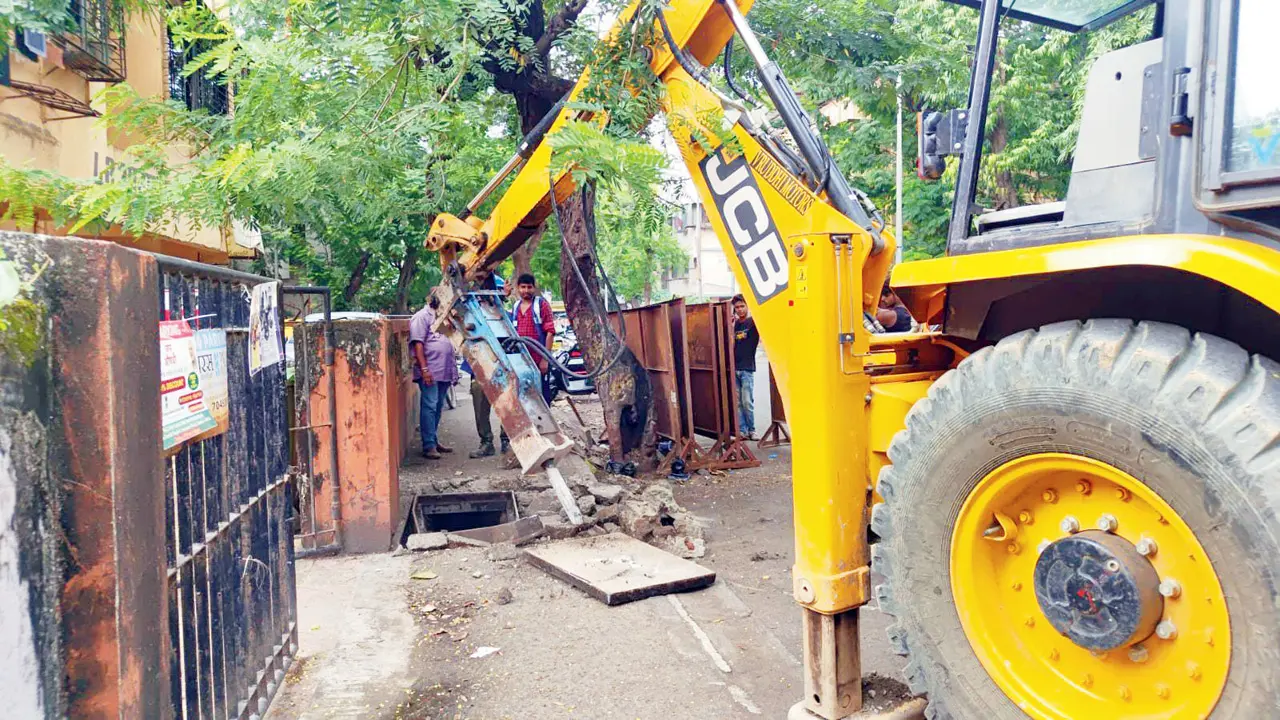
For residents of Santacruz, walking to work or school has become a test of endurance. What was once a safe pedestrian stretch has now turned into a hazardous construction zone as yet another footpath has been dismantled for civic works. The repeated digging, debris, and unplanned demolitions have reignited public anger over Mumbai’s increasingly chaotic urban management.
According to residents, Road No. 3 in Santacruz has been dug up for ongoing sewage treatment plant (STP) work, while nearby Road No. 1 has also been stripped of its pavement for fresh concreting. The result — both parallel streets now lack pedestrian access on one side, forcing people to share narrow lanes with fast-moving traffic. Locals describe the area as a “death trap” during rush hours. Officials claim the measure is temporary, part of larger civic improvement works aimed at upgrading infrastructure and ensuring efficient drainage. However, residents say these explanations have lost credibility over time. “Every time a road is dug up, we are told the disruption will be short-lived. But temporary repairs in Mumbai often stretch for months,” said one resident, highlighting the city’s dismal record in executing and restoring public amenities.
The affected stretch runs adjacent to a crucial internal road that links to the Western Express Highway, one of Mumbai’s busiest arterial corridors. With no safe walkway, pedestrians — including schoolchildren and senior citizens — are left to navigate dangerously close to moving vehicles. Citizens have also pointed out that many existing pavements remain blocked by parked vehicles, making walking even more unsafe. Adding to the concern, a new municipal school is under construction merely metres away from the dug-up stretch. Locals fear that without reinstating proper footpaths, children will be left vulnerable while commuting. “How can a civic body plan an educational facility without ensuring safe access for students?” asked a local resident, calling for urgent coordination between departments to align civic projects with pedestrian safety.
Urban planners say this recurring pattern — breaking existing infrastructure before completing previous work — reflects systemic inefficiency in civic project sequencing. Experts stress that Mumbai’s development cannot come at the cost of basic pedestrian safety and urban accessibility. When contacted, a civic official confirmed that the works are part of a long-term improvement plan and assured that footpaths will be reconstructed once the projects conclude. However, residents remain sceptical, citing numerous previous instances where similar promises were delayed or forgotten.
As Mumbai pushes towards becoming a smarter, more sustainable city, the episode in Santacruz underscores an uncomfortable truth — the city’s progress cannot be measured solely by concrete and cables, but by how safely its citizens can walk.
Also Read: Pune Revives Tunnel Plan For Balbharati–Paud Phata Road Project Again
