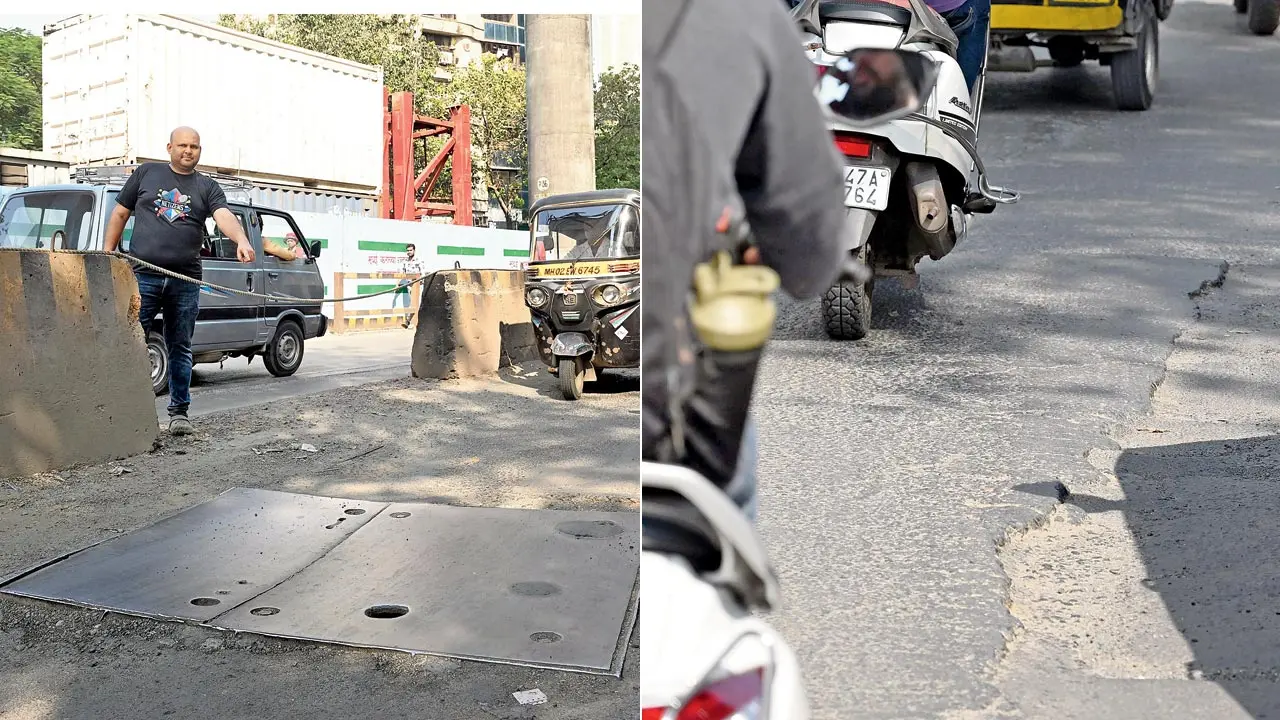
Residents in Lokhandwala have raised serious concerns over the condition of a key road segment affected by ongoing construction of Mumbai Metro’s Line 6, warning that the prolonged closure of lanes and deteriorating surface quality have created an unsafe environment for daily commuters. The stretch near the bridge over the Mogra nullah, a vital connector for thousands of residents, has become uneven, congested and increasingly accident-prone, according to local associations monitoring the issue.
The elevated corridor, linking Swami Samarth Nagar and Vikhroli as part of the city’s expanding east–west mobility network, has been under construction for several years. While the project is expected to significantly reduce traffic pressure once operational, its interim impact on neighbourhood streets has drawn mounting criticism. Representatives from citizen groups said that two lanes on the bridge have remained shut for more than a year, forcing all traffic onto a single compromised lane.A member of a local citizens’ association said the surface has developed large potholes that recur despite temporary patchwork. “The absence of traffic marshals and the slow pace of construction have worsened daily commute times and created avoidable risks,” the member noted, adding that repeated complaints to agencies had not resulted in visible improvements. On social media, residents have regularly flagged the poor condition of P Tandon Marg, especially the uneven slopes at the bridge landing.
Officials familiar with the project acknowledged that girder-launching activities on one side of the bridge had restricted movement but insisted that work was progressing in phases. They explained that safety protocols during elevated construction limit how quickly certain operations can be completed. However, transport planners argue that inadequate interim traffic management measures often exacerbate localised congestion and safety concerns around major infrastructure projects. Urban experts say the situation illustrates a common challenge in fast-growing cities: the gap between large-scale infrastructure planning and micro-level neighbourhood management. With vulnerable road users such as pedestrians, cyclists and two-wheeler riders disproportionately affected by poor road conditions, they emphasise the need for responsive coordination between construction agencies and municipal authorities. “Major transport investments must coexist with safe streets and accessible mobility during construction,” said an urban mobility specialist. Residents living near the corridor argue that the problem has moved beyond inconvenience to endangering public safety. Several have highlighted instances of vehicles scraping the uneven surface, near collisions due to narrowed lanes, and extended delays during peak hours. They have urged authorities to repair the surface, reopen closed lanes after completing girder work and reinforce traffic management until the corridor is operational.
As Mumbai accelerates its mass transit expansion to reduce congestion and carbon emissions, the Lokhandwala episode underscores the importance of prioritising commuter safety and minimising environmental and social disruptions during construction. For now, the community hopes that timely intervention will restore navigability and ensure that the benefits of the upcoming Metro Line do not come at the cost of day-to-day safety.
Mumbai Residents Highlight Dangers On Lokhandwala Metro Line Six Construction Stretch