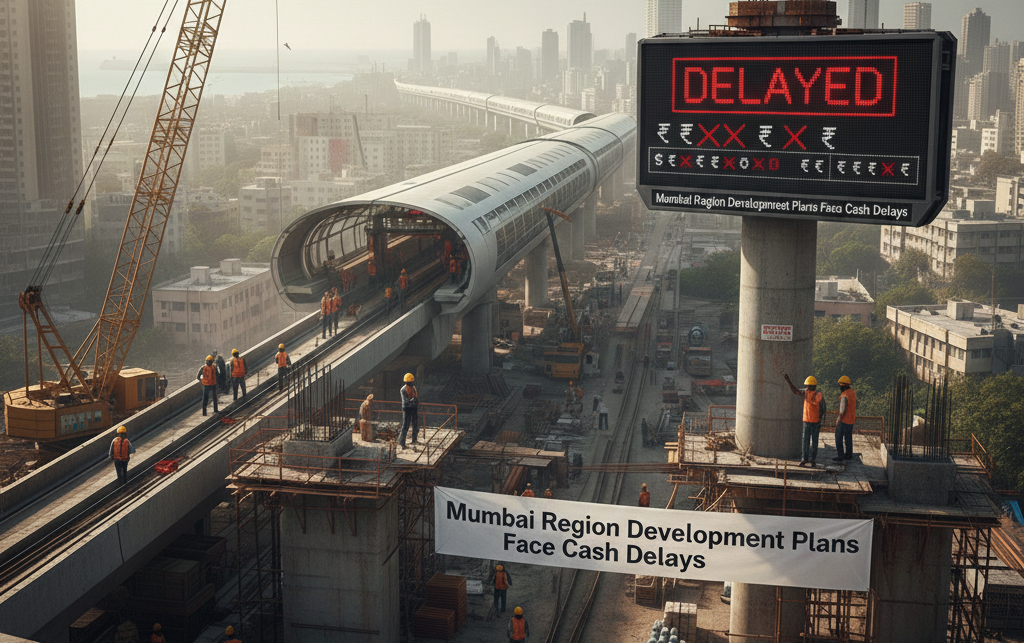
The Mumbai Metropolitan Region’s ambitious infrastructure pipeline is facing a significant financial bottleneck, with the regional planning authority flagging long-pending dues from government bodies as a critical risk to its medium-term development roadmap. As preparations begin for the 2026–27 budget cycle, officials have underscored that timely recovery of these funds will determine the pace and scale of upcoming urban projects across transport, water supply and regional growth corridors.
According to internal budget documents reviewed by Urban Acres, the Mumbai Metropolitan Region Development Authority is awaiting more than ₹2,800 crore in principal and interest linked to deposits placed with various public institutions over two decades ago. These funds, transferred between the late 1990s and early 2000s under government directives, were intended to support coordinated infrastructure delivery but have not been fully returned or accrued interest as originally envisaged. Senior officials familiar with the matter said the outstanding amounts now form a material constraint on fiscal planning, particularly as the authority scales up capital-intensive projects aligned with climate-resilient and transit-oriented urban development. In addition to legacy deposits, substantial arrears are pending from other public agencies, including loans and interest linked to road infrastructure works and revolving urban development funds established to accelerate city upgrades.
One of the largest exposures relates to borrowings associated with the Maharashtra State Road Development Corporation, alongside unrecovered balances under long-running urban renewal programmes designed to support municipal infrastructure and service delivery. Urban finance experts note that such inter-agency dues, while common in India’s public sector ecosystem, often weaken the cash flow predictability needed for large-scale metropolitan investments. For 2026–27, the authority has earmarked over ₹44,000 crore for development schemes spanning mass transit, regional water security and strategic growth nodes. Budget projections indicate near-equal receipts and expenditure, leaving limited headroom to absorb delays in fund recovery. “When capital budgets are this tightly balanced, even modest slippages in receivables can cascade into project deferrals,” said an urban economist tracking metropolitan infrastructure financing.
At the same time, MMRDA continues to build stable revenue streams from operational assets. Ridership-linked income from metro corridors such as Mumbai Metro Lines 2A and 7 and toll collections from the Mumbai Trans Harbour Link have provided recurring inflows, while regional water supply systems generate steady monthly earnings. However, officials cautioned that operating revenue alone cannot substitute for delayed capital recoveries when funding new infrastructure. Urban planners argue that resolving long-pending inter-government dues is essential not only for financial discipline, but also for sustaining public confidence in large-scale urban transformation. As Mumbai pushes towards lower-emission mobility, equitable access to services and employment-linked development, predictable funding mechanisms will be central to delivering projects on schedule.
Looking ahead, the authority is expected to intensify recovery efforts while seeking stronger financial coordination frameworks with state agencies. The outcome will shape how effectively Mumbai’s next phase of growth balances fiscal stability with the urgency of building a resilient, people-first metropolitan region.
Mumbai Region Development Plans Face Cash Delays