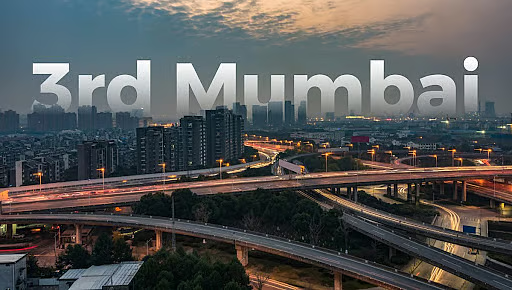
Mumbai Region Clears Land Policy For Third Mumbai Plan
The Maharashtra government has approved a land acquisition and allotment policy under which nearly 200 sq km of territory will be brought under formal planning jurisdiction to accelerate the envisioned Third Mumbai development near the Mumbai Trans Harbour Link (Atal Setu) corridor. The decision, taken by the state cabinet in Mumbai on Tuesday, marks a strategic pivot in efforts to coordinate urban expansion, infrastructure delivery and land use governance in one of India’s fastest-growing metropolitan regions.
The policy applies to areas under the newly constituted New Town Development Authority, with implementation responsibilities delegated to the Mumbai Metropolitan Region Development Authority (MMRDA). Officials framing the decision emphasised the need to integrate land markets and infrastructure planning in the impact zone of major transport investment like the Mumbai Trans Harbour Link — an elevated sea bridge connecting Sewri and Nhava Sheva — to reduce regional congestion and balance growth across nodal centres.Urban planners say the move could provide a clearer regulatory environment for land assembly, overcoming long-standing fragmentation in land parcels that has slowed large-scale master planning. By placing land under a statutory allotment regime, authorities aim to reduce delays in approvals for roads, public transit corridors and social infrastructure. “Coherent land governance is foundational for cities that aspire to be equitable and climate-resilient,” said a senior planner familiar with the process. However, the details of compensation frameworks and dispute resolution mechanisms are yet to be published.
For residents and investors, the policy signals renewed focus on developing the Karnala-Sai-Chirner (KSC) New Town belt — often referred to in planning circles as Third Mumbai — envisioned as a multi-nodal, mixed-use urban centre with strong connectivity to Navi Mumbai and greater Mumbai. Connectivity investments — including the Atal Setu and ancillary interchanges — underpin expectations that strategic infrastructure will unlock economic clusters beyond the traditional metropolitan core, easing pressure on housing and jobs markets in the city’s saturated central districts.Yet questions remain over how land rights, ecological conservation and community interests will be balanced. Past surveys for the Third Mumbai footprint identified substantial swathes of agricultural, forest and undulating terrain across more than 120 villages, raising concerns among rural stakeholders about land use change, livelihood impacts and environmental safeguards. Independent urban economists warn that absent transparent public engagement, large-scale land conversion risks governance challenges and social inequities.
Environmental planners also note that any extensive development in coastal Maharashtra must incorporate robust climate adaptation measures. The region’s exposure to monsoon intensification, sea-level rise and biodiversity pressures underscores the need for green infrastructure and ecosystem-based planning — not just hard infrastructure. As the new policy framework is operationalised, integrating these elements into zoning, building standards and mobility planning will be critical to ensuring that Third Mumbai supports sustainable and inclusive outcomes.
Next steps for authorities include finalising a detailed master plan and implementation roadmap, outlining incentives for affordable housing, public transport investment and climate-responsive design. Clear communication of these strategies to local communities and investors will shape the socio-economic trajectory of this ambitious metropolitan expansion.