


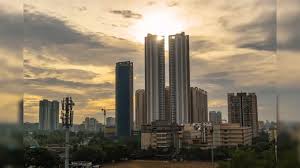
Mumbai’s eastern suburb of Mulund is witnessing renewed developer interest, with a leading national builder unveiling a mid-to-premium residential project aimed at capturing sustained end-user demand. The launch signals growing confidence in the Mulund housing market as infrastructure upgrades and transit connectivity reshape the city’s peripheral growth corridors.
The 2.77-acre development, comprising five residential towers with two- and three-bedroom apartments, comes at a time when Mumbai real estate is recalibrating around suburban micro-markets that offer relative affordability compared to South Mumbai and Bandra-Kurla Complex-adjacent zones. Ticket sizes begin in the mid-Rs 1 crore range, positioning the project squarely within the aspirational upgrade segment. Mulund has long functioned as a bridge between Mumbai and Thane. Its appeal lies in established social infrastructure schools, hospitals, neighbourhood retail and business parks combined with arterial road access through LBS Road and the Eastern Express Highway. Rail connectivity via Mulund and Nahur stations continues to anchor daily commuting patterns. However, the larger shift stems from upcoming transport investments. The Wadala–Kasarvadavali Metro corridor, the Goregaon–Mulund Link Road and the proposed Thane–Borivali tunnel are expected to improve east–west travel and reduce cross-city congestion. Urban economists say such projects often trigger land value appreciation and densification in adjacent precincts, reinforcing the Mulund housing market’s long-term trajectory.
Within the project, planning emphasis appears to be on optimising light, cross-ventilation and shared open spaces a response to post-pandemic preferences for healthier living environments. More than two dozen lifestyle amenities, including podium-level recreation, walking tracks and rooftop community areas, reflect the increasing integration of leisure and residential design in Mumbai real estate. Urban planners caution, however, that sustained growth must align with civic capacity. Water supply augmentation, waste management systems and localised traffic planning will determine whether density translates into liveability. Mulund’s tree cover and proximity to the Sanjay Gandhi National Park buffer also raise questions about balancing development with ecological sensitivity. Industry analysts note that developers are increasingly concentrating on micro-markets with proven absorption rather than speculative land banking. The Mulund housing market, supported by both end-users and selective investor interest, fits that profile. Compared to emerging nodes further north, Mulund offers lower execution risk due to its established civic ecosystem.
As infrastructure corridors reshape Mumbai’s geography, suburbs like Mulund are emerging as self-contained urban clusters rather than mere commuter extensions. If supported by careful planning and climate-conscious design, new residential supply here could contribute to a more distributed, resilient growth model for Mumbai real estate one less dependent on a handful of central business districts and more attuned to everyday urban life.
Also Read: Hyderabad real estate market eyes sustainable scale
Mumbai real estate expands in Mulund
