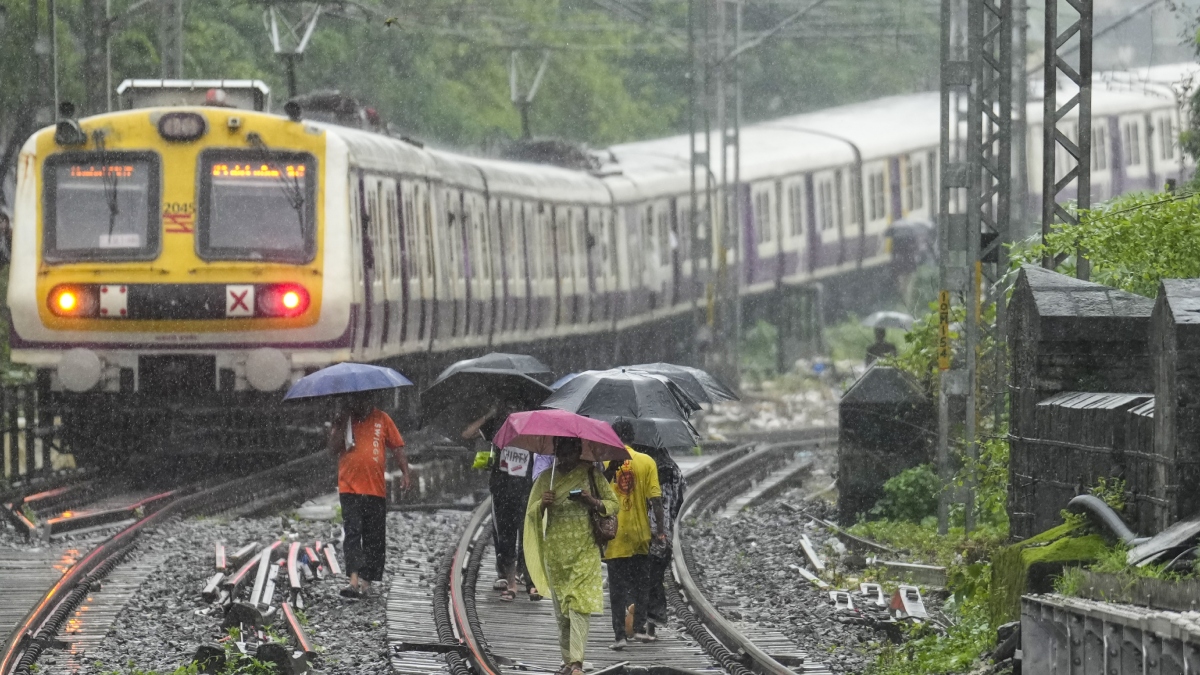
Mumbai rains force cancellation of Pune trains and disrupt rail services
Persistent monsoon showers across Maharashtra brought Pune–Mumbai rail connectivity to a standstill on Tuesday, with seven major express services cancelled and suburban operations running with significant delays. Railway officials confirmed that the cancellations were prompted by continuous rainfall in the Ghat sections, low visibility, and water accumulation on tracks, making operations unsafe. The Indian Meteorological Department has already placed Mumbai and adjoining regions under an orange alert for heavy downpours.
The cancellations affected some of the busiest trains on the Pune–Mumbai corridor, including the Deccan Queen, Pragati Express, Sinhagad Express, Indrayani Express, and the Vande Bharat Express. These trains are considered lifelines for daily commuters, office travellers, and students between the two cities, and their suspension highlights the growing vulnerability of India’s urban mobility to climate extremes. The Central Railway advised passengers to postpone non-essential travel, while officials at Chhatrapati Shivaji Maharaj Terminus (CSMT) said further reviews would be made depending on rainfall intensity.
In Mumbai, local train services the backbone of daily mobility for over 7.5 million residents were equally impacted. Suburban services on the Central Railway’s Harbour Line remained shut for over 15 hours before resuming operations at 3 am on Wednesday. Services between CSMT and Thane were disrupted for nearly eight hours, while other corridors are operating with delays of 20–30 minutes. The Western Railway division also confirmed cancellations on multiple suburban routes due to waterlogging.According to railway engineers, the waterlogging of tracks is no longer just an operational problem but a sign of how climate-induced weather events are overwhelming outdated urban infrastructure. The Mumbai Metropolitan Region recorded over 200 millimetres of rainfall within 21 hours in some suburbs, forcing the Brihanmumbai Municipal Corporation to issue public advisories. Officials also released water from reservoirs near Igatpuri to manage rising levels of the Godavari River, urging residents on riverbanks to remain alert.
Transport experts argue that the current disruption underlines the urgent need for climate-resilient infrastructure. With the state government investing heavily in high-speed corridors and metro systems, analysts emphasise that equal priority must be given to drainage networks, track elevation, and disaster response measures to ensure uninterrupted public mobility. Sustainable transport planning, they note, is central not only to reducing carbon footprints but also to safeguarding livelihoods during unpredictable weather shocks.Although suburban bus services operated by the Brihanmumbai Electric Supply and Transport (BEST) resumed normally, long power outages were reported from several localities, with some neighbourhoods witnessing blackouts lasting over 24 hours. The situation has once again raised questions about the preparedness of India’s financial capital to handle recurring monsoon crises while balancing its aspiration for a greener and more equitable urban future.