


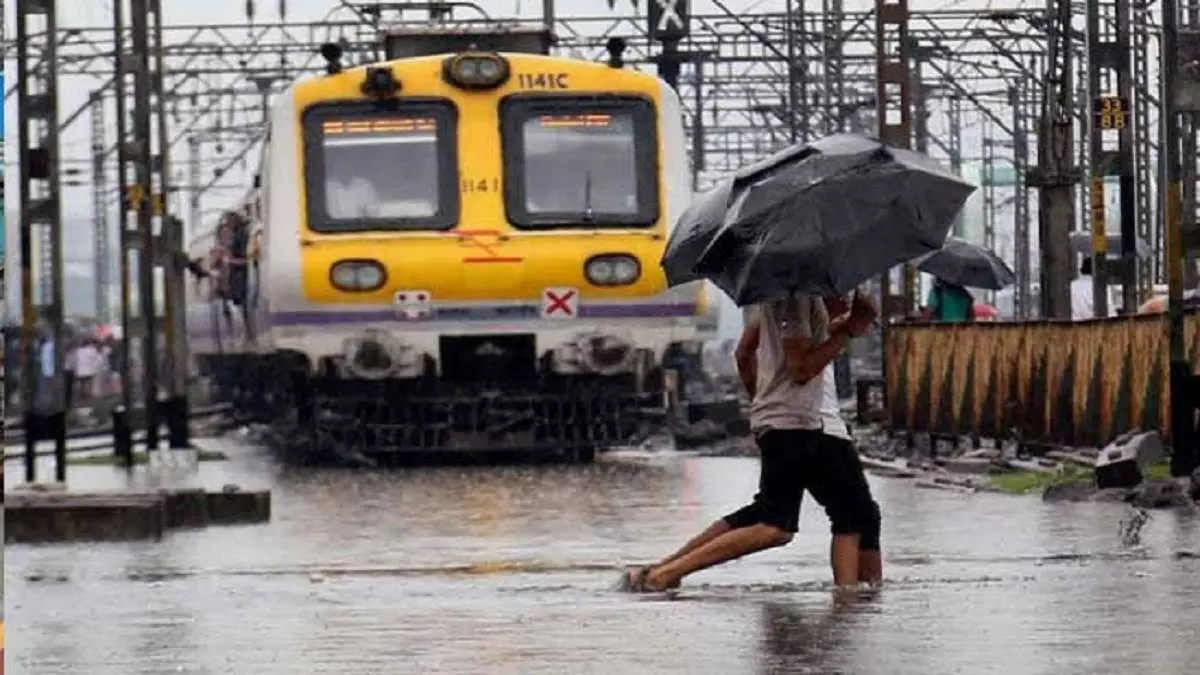
Mumbai’s monsoon made a forceful return this morning, severely disrupting local train operations across the city and forcing commuters at key stations such as Dadar, Kurla, Thane, Kalyan, Churchgate, and Borivali to endure delays of up to 25 minutes.
As torrential rain continued to lash several parts of the city, services on the Central, Western, and Harbour lines suffered consistent slowdowns, testing the resilience of Mumbai’s otherwise reliable suburban railway network. According to officials from the Central Railway, train services between Kalyan and Kasara were especially affected due to extensive waterlogging on the tracks. Multiple trains ran at restricted speeds as visibility dipped and safety concerns rose amid persistent rainfall and thunderstorm activity. Commuters across Mumbai reported delays ranging between 15 and 25 minutes, particularly on the Central line, where trains were halted or operated at reduced speed due to rain-induced track conditions. On the Western line, services between Churchgate and Marine Lines saw significant disruptions, resulting in longer waiting times and increased congestion at key junctions.
This wave of disruption comes in the wake of a red alert issued by the India Meteorological Department (IMD) for heavy to very heavy rainfall across Mumbai and adjoining suburbs. Neighbourhoods including Borivali, Santacruz, and Colaba are expected to receive intense rainfall accompanied by thunderstorms and gusty winds. The IMD has also warned of continued heavy downpours in the coming days, suggesting that the city’s transport infrastructure could remain under pressure through the week. Civic rainfall gauges recorded varied levels of precipitation across different regions. Notable readings include 25 mm in Supari Tank, 24 mm in Khar Danda, 13 mm at Collector Colony, and 12 mm in Britania SWD & Sewri Koliwada. These figures indicate a widespread and sustained weather pattern that is likely to keep the city on high alert.
Although railway authorities have not reported any fresh incidents of track obstruction or infrastructure damage today, waterlogged sections from previous showers continue to hamper operations. The Central Railway’s spokesperson stated that ground teams are monitoring vulnerable zones, and all necessary safety protocols have been activated to ensure the security of passengers. Emergency response teams across Mumbai’s municipal and railway divisions have also been placed on standby. Flood-prone areas are being patrolled regularly, and stormwater drains are being cleared to manage runoff more efficiently. Civic officials urged residents to avoid low-lying and waterlogged areas unless necessary and to use digital platforms to track train schedules before venturing out.
From a broader urban planning perspective, the recurring disruption of suburban train services during the monsoon season underlines the urgent need for Mumbai to adopt climate-resilient transport infrastructure. As India’s financial capital battles extreme weather events with increasing frequency, stakeholders must push for long-term sustainable solutions, including better drainage systems along railway lines and green urban planning that integrates flood management. Experts argue that while the railway network has shown remarkable capacity to recover from monsoon setbacks, the current challenges reveal structural weaknesses that cannot be resolved by short-term measures alone. Enhancing platform drainage, raising track levels in flood-prone zones, and adopting predictive weather-based control systems could form part of a comprehensive urban mobility reform plan.
For now, however, the focus remains on minimising disruption and ensuring safety. Authorities have advised passengers to check live updates via railway apps and helplines, and to plan their travel keeping in mind possible delays. The Mumbai monsoon, while welcome for the relief it brings from the summer heat, continues to test the city’s infrastructure and its citizens’ patience. As the rain clouds linger and tracks remain slick with runoff, Mumbai once again finds itself navigating the delicate balance between climate unpredictability and urban resilience. Whether the monsoon brings rejuvenation or chaos will depend on how swiftly and sustainably the city adapts to its seasonal challenges.
Also Read : Mumbai battles rain chaos as red alert issued
