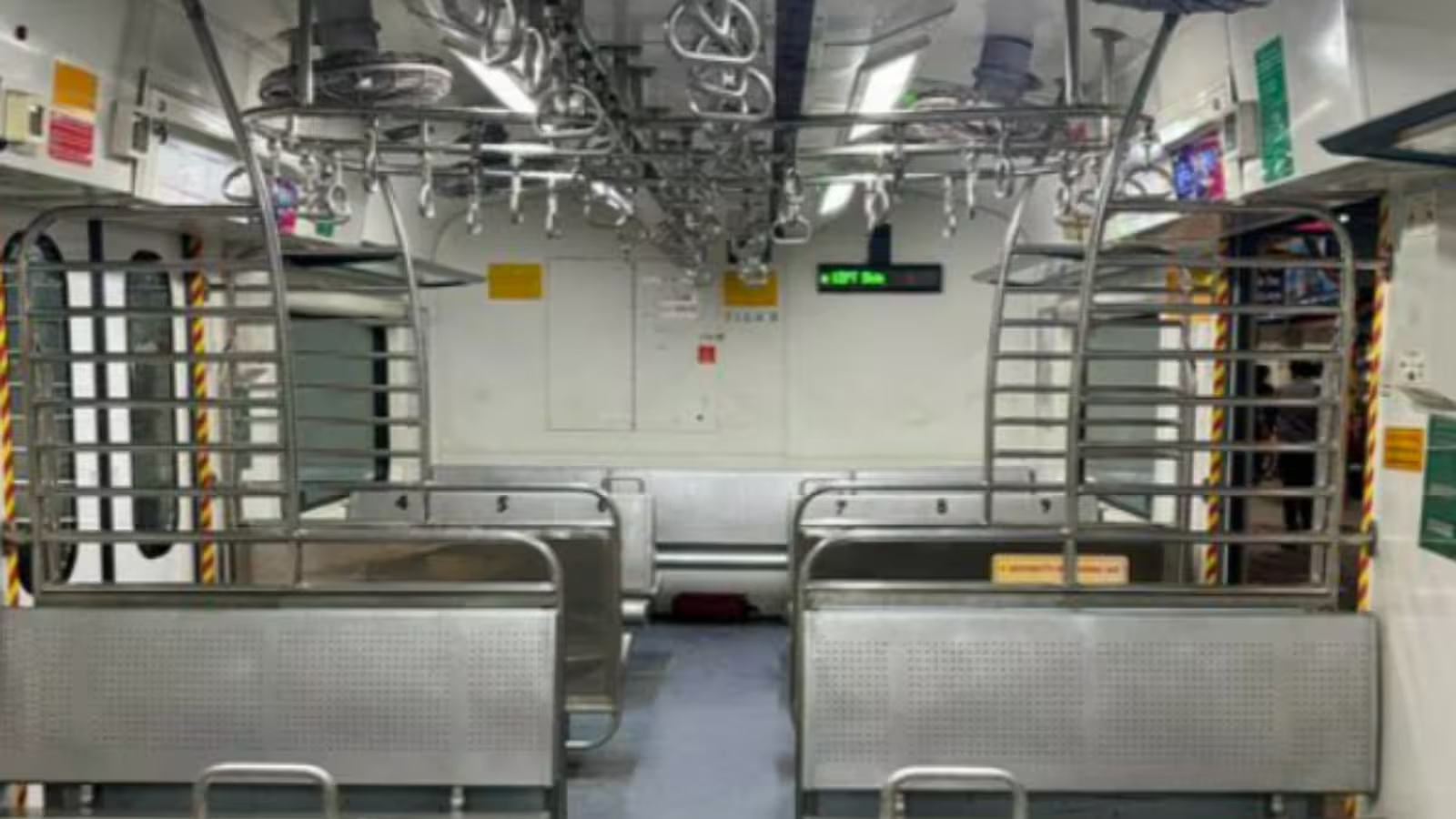
Mumbai’s suburban railway system may be on the cusp of a significant safety-driven redesign, as railway authorities prepare to trial the city’s first non air-conditioned local trains equipped with automatic doors. The development signals a potential shift in how safety, capacity, and passenger comfort are balanced on one of the world’s most heavily used urban rail networks.
The new trainset, recently sighted at a Central Railway facility, features sealed doors similar to those used on air-conditioned services. Railway officials familiar with the plan indicate that the rake is technically ready and will undergo controlled trial runs before being considered for passenger operations. The initial tests are expected on the high-density corridor connecting the city centre to Kalyan, a stretch that routinely experiences extreme crowding during peak hours. This move follows renewed scrutiny of commuter safety after a fatal overcrowding incident near Mumbra, which once again exposed the risks associated with open-door travel on suburban trains. Transport planners note that open doors, while historically seen as essential for ventilation, have also enabled unsafe travel behaviour, including passengers standing on footboards or leaning out of moving trains during rush hours.
Automatic doors on non AC locals are being evaluated as a way to reduce fall-related accidents and enforce safer boarding and alighting practices. During trials, railway engineers are expected to closely monitor door response times, airflow, internal temperatures, and passenger circulation within coaches. These findings will influence whether the design can be scaled across other sections of the Mumbai local network. However, the proposal has triggered intense public debate, particularly around ventilation and heat management. Urban mobility experts acknowledge that Mumbai’s climate and passenger densities pose unique challenges. Unlike air-conditioned trains, non AC coaches rely heavily on natural airflow, and sealing doors without robust ventilation systems could affect travel comfort and health, especially during summer months.
Railway officials maintain that the pilot is precisely intended to address these concerns through real-world testing rather than assumptions. Industry specialists say that if mechanical ventilation or improved airflow design proves effective, closed-door non AC trains could offer a safer alternative without significantly increasing energy consumption, aligning with low-carbon transport goals. From a broader urban perspective, the trials reflect a growing emphasis on people-first infrastructure within Mumbai’s transport ecosystem. With suburban rail carrying millions daily, even incremental safety improvements can have outsized social impact, particularly for lower-income commuters who rely on non AC services.
The outcome of the trials will be closely watched by commuters, planners, and policymakers alike. If successful, the initiative could redefine safety norms on Mumbai locals, setting a precedent for other high-capacity rail systems across Indian cities. If challenges persist, the findings may still inform future coach design, ensuring that safety upgrades are grounded in operational reality rather than one-size-fits-all solutions.
Mumbai Railways Pilot Automatic Doors On Non AC Locals