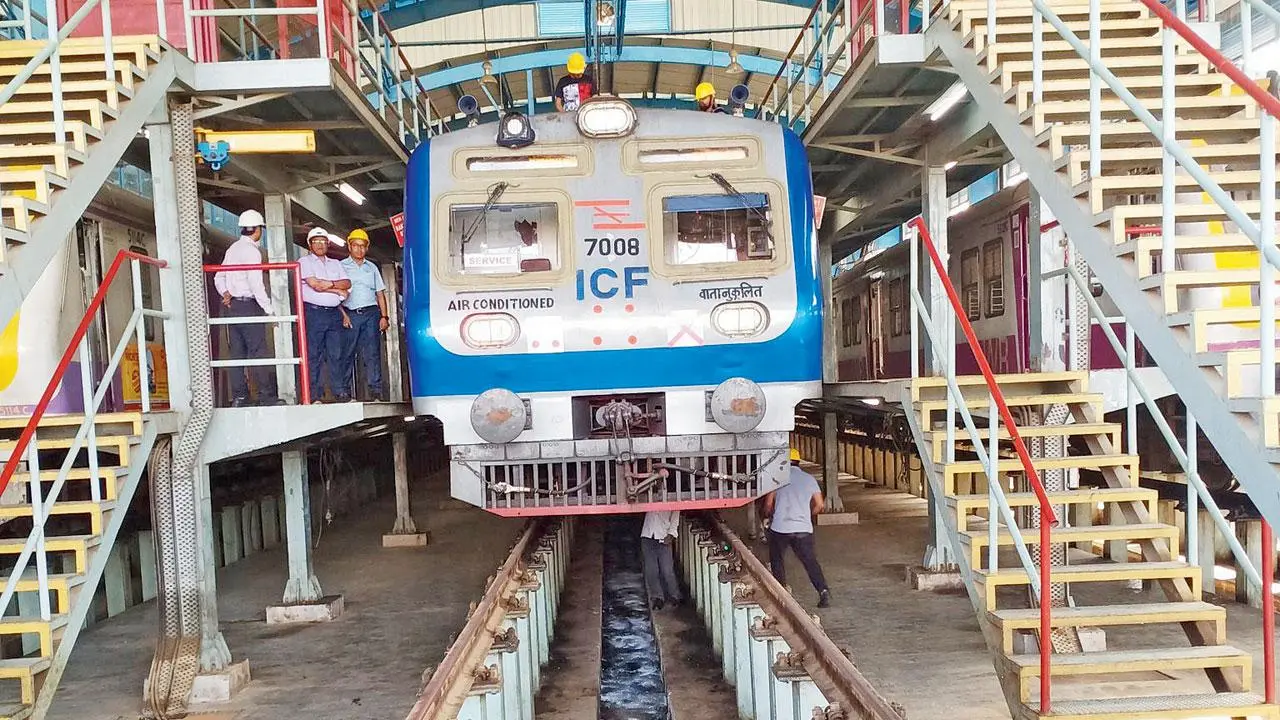
After prolonged delays linked to land acquisition and planning clearances, two long-pending suburban rail car shed projects in the Mumbai Metropolitan Region have entered a decisive execution phase. The developments are expected to play a critical role in supporting the city’s next phase of suburban fleet expansion, easing pressure on overstretched maintenance facilities and improving service reliability across the rail network.
The projects are being implemented by the Mumbai Railway Vikas Corporation under the third phase of the Mumbai Urban Transport Project. Together, the new electric multiple unit depots at Vangaon and Bhivpuri Road represent an investment of more than ₹2,300 crore, signalling a renewed focus on backend rail infrastructure rather than just track and station upgrades. Railway planners say the Bhivpuri Road facility, which will cater to the Central Railway corridor, is particularly significant. Land acquisition for the project has now been completed in full, removing one of the biggest obstacles that stalled progress for years. Site development activities, including internal roads, drainage networks and boundary infrastructure, have commenced, marking the transition from planning to on-ground execution.
Once operational, the Bhivpuri Road car shed is expected to reduce dependence on legacy depots closer to the city core, which currently operate at near-capacity. By redistributing maintenance and stabling functions towards the periphery, rail operators anticipate better fleet utilisation, shorter turnaround times for train rakes, and improved punctuality for daily commuters travelling from extended suburban catchments. On the western side, the Vangaon depot is designed to strengthen operations on the Western Railway network, where rising ridership from outer suburbs has intensified the demand for additional services. Urban transport experts note that without parallel investments in depots and stabling yards, fleet augmentation often fails to translate into tangible service improvements on the ground.
Beyond operational efficiency, the projects also carry broader urban and environmental implications. Modern car sheds are increasingly being designed with energy-efficient systems, water recycling facilities and optimised land use, aligning with Mumbai’s longer-term goals of low-carbon and climate-resilient transport infrastructure. By enabling smoother suburban rail operations, the depots could also support a gradual shift away from private vehicle use in fast-growing peripheral areas. For real estate markets along the suburban rail corridors, improved train availability and reliability can enhance connectivity-led development, provided growth is managed responsibly. Urban planners caution that transport infrastructure must be synchronised with housing, employment and social amenities to ensure equitable outcomes.
As Mumbai prepares for the next phase of suburban rail expansion, the momentum on these long-delayed car shed projects signals a structural correction in how rail capacity is planned. The challenge ahead will be to maintain execution discipline, integrate sustainability benchmarks, and ensure that backend infrastructure keeps pace with the city’s growing mobility needs.
Mumbai Railway Vikas Corporation Accelerates Car Shed Projects