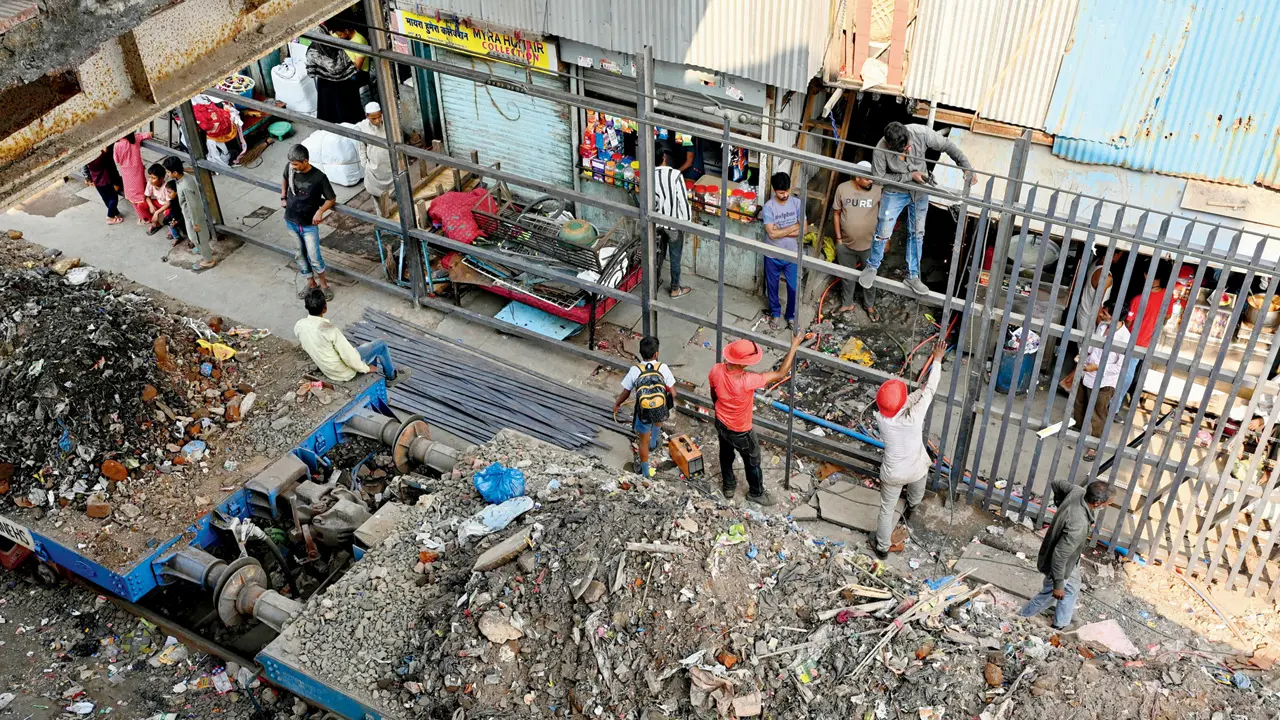
Railway authorities have begun installing protective barriers along a vulnerable section of track in Mumbai’s Bandra East area in an effort to curb illegal dumping and improve safety near a densely populated settlement. The initiative centres on a new Mumbai railway track fencing project designed to restrict access to operational rail land while addressing sanitation challenges along the corridor.
The fencing is being installed along a stretch of track running close to Garib Nagar, a tightly packed residential settlement located near rail infrastructure used for operational movements and train diversions. Officials responsible for the work say the project is intended to prevent direct access to railway land and reduce the dumping of solid waste along the trackside. Engineering teams have begun erecting metal railings rising roughly three metres above ground level. The barrier will run for approximately 150 metres along the sensitive corridor, where dense housing clusters sit immediately adjacent to railway land. According to officials overseeing the project, a portion of the Mumbai railway track fencing structure has already been completed, with foundations laid for most of the planned support columns. Construction crews are installing vertical steel posts and protective railings designed to create a continuous barrier between residential areas and the railway right of way.
Urban rail planners say such interventions are increasingly necessary in cities where railway lines pass through highly congested neighbourhoods. Informal settlements and densely built residential clusters often develop close to rail corridors due to limited availability of affordable housing, creating operational risks for railway networks. In the Bandra East area, railway authorities have previously reported recurring problems with waste dumping along the tracks. Maintenance teams have cleared large quantities of garbage from the site over the past year, highlighting the scale of sanitation challenges facing transport corridors in densely populated urban zones. Infrastructure specialists note that uncontrolled waste accumulation near rail tracks can obstruct drainage systems, damage equipment and pose safety hazards for maintenance staff. In addition, easy access to railway land increases the risk of trespassing, which remains a major cause of railway accidents in India’s metropolitan networks.
The section where the Mumbai railway track fencing is being installed also carries a secondary rail line used for locomotive movement and operational diversions. While it may not handle constant passenger traffic, the track plays a strategic role in managing rail operations in the busy suburban corridor. Authorities have simultaneously restricted certain access points near the Bandra Terminus area in recent years as part of broader safety measures aimed at protecting rail infrastructure from encroachment and unauthorised entry. Urban infrastructure experts say trackside fencing is one of several measures cities can adopt to improve rail corridor safety while maintaining operational reliability. However, they also emphasise that long-term solutions require coordinated urban planning, improved waste management systems and inclusive housing strategies.
For Mumbai, where suburban railways remain the backbone of daily commuting, safeguarding rail corridors from encroachment and environmental damage is increasingly viewed as a critical component of resilient transport infrastructure. Officials say the ongoing Mumbai railway track fencing work is one step toward creating safer and cleaner rail corridors in the city’s most crowded neighbourhoods.
Mumbai Railway Track Fencing To Stop Dumping