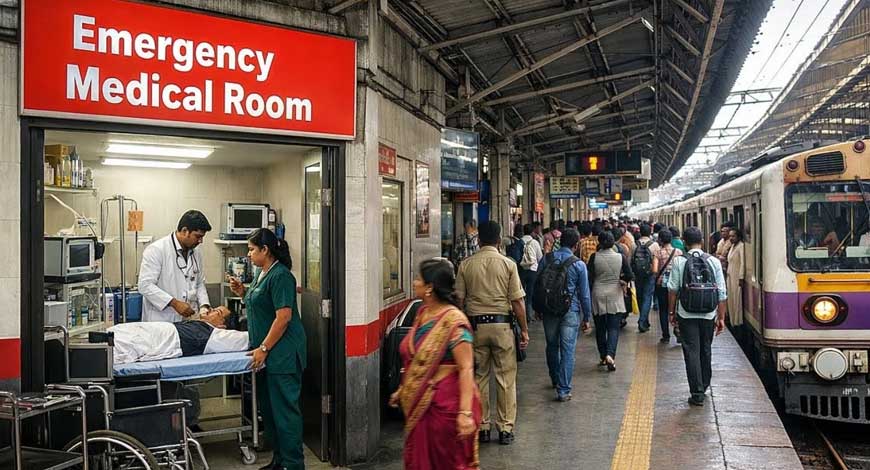
A network-wide push to improve commuter safety has led to the rollout of additional on-site healthcare facilities across suburban railway stations in Mumbai. The expansion, led by Central Railway, introduces new emergency medical rooms at key transit nodes, aiming to reduce response time during accidents and health crises in one of the world’s busiest rail systems.
The initiative is designed around the concept of the “golden hour”—the critical period immediately following a medical emergency when timely intervention can significantly improve survival outcomes. By placing medical infrastructure directly within station premises, authorities intend to bridge the gap between incident occurrence and access to professional care, particularly in high-footfall environments. The emergency medical rooms are equipped with essential life-support systems, including oxygen supply, stretchers, and basic diagnostic facilities. Each unit is staffed by trained healthcare personnel, ensuring round-the-clock readiness. Officials indicate that this decentralised model of care is expected to be especially effective during peak commuting hours, when station congestion can delay access to external medical services.
The Mumbai emergency medical rooms initiative also aligns with broader efforts to enhance resilience in public infrastructure. Urban transport systems are increasingly being viewed not only as mobility networks but also as critical public spaces where safety, accessibility, and emergency preparedness must be prioritised. Transport analysts point out that suburban railways in Mumbai handle millions of passengers daily, often under conditions of extreme crowding. In such a context, even minor incidents can escalate quickly without immediate medical support. Embedding healthcare facilities within stations introduces a layer of preparedness that has long been absent in legacy transit systems.
The programme is expected to scale further, with additional stations earmarked for similar upgrades in the coming months. Authorities are working towards expanding coverage across the suburban network, in line with judicial directives and public safety expectations. Industry experts note that such mandates have accelerated the integration of health infrastructure into transport planning. From a governance perspective, the initiative reflects a shift towards more accountable and commuter-centric infrastructure management. Investments in emergency response systems, while not directly revenue-generating, contribute to long-term public trust and system reliability—factors that influence ridership and urban productivity.
There are also implications for inclusive urban development. Accessible emergency care within transit hubs can benefit vulnerable populations, including elderly passengers, persons with disabilities, and daily wage workers who may lack immediate access to private healthcare. However, experts caution that the success of the Mumbai emergency medical rooms initiative will depend on consistent maintenance, staffing quality, and coordination with city-wide emergency services. Without seamless integration, the effectiveness of on-site facilities may be limited.
As Mumbai continues to expand its transport infrastructure, the integration of health and safety systems within mobility networks is likely to become a defining feature of future urban planning—ensuring that growth is matched with resilience and human-centred design.
Mumbai Railway Stations Add Emergency Medical Facilities