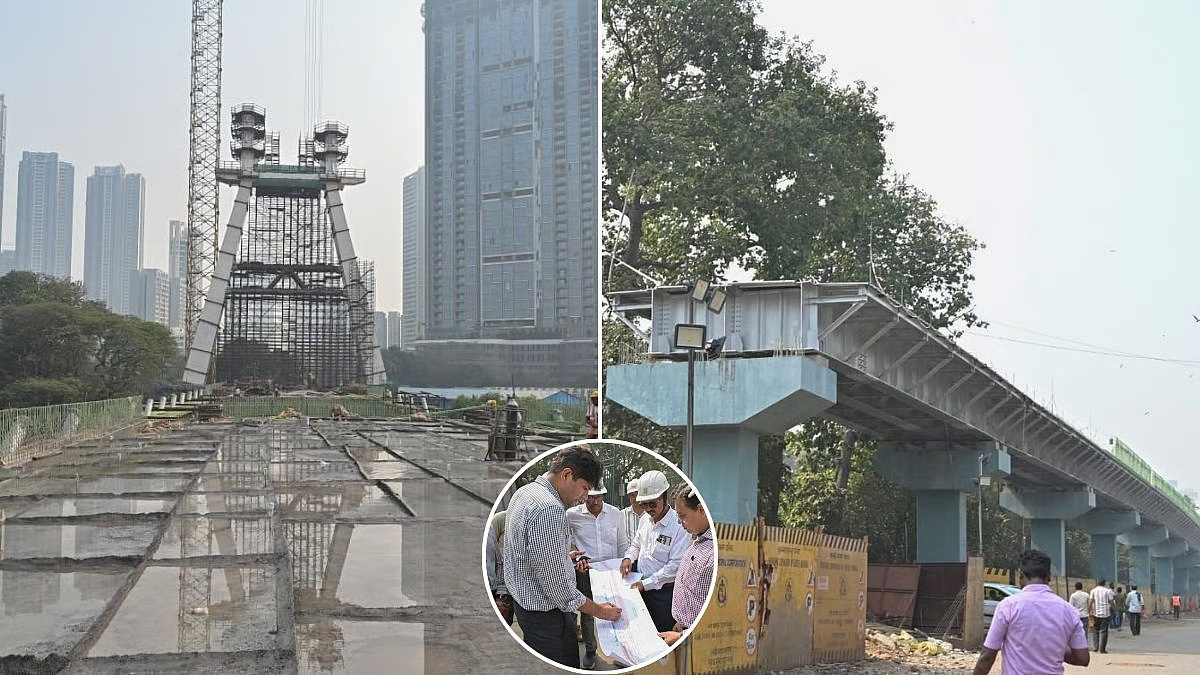
Mumbai’s transport infrastructure is set to undergo a significant upgrade as work progresses on the city’s first cable-stayed flyover constructed over active railway tracks near Mahalaxmi. The project, being executed by the municipal corporation, is designed to ease chronic congestion in a key central corridor while introducing advanced bridge engineering to one of the city’s most constrained urban zones.
The flyover is being developed to directly connect two major arterial roads—Dr E Moses Road and Keshavrao Khadye Marg—creating a new east–west link that bypasses traffic bottlenecks near the Mahalaxmi station area. Urban mobility planners say the project is strategically important, as it will improve connectivity between dense residential neighbourhoods, employment districts, and transit hubs in south-central Mumbai. At the core of the structure is a towering steel-and-concrete pylon rising nearly 80 metres, which will support the bridge deck through a network of high-tensile cables. Civic engineers involved in the project confirm that more than half of the pylon construction has already been completed, marking a critical milestone in what is considered one of the most technically complex flyovers undertaken by the city administration to date.
Unlike conventional flyovers, cable-stayed bridges require precision sequencing and specialised equipment. A high-capacity crane system, taller than the pylon itself, has been deployed to manage staged construction in a tightly controlled environment above live railway lines. Industry experts note that such technology reduces the need for extensive foundations, helping minimise disruption to rail operations and surrounding neighbourhoods. The bridge will extend over 800 metres and span the Western Railway corridor with two independent arms—one towards the west and the other towards the east. Construction of the shorter span is expected to conclude first, while work on the longer section is dependent on scheduled railway traffic blocks. Officials indicate that coordination with railway authorities remains central to maintaining timelines without compromising safety.
Environmental considerations have also shaped the project’s design. The alignment has reportedly been adjusted to limit tree removal, reflecting a growing emphasis on balancing infrastructure expansion with ecological sensitivity. Urban planners say this approach is increasingly necessary as Mumbai upgrades transport capacity within an already built-up landscape. Beyond easing traffic congestion, the flyover is expected to contribute to fuel savings and lower vehicular emissions by reducing idling time at junctions—an outcome aligned with the city’s broader climate resilience goals. However, experts caution that long-term benefits will depend on effective traffic management and integration with public transport networks.
If construction continues as scheduled, the flyover is expected to be fully operational by late 2026. For commuters navigating one of Mumbai’s most congested corridors, the project represents not just a new piece of infrastructure, but a test case for how complex engineering, environmental safeguards, and urban mobility planning can converge in a dense metropolitan setting.
Mumbai Railway Crossing Flyover Scheduled For 2026 Opening