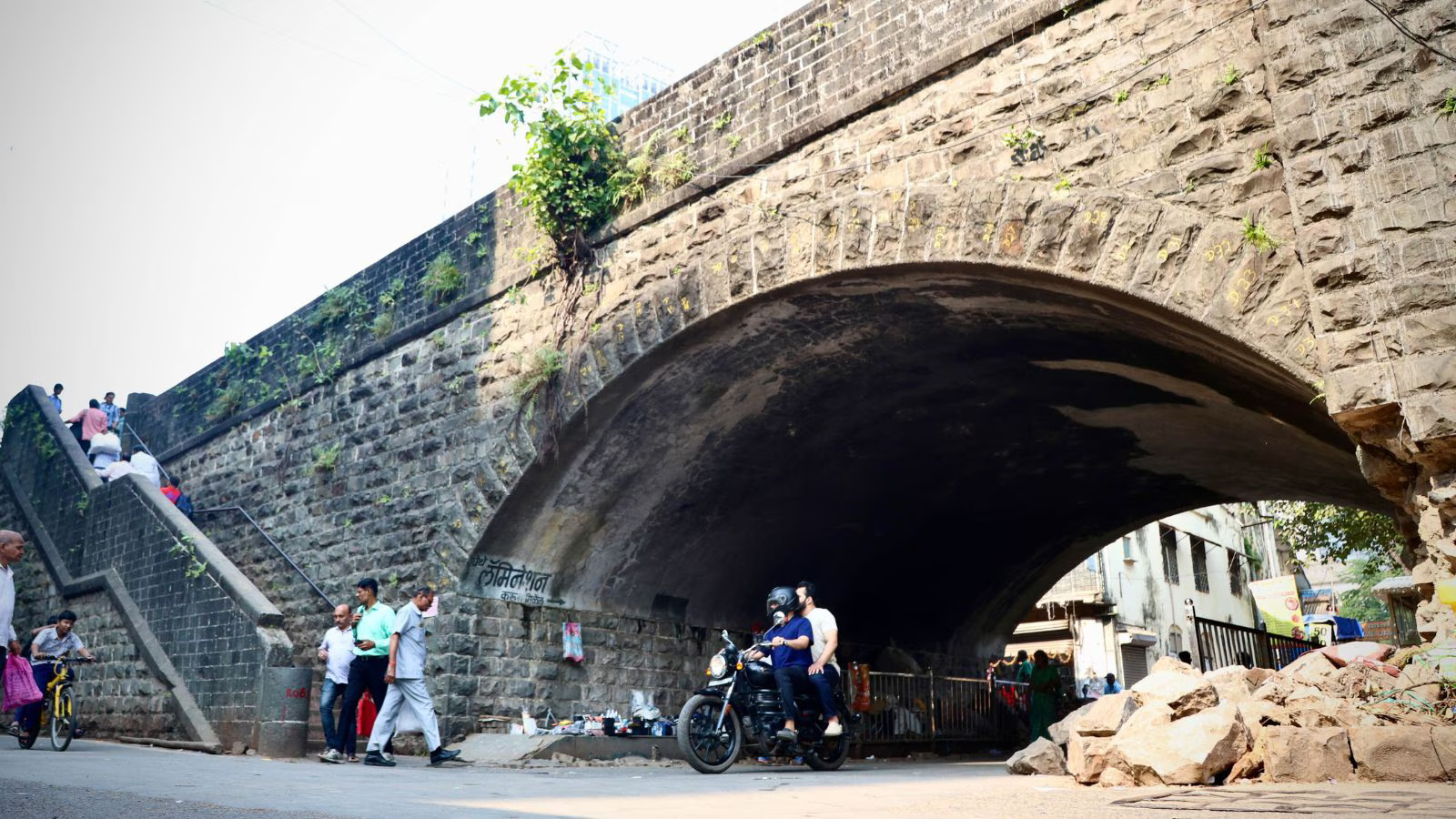
Mumbai’s urban landscape is set to retain a tangible link to its colonial-era engineering as the Brihanmumbai Municipal Corporation (BMC) moves to preserve basalt blocks from the Elphinstone Bridge. Though the bridge is being demolished to make way for a new double-decker flyover connected to the Sewri-Worli corridor, the 113-year-old masonry stones are being restored for use in a miniature replica in an open city space.
Constructed in 1913 by the Great Indian Peninsular Railway with Scottish engineering expertise, the 130-metre bridge represents a period when interlocking basalt blocks formed the backbone of urban infrastructure, without cement. Its two arch-shaped pedestrian subways and stone staircases highlight the durability and craftsmanship of early 20th-century masonry techniques. Each arch comprises 37 basalt blocks, weighing approximately a tonne each, which are now being dismantled manually, numbered, polished, and preserved at BMC’s Textile Mills compound for future installation. “The stones will form a miniature bridge in a public space, complete with an informational plaque highlighting their heritage value,” said an official from the BMC’s heritage department. This initiative ensures the bridge’s legacy survives despite its physical demolition, exemplifying sustainable urban conservation practices by repurposing historic materials rather than discarding them.
Mumbai has precedent for such heritage-driven restorations. Basalt blocks from the Reay Road Bridge were reused to construct a gate at August Kranti Maidan, and plaques from the erstwhile Carnac Bridge were incorporated into a new bridge. Experts note that Mumbai’s local basalt, historically quarried from areas like Malad and Kurla, was integral to constructing iconic landmarks including the Afghan Church, providing both aesthetic and structural resilience. The bridge itself was commissioned to alleviate the logistical challenge of level crossings in a rapidly industrialising city. It linked the Parel and Prabhadevi areas, which housed textile mills and residential clusters, streamlining pedestrian movement over railway tracks. Constructed by Bomanji Rustomji contractors and P & W Maclellan Ltd, the bridge’s plaques originally commemorated the builders and the 1913 completion year, though its contemporary name has varied in municipal records.
Urban planners view the miniature bridge project as a model for sustainable heritage preservation, balancing infrastructure expansion with cultural memory. By reusing materials and creating a public display, the city reinforces both educational and environmental values, encouraging awareness of Mumbai’s engineering history while avoiding wasteful demolition practices. As Mumbai continues to modernise its transport corridors, projects like the Elphinstone Bridge miniature offer a blueprint for cities aiming to merge urban growth with historical stewardship, preserving tangible artefacts of civic identity for future generations.
Mumbai Preserves 113-Year-Old Elphinstone Bridge Basalt Blocks For Miniature Replica Project