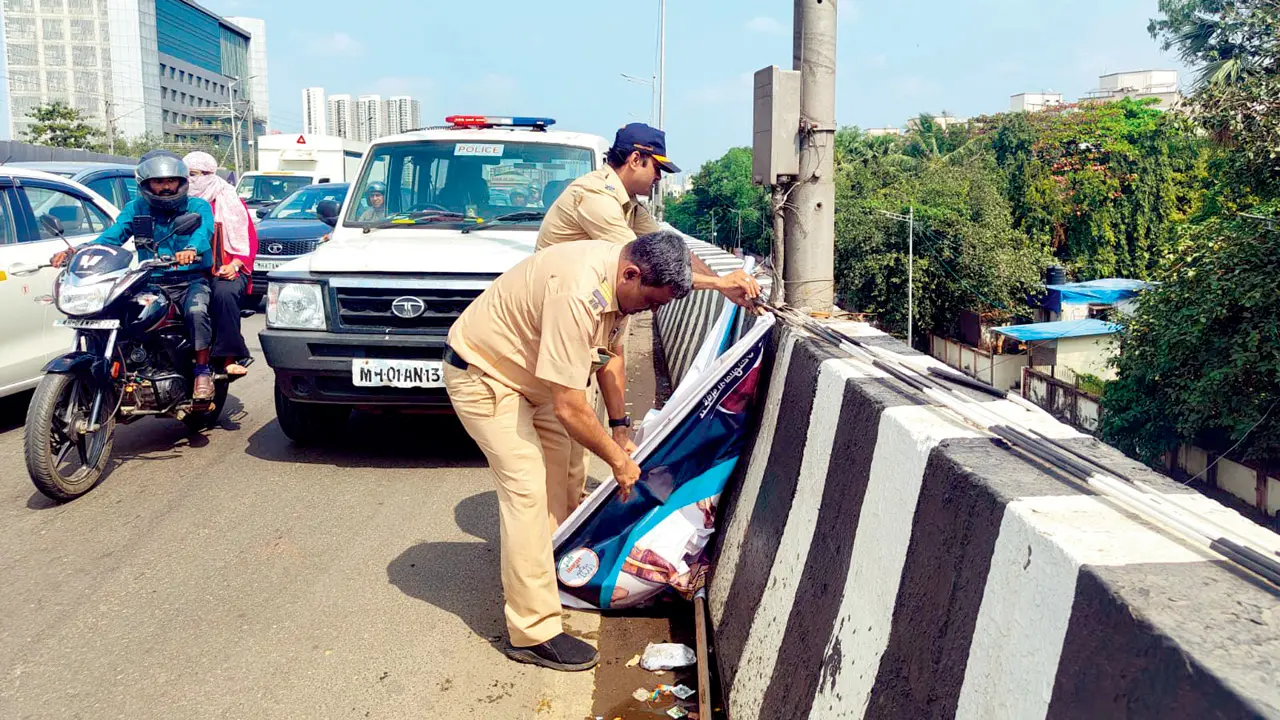
Mumbai Police Clear Unsafe Hoardings On Western Express Highway For Safety
Amid rising safety concerns and recurring lapses in civic enforcement, police officials in Mumbai have stepped in to remove illegal and unsafe hoardings along the Western Express Highway (WEH). The move, initiated by the local police despite the task being under the civic body’s jurisdiction, highlights growing frustration among enforcement agencies and commuters over unchecked visual clutter and roadside hazards that endanger motorists.
The illegal hoardings, many of them oversized and poorly installed, had become a menace for highway users. Positioned dangerously close to moving lanes, several flex banners and metal frames jutted beyond the designated safety line, forcing motorists to swerve or brake abruptly. According to officials, the immediate intervention was necessary after multiple complaints from commuters reported near misses and traffic disruptions.
During the festive season, the problem has intensified as advertisers and political groups compete for visibility on key corridors like the WEH. Such unregulated installations not only compromise public safety but also violate environmental and urban aesthetic norms. With no clear accountability in enforcement, the burden of civic oversight increasingly falls on other departments an unsustainable model for a city striving toward safer and more liveable infrastructure.
A senior police official involved in the drive stated that the initiative was undertaken as a matter of urgency. “Our priority was to prevent accidents. Waiting for procedural clearance could have led to serious incidents,” the officer said, confirming that removed materials have been handed over to the civic authorities for safe disposal. The official added that reports of repeated violations had been communicated to the municipal body, but on-ground action remained slow.
Commuters have expressed relief over the police initiative, describing it as a rare example of proactive governance. Many noted that these hoardings not only obstruct the driver’s view but also collapse during high winds or rainfall, posing risks to pedestrians and two-wheelers. Environmental experts have also stressed that unregulated outdoor advertising increases waste, carbon footprint, and visual pollution, detracting from Mumbai’s sustainable mobility goals.
Urban planning professionals argue that such hazards stem from a lack of coordination between the municipal corporation, advertising regulators, and law enforcement agencies. They suggest that sustainable city management requires continuous inspection of arterial roads and digital monitoring of outdoor displays. Experts also emphasised that both permission granters and violators should face penalties to deter future breaches.
While the civic body has remained silent on the latest action, the episode underscores a recurring governance gap in Mumbai’s urban management. As India’s financial capital accelerates its transition toward smart and eco-friendly mobility, stronger inter-agency collaboration and consistent enforcement are crucial. A safer, cleaner, and more sustainable Mumbai cannot rely on ad-hoc interventions it requires systemic reform.