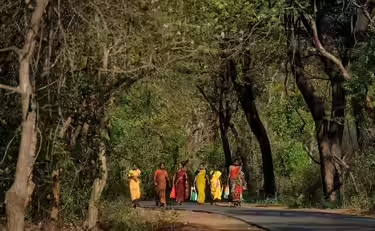
A cherished urban walking route connecting Thakur Village in Kandivli West with Sanjay Gandhi National Park (SGNP) is facing possible closure, stirring local concern over access to natural spaces amid competing demands for infrastructure development and environmental management. The decision, driven by plans for a road project within park territory, highlights persistent tensions in metropolitan planning between improved connectivity and preservation of vital green corridors.
For years, the Thakur Village walkers path has served residents as a verdant, low‑impact link to one of the city’s largest urban forests — a roughly 104 sq km ecological buffer that offers recreational, health, and biodiversity benefits on Mumbai’s northern edge. The path’s potential shutdown comes after residents filed a formal complaint questioning a road under construction inside SGNP from the Thakur Village side, raising fears that future access will be restricted and natural terrain altered.Urban planning experts describe the walkers’ route not merely as a leisure trail but as a community‑embedded green artery that supports everyday well‑being in a densely built region. Unlike gated parks, SGNP’s boundary paths provide informal, free access to nature for neighbourhoods that otherwise lack safe, walkable open spaces. Its closure would remove a rare option for low‑cost physical activity, stress relief and nature engagement amid urban density.
The proposed road project that triggered the backlash is part of a wider push to upgrade connectivity around SGNP. Authorities have pursued multiple infrastructure initiatives — including roads, tunnels and link corridors — that intersect or abut the ecological limits of the park in efforts to ease commuter congestion and expand transit options between suburbs. While precise details of the Thakur path‑adjacent road are emerging, the issue resonates with wider debates over whether infrastructure investments should take precedence over conservation of city green lungs.Environmental groups and residents stress the cumulative impacts of encroachments and access changes on SGNP’s ecological integrity. For more than two decades, courts and civic agencies have wrestled with encroachment, rehabilitation and formal delineation of park boundaries, reflecting longstanding conflict between human settlement pressures and biodiversity protection missions. Recent High Court orders have even prompted calls for structured mechanisms to resolve encroachment and rehabilitation challenges holistically, underscoring the complexity of managing urban fringe ecosystems.
City conservationists caution that key wildlife corridors and ecosystem services could be imperilled if access paths like this one are sacrificed without robust environmental impact assessments and mitigation plans. Such paths — while informal — serve as buffers that distribute pedestrian flow and reduce concentrated pressure on core habitats. Design interventions that integrate green access with protective measures could potentially reconcile both aims, but require transparent planning and community engagement.
For local residents, the walkers’ path represents more than a trail; it is a social and ecological connector that fosters daily interactions with nature. Its likely shutdown may spur greater civic advocacy for balanced urban planning frameworks that prioritise both mobility and meaningful access to open spaces. As Mumbai’s built environment evolves, policymakers may need to revisit how urban infrastructure projects intersect with vital natural resources and the everyday needs of residents — ensuring that connectivity improvements do not come at the cost of environmental accessibility.