


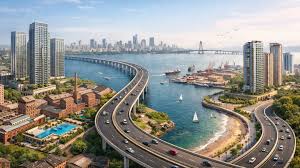
The Parel–Sewri stretch of central Mumbai is witnessing a marked transition from an industrial and transitional belt into a high-value luxury housing corridor, driven by new transport links and the gradual release of large land parcels along the eastern waterfront.
For decades, Parel benefitted from mill land redevelopment, evolving into a dense commercial and residential district. Sewri, by contrast, retained its port-linked and industrial character. That imbalance is now narrowing as infrastructure and mobility upgrades redraw the city’s residential map. The operational Mumbai Trans Harbour Link, which originates near Sewri and connects to Navi Mumbai, has significantly reduced cross-harbour travel time. This link is reshaping perceptions of the eastern seaboard, positioning the corridor as a strategic connector within the wider Mumbai Metropolitan Region. Proposed elevated connectors toward Worli and upgrades to arterial roads are expected to further integrate the area with established business districts. Urban planners say improved east–west connectivity is encouraging developers to consider integrated projects that combine residential, commercial and lifestyle components. Larger contiguous plots relatively scarce in Mumbai’s western suburbs are becoming available as ageing industrial and port-linked tracts transition to new uses. Industry representatives from NAREDCO Maharashtra note that infrastructure-led regeneration is redefining central Mumbai’s development trajectory. The Parel–Sewri corridor, they suggest, offers the rare combination of centrality and scale, two attributes that underpin premium residential demand.
Recent joint development activity by major listed developers, including the Lodha Group, signals institutional confidence in the area’s long-term potential. Such transactions indicate that developers view Sewri not merely as an extension of Parel, but as a distinct urban precinct capable of supporting large-format luxury housing with expansive layouts and curated amenities. Compared to redevelopment-heavy micro-markets in the western suburbs, where fragmented ownership patterns limit project scale, Parel–Sewri presents opportunities for master-planned schemes. Waterfront adjacency further enhances the value proposition. Designers are exploring sea-facing configurations, landscaped open spaces and pedestrian-friendly edges that align with contemporary expectations around wellness and environmental quality. While still in the early stages of transformation, the corridor reflects a broader eastward shift in Mumbai’s premium residential geography. As infrastructure projects reach completion and regulatory clearances unlock additional land, the area could evolve into a structured urban growth zone rather than a patchwork of isolated towers. For buyers, the appeal lies in proximity to established commercial districts without sacrificing space.
For the city, the challenge will be ensuring that high-end development integrates public realm improvements, coastal resilience measures and transport capacity critical factors in sustaining long-term urban liveability.
Also Read: MMR Residential Sales Growth Enters Cooldown
Mumbai Parel Sewri Luxury Housing Expands
