


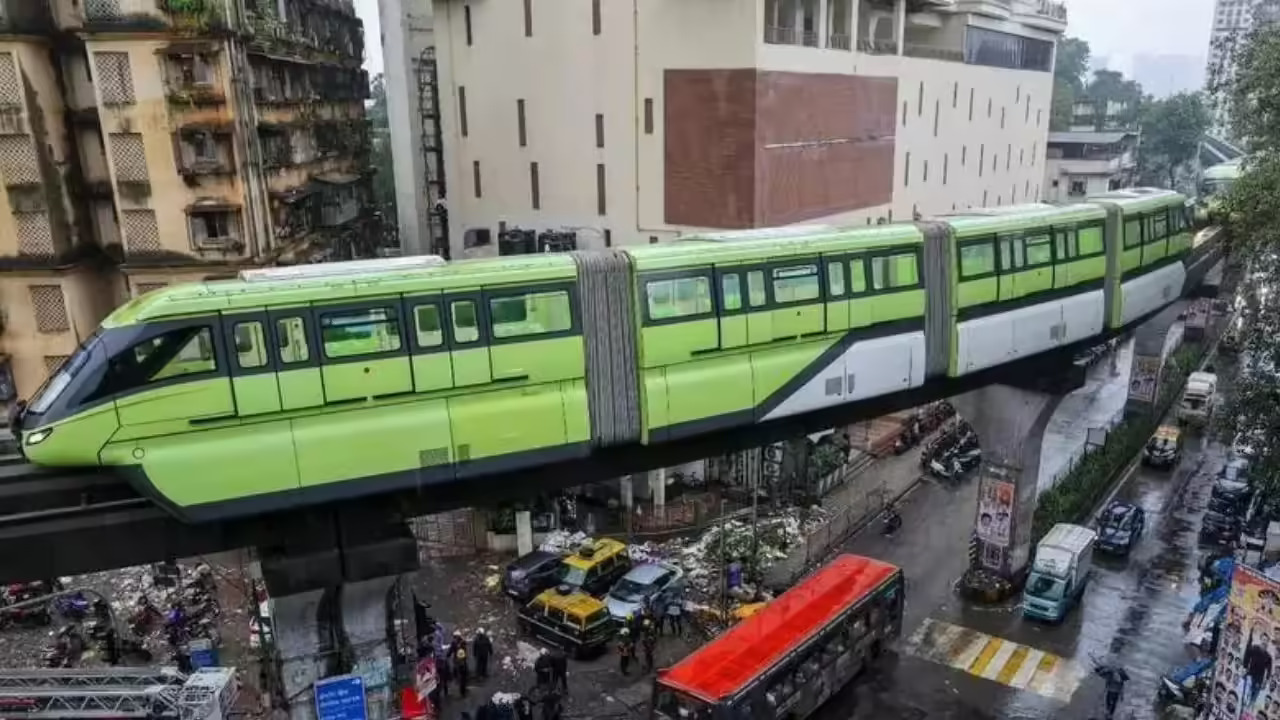
Mumbai’s troubled monorail system is headed for another suspension as officials confirmed that services will be halted for a few days to conduct a full-scale safety and reliability review. The move follows a series of recurring technical failures that have raised concerns about the system’s dependability and passenger safety.
According to transport officials, new rakes are expected to be introduced during the shutdown period, while the Commissioner of Metro Rail Safety will be invited to carry out a detailed inspection before operations resume. A public notice will be issued to inform commuters ahead of the suspension. This is not the first time the city’s monorail has faced a complete closure. In November 2017, an empty rake caught fire near Mysore Colony station, forcing a nine-month suspension that ended only towards late 2018. The current decision, officials said, reflects the seriousness of the technical lapses and the need for preventive measures before further disruptions occur.
The Mumbai Metropolitan Region Development Authority (MMRDA), which oversees the monorail, has set up a high-level committee tasked with recommending ways to improve both performance and safety. Experts note that this signals an overdue recognition that the monorail, once touted as a futuristic transport system, has failed to integrate effectively into the city’s mobility network. Launched in 2014 with the opening of the Chembur–Wadala Phase I, the 20-km corridor was completed up to Sant Gadge Maharaj Chowk in 2019. Despite initial optimism, the monorail has been plagued with breakdowns, delays, and persistently low ridership. Against an official projection of one lakh daily commuters, actual usage stands at only around 18,000 passengers, raising questions about its financial and operational sustainability.
The financial strain is significant. The system is expected to post a net loss of ₹529 crore in the 2023–24 financial year. Urban transport experts argue that this underperformance was foreseeable, given that the project lacked integration with other modes of mass transit such as suburban rail, metro, and buses. The monorail has often been described as a “white elephant,” symbolic of poor planning and underutilisation of public resources. Still, authorities maintain that the upcoming overhaul is an opportunity to restore confidence in the project. Officials highlighted that safety inspections, the induction of new rakes, and structural upgrades could improve reliability. However, experts caution that without stronger last-mile connectivity, passenger-friendly service schedules, and operational efficiency, the monorail risks remaining a peripheral transport option rather than a core component of Mumbai’s transit system.
The latest suspension underscores the challenges of managing costly urban infrastructure that has yet to win commuter trust. Whether the monorail can reinvent itself as a reliable and eco-friendly urban mobility choice remains an open question—but one with critical implications for Mumbai’s vision of sustainable and inclusive transport.
Also Read : PM Modi To Inaugurate Navi Mumbai Airport On September 30 With Green Focus
