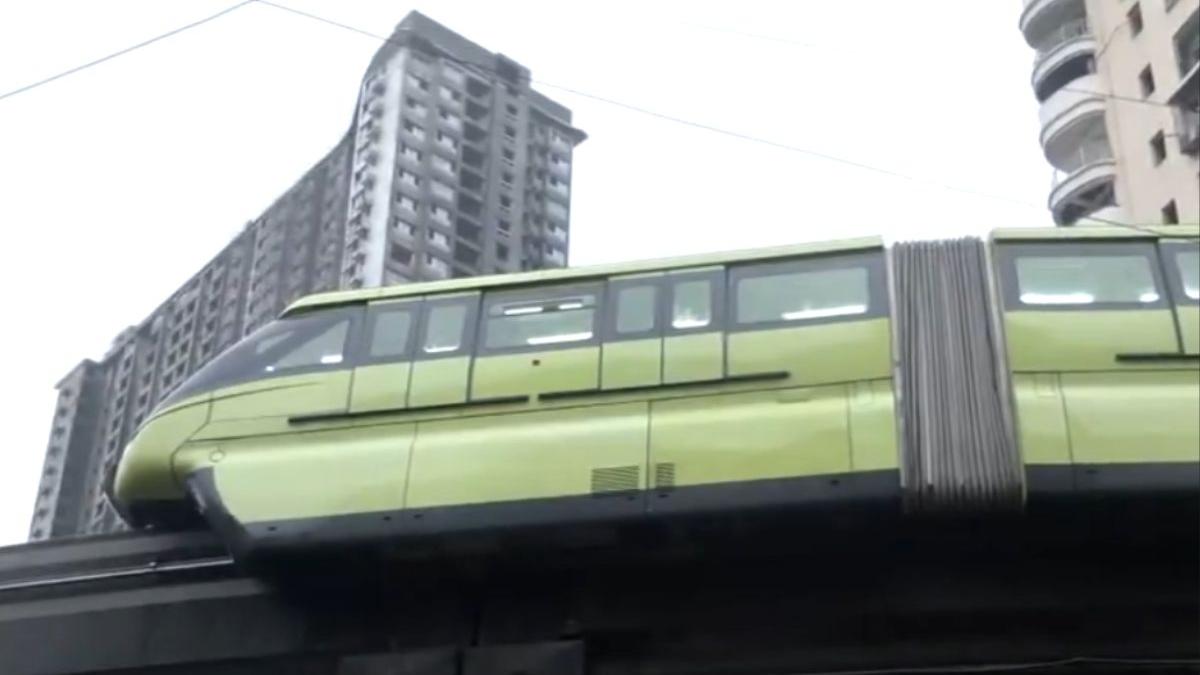
Mumbai’s long-stalled monorail system has taken a decisive step toward resuming passenger services, following the completion of mandatory safety assessments for new train sets and a modern signalling framework. The development affects the 19.5-kilometre monorail corridor linking eastern suburbs and central city precincts, a route that has remained non-operational for several months, disrupting daily travel patterns and raising broader questions about the reliability of mid-capacity urban transit in India’s financial capital.
Officials overseeing the project confirmed that independent safety certification has now been secured for newly inducted rolling stock and a Communication-Based Train Control system, a technology designed to improve operational precision, headways, and passenger safety. The clearance follows extensive trials across multiple sections of the alignment, including both static and dynamic testing under simulated operational conditions. The Mumbai monorail network has faced repeated service interruptions in recent years, culminating in a complete suspension of operations last September after a series of technical failures. Heavy rainfall events exposed vulnerabilities in the system, while isolated incidents involving stalled trains and overcrowding eroded commuter confidence. Urban transport planners note that prolonged shutdowns not only inconvenience passengers but also weaken the credibility of public transport investments intended to reduce car dependency and emissions.
The latest round of testing was conducted by an independent global inspection and certification agency, which evaluated train behaviour, system interfaces, braking performance, oscillation parameters, and signalling integration. According to officials familiar with the process, particular emphasis was placed on the reliability of the CBTC-based signalling system, given its central role in managing train movements and ensuring safe operations during peak frequencies. As part of the reset, the Mumbai Metropolitan Region Development Authority has inducted a new fleet of domestically manufactured monorail rakes. These trains incorporate multiple upgrades aimed at improving passenger experience and operational resilience, including real-time monitoring, enhanced fire safety design, improved suspension systems, accessibility features for persons with disabilities, and onboard surveillance. Transport experts say such features are now baseline requirements for urban rail systems operating in high-density environments.
Before passengers can return, the corridor must undergo a final statutory inspection by the rail safety regulator, who will review the findings of the independent audit and conduct a physical assessment of the entire alignment. In parallel, state-level administrative approvals are awaited for the appointment of a senior technical authority to validate compliance and close any residual gaps flagged during testing. From a city-planning perspective, the potential revival of the Mumbai monorail carries wider implications. While metro rail forms the backbone of Mumbai’s future mass transit network, planners argue that feeder and intermediate-capacity systems remain essential for neighbourhood-level connectivity. A stable, safe monorail could help bridge gaps between metro corridors, bus routes, and suburban rail stations, particularly in dense eastern suburbs.
The coming weeks will determine whether safety certification translates into sustained, reliable service. For commuters, the focus will be on consistency rather than announcements. For policymakers, the challenge lies in ensuring that technical upgrades are matched by institutional accountability—so that public transport systems deliver on their promise of safer, lower-carbon, people-first urban mobility.
Mumbai Monorail Network Near Restart After Safety Clearance