


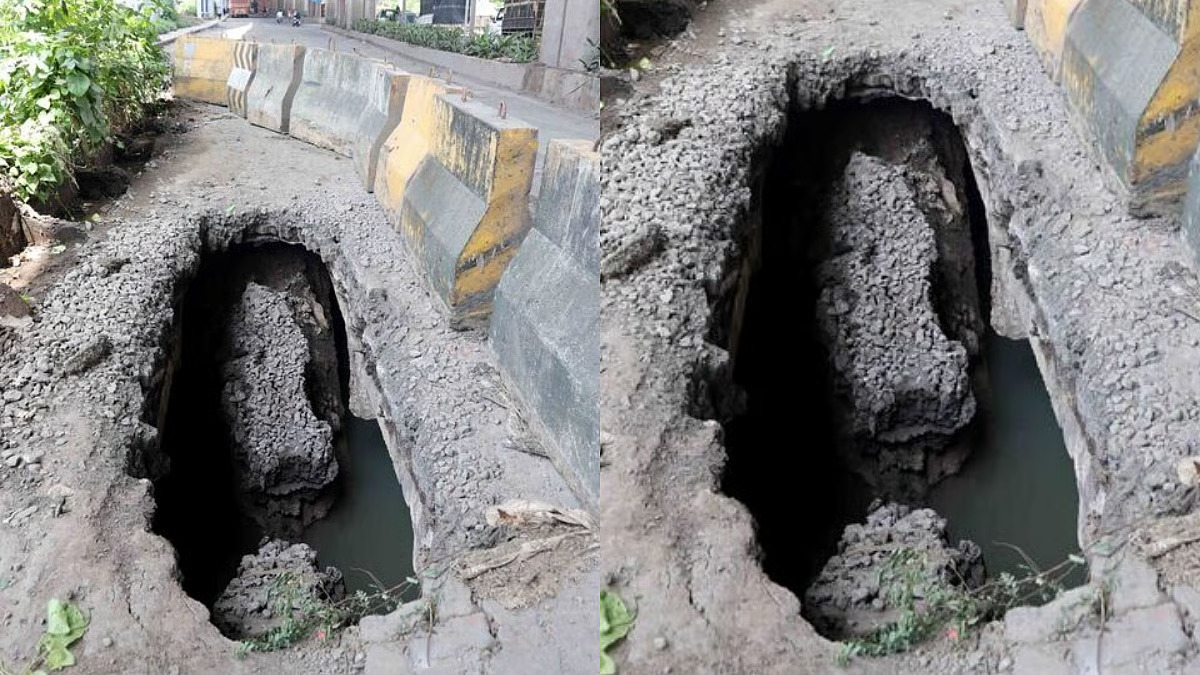
Mumbai’s infrastructure faced fresh scrutiny on Thursday after a portion of the approach road leading to Atal Setu caved in, leaving behind a 20-foot crater and sparking concerns about commuter safety. The collapse occurred on BPT Road near Shivadi, exposing a stormwater drain and raising immediate questions on the quality of construction and maintenance in one of the city’s most critical transport corridors.
Fortunately, no vehicles were travelling on the stretch at the time of the incident, preventing what could have been a serious accident. Residents in the area claimed that a pothole had been visible for nearly four days, but no remedial action was taken. This perceived inaction has fuelled local anger and renewed debate on how quickly agencies respond to early warning signs.
Also Watch: An Exclusive Interview with Sanjeev Jaiswal (IAS), CEO MHADA
Following the collapse, police cordoned off the affected road and imposed traffic restrictions. Authorities said the sinkhole had not been caused by monsoon rains but by a weakened stormwater drain. Officials clarified that this section does not fall under Atal Setu’s direct jurisdiction but lies on a stretch maintained by the Mumbai Port Authority.
A joint inspection was carried out by representatives of the municipal corporation, the port trust, the traffic police, and the metropolitan development authority. The municipal corporation has taken charge of repairing the drain and restoring the road surface, while the port trust has committed to granting necessary approvals. Development officials said they would continue coordinating between agencies to ensure that the work is completed with minimum inconvenience to road users.
The incident has reignited concerns about the resilience of Mumbai’s transport network, especially at a time when large capital investments are being made into flagship projects such as the Coastal Road and Atal Setu. Experts argue that without a parallel emphasis on long-term maintenance, safety audits, and eco-sensitive engineering, the city risks undermining the very benefits of its infrastructure expansion.Adding to the sombre mood, a separate accident on the Atal Setu corridor a day earlier claimed the life of a commuter after his vehicle collided with a heavy dumper. Police investigations are under way, and the driver of the heavy vehicle has been taken into custody.
While the fatal crash and the sudden road cave-in are unrelated incidents, together they underline the urgent need for Mumbai to strengthen safety standards on its expanding highway network. The push for seamless connectivity between Mumbai and Navi Mumbai must now be balanced with a stronger focus on structural audits, climate-resilient materials, and preventive upkeep.The authorities have promised quick restoration of the affected stretch, but commuters remain wary. For a city seeking to brand itself as a global, sustainable, and liveable metropolis, ensuring reliability and safety in everyday infrastructure will be the true measure of progress.
Also Read :Mumbai Metro Line 2B Phase 1 Final Safety Inspection Starts September 10
Mumbai MMRDA responds as Atal Setu entry road caves in
