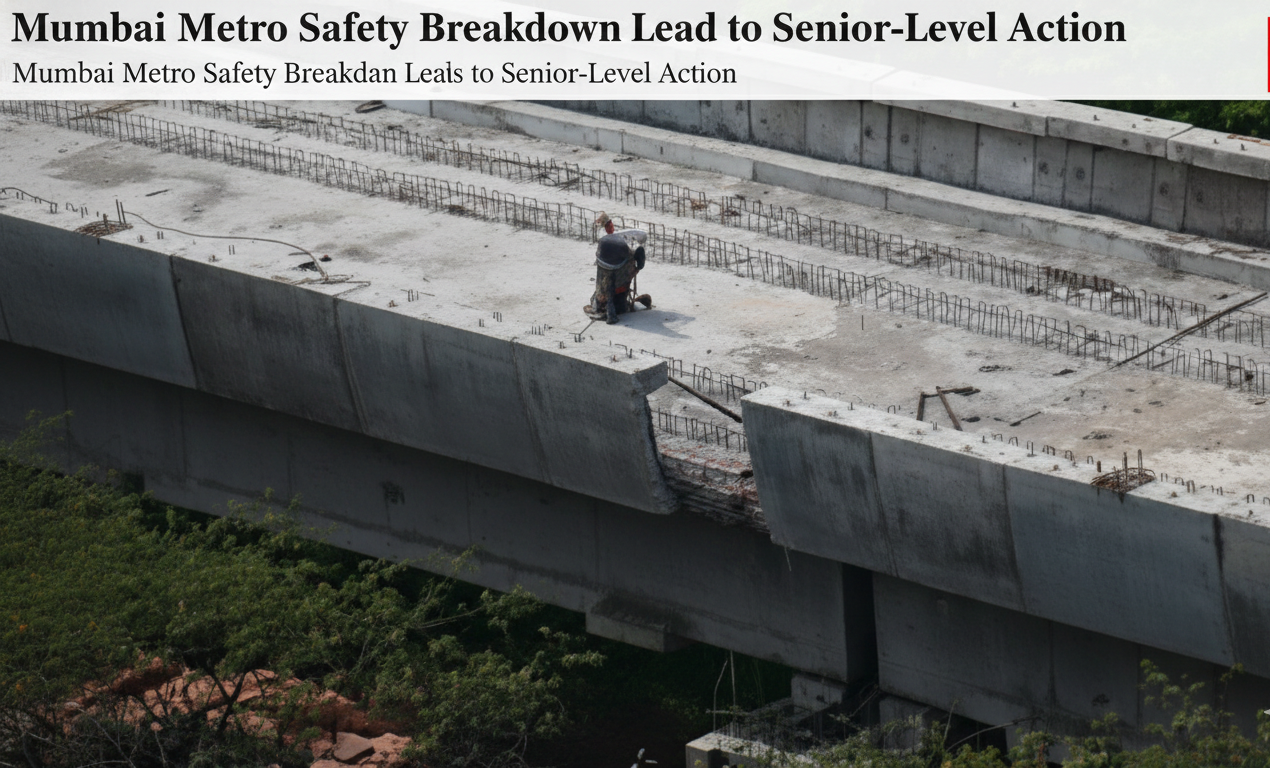
A fatal construction failure on Mumbai’s Metro Line 4 has triggered one of the most extensive internal accountability exercises seen in the city’s recent infrastructure history, with the Mumbai Metropolitan Region Development Authority expanding disciplinary action across its engineering chain and moving to sever ties with the project’s general consultant. Beyond individual responsibility, the episode has reignited questions around safety governance in fast-tracked urban transit projects critical to Mumbai’s mobility transition.
The incident occurred earlier this month on a busy arterial corridor in eastern Mumbai, when a concrete parapet segment from an under-construction viaduct fell onto live traffic, killing one commuter and injuring several others. The collapse disrupted movement on the corridor for hours and underscored the human cost of lapses in construction-stage oversight within dense, mixed-use urban environments. Following an internal review, the authority suspended two additional engineering officials responsible for on-site supervision and ordered a formal departmental inquiry against a senior technical official overseeing the corridor. The action comes on top of an earlier suspension and substantial financial penalties imposed on the construction contractor and the project’s general consultant. Officials familiar with the decision-making said the measures reflect a determination to assign responsibility not only for execution failures, but also for breakdowns in inspection and certification systems.
The consultant consortium, tasked with quality assurance, safety certification and procedural compliance, is now facing termination. Urban infrastructure experts note that consultants play a pivotal role in ensuring that elevated construction interfaces safely with traffic, pedestrians and nearby properties — a responsibility that becomes more critical as cities pursue compact, transit-oriented growth. In parallel, the authority has cleared the formation of an internal vigilance cell empowered to conduct surprise inspections across metro sites, verify deployment of qualified personnel and flag safety deviations in real time. For planners and policy observers, this signals a shift from reactive enforcement towards institutionalised risk management — a long-standing gap in India’s urban infrastructure delivery model.
Law enforcement agencies continue to investigate the circumstances leading to the collapse, including alleged deviations from approved construction practices during late-stage installation work. Officials indicated that progress in the criminal probe is linked to findings from the authority’s technical report, which is expected to detail whether standard operating procedures were bypassed to meet construction timelines. Metro Line 4, running through some of Mumbai’s most congested residential and employment districts, is a cornerstone of the region’s low-carbon transport strategy, aimed at reducing private vehicle dependence and cutting urban emissions. However, the episode highlights how public confidence in sustainable mass transit hinges as much on construction safety and accountability as on long-term environmental benefits.
As Mumbai accelerates multi-line metro construction to meet mobility and climate goals, urban analysts argue that the response to this failure could set a precedent. Stronger safety audits, clearer liability frameworks and transparent reporting may determine whether large-scale transit expansion proceeds with public trust intact — or faces growing resistance from communities living beneath the infrastructure being built.
Mumbai Metro Safety Breakdown Leads to Senior-Level Action