


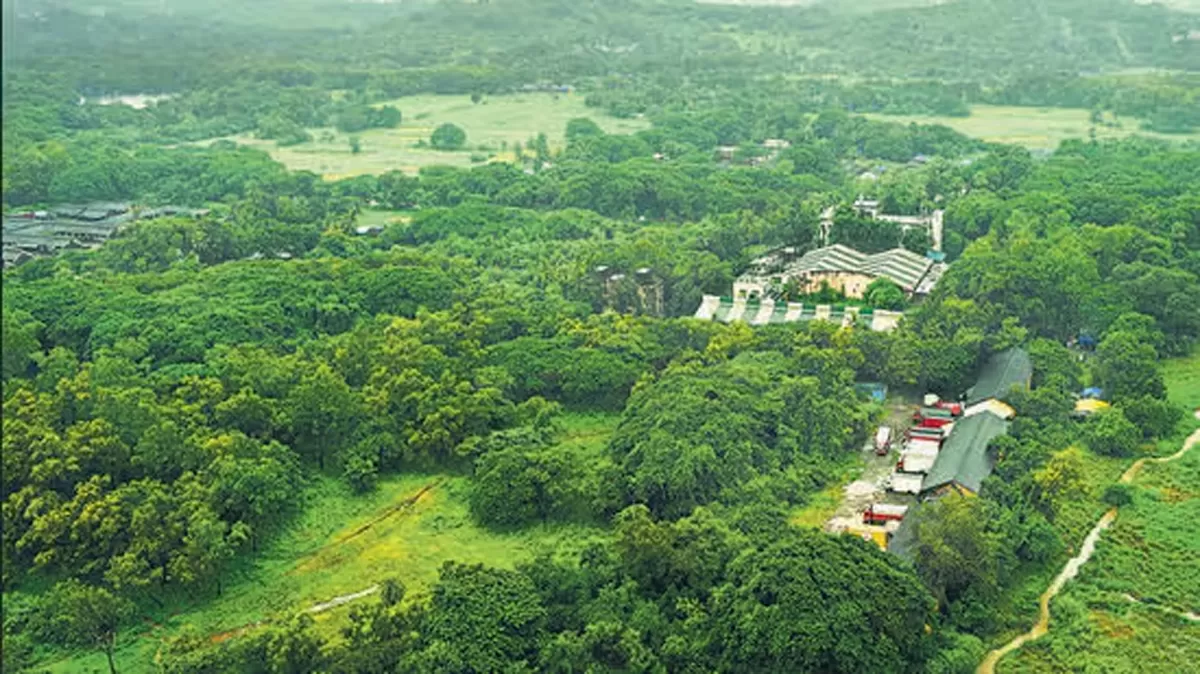
Mumbai Metro Rail Corporation (MMRC) is exploring the development of a ropeway linking Aarey metro station to Sanjay Gandhi National Park via Film City. The proposed aerial transit system aims to enhance last-mile connectivity while offering a sustainable mobility alternative across the Aarey forest zone.
The concept is part of MMRC’s broader strategy to boost footfall along the underutilised Aqua Line (Metro 3), particularly at the Aarey–JVLR station. Since the partial launch of the corridor in October 2024, ridership has remained below projected figures. The idea of a ropeway is seen as a potential game-changer—easing congestion at road choke points like Dindoshi and Yashodham Junction and transforming Aarey into a tourism-friendly mobility hub. According to officials overseeing the project, the proposed alignment would span roughly 3 km, traversing the ecologically sensitive Aarey hills. The ropeway is being planned with minimal ecological footprint and will avoid heavy land acquisition. The technology under evaluation includes mono-cable, bi-cable, or tri-cable detachable gondola systems, selected based on terrain, cost, and carrying capacity.
The system could transport between 2,000 to 3,000 passengers per hour per direction, significantly easing commuter strain on road infrastructure while offering a scenic and low-emission transport option to the green lungs of the city. Experts believe that the success of such a model would also reinforce the relevance of public-private partnerships in modern urban infrastructure. The project is expected to be developed under the Design, Build, Finance, Operate, and Transfer (DBFOT) model, inviting private sector investment while ensuring public benefit. If implemented, it will further integrate Film City—an employment and media hub—with the metro network, correcting a long-standing gap in accessible transport.
The MMRC has already initiated feeder service collaborations with private bus operators to support Metro 3 stations. However, officials believe that fixed-line aerial transit may offer a longer-term, tourist-friendly, and weather-resilient solution, especially in terrain-challenged areas. Since its full-scale opening in May 2025 between Aarey-JVLR and Worli, the Aqua Line has seen weekday ridership climb from 20,000 to over 52,000 passengers. However, with trains built to carry 2,500 commuters per trip, occupancy remains below target. The final stretch from Aarey to Cuffe Parade is expected to be operational within weeks, further intensifying the need for end-to-end multimodal integration.
With Mumbai steadily moving towards becoming a net-zero and citizen-friendly city, such transit innovations offer more than just utility—they represent the future of low-carbon, inclusive urban mobility. The proposed ropeway could be one such leap, pending environmental and technical clearances.
Also Read : Dharavi Survey Ends August 12 Late Applications Still Accepted
