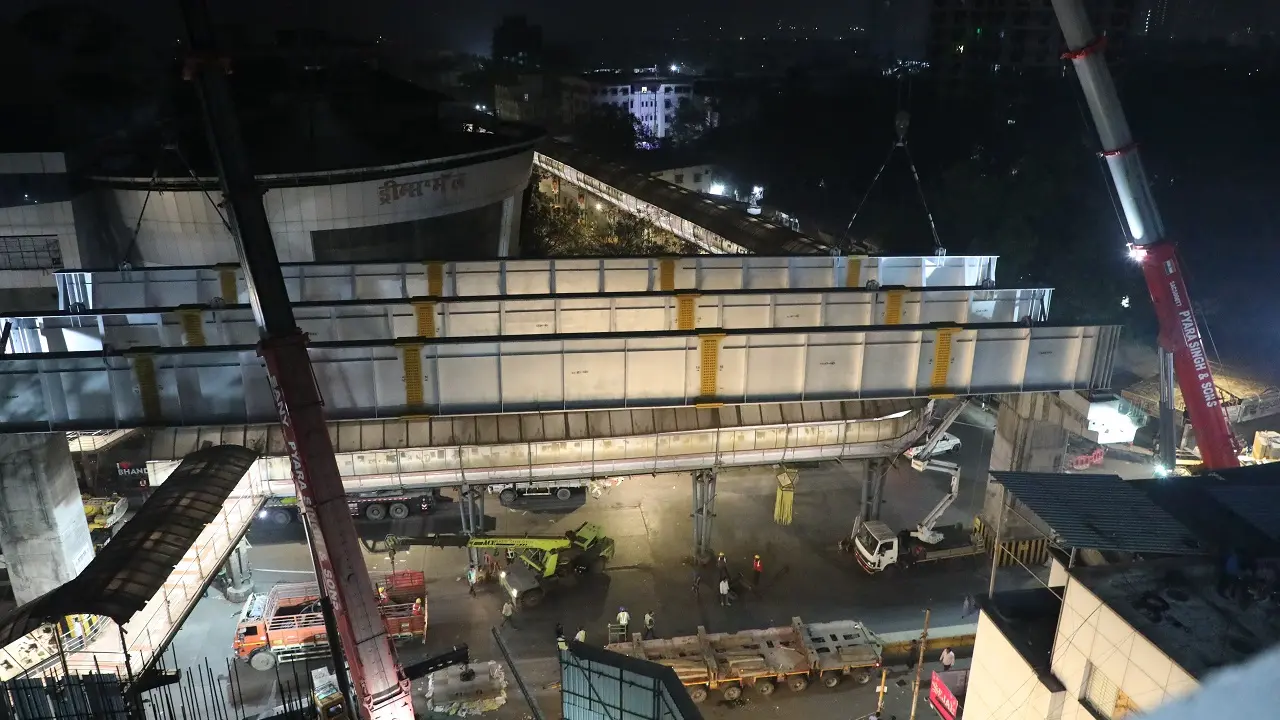
Mumbai’s push to expand its mass rapid transit network crossed a crucial construction threshold this week as heavy steel superstructure segments were installed along Metro Line 4 in Bhandup West. The overnight operation marks a decisive step in building the elevated viaduct on one of the city’s most logistically complex suburban corridors, where dense development and continuous traffic leave little margin for error.
The installation involved placing three large steel spans, collectively weighing over 300 tonnes, across a critical section of the alignment. Urban transport officials involved in the project said the work was completed during carefully planned night blocks to limit disruption to local traffic and nearby residential areas. Such operations are considered high-risk in built-up neighbourhoods, requiring precise coordination between engineering, traffic management and safety teams. What makes this milestone significant is not only the scale of the structures involved but also the time efficiency achieved. The activity, originally scheduled across multiple nights, was wrapped up ahead of plan, reflecting improved execution capacity as Mumbai Metro projects mature. Industry experts note that faster completion of complex tasks reduces indirect costs such as prolonged road diversions, fuel wastage from congestion, and extended inconvenience for local communities.
Metro Line 4 is a central component of Mumbai’s east–west mobility strategy. Stretching over 32 kilometres between Wadala and Kasarvadavali, the corridor is designed to connect densely populated eastern suburbs with employment hubs and transit interchanges in the west. Once operational, planners estimate it could significantly reduce dependence on private vehicles along arterial roads such as the Eastern Express Highway, which currently bear a heavy traffic load. The Bhandup section illustrates the engineering challenges inherent in building climate-resilient urban infrastructure within a live city. The use of prefabricated steel spans allows for quicker installation compared to conventional concrete casting, while also reducing on-site construction time and associated emissions. Transport planners increasingly view such methods as essential for building large-scale infrastructure without amplifying urban environmental stress.
Beyond mobility benefits, the progress on Mumbai Metro Line 4 carries implications for real estate and local economies along the corridor. Improved public transport access typically leads to more compact, transit-oriented development, lowering long-term travel distances and supporting more inclusive growth. Urban analysts caution, however, that these gains depend on parallel investments in pedestrian access, last-mile connectivity and affordable housing near stations. With structural works advancing steadily, attention will now shift to systems installation, station construction and integration with other metro lines. Officials overseeing the programme indicate that maintaining construction momentum while safeguarding neighbourhood liveability remains a priority.
As Mumbai continues to balance infrastructure expansion with climate and equity goals, milestones like the Bhandup installation signal progress toward a transport network that is faster, cleaner and better aligned with the city’s long-term urban resilience objectives.
Mumbai Metro Line 4 Clears Key Bhandup Hurdle