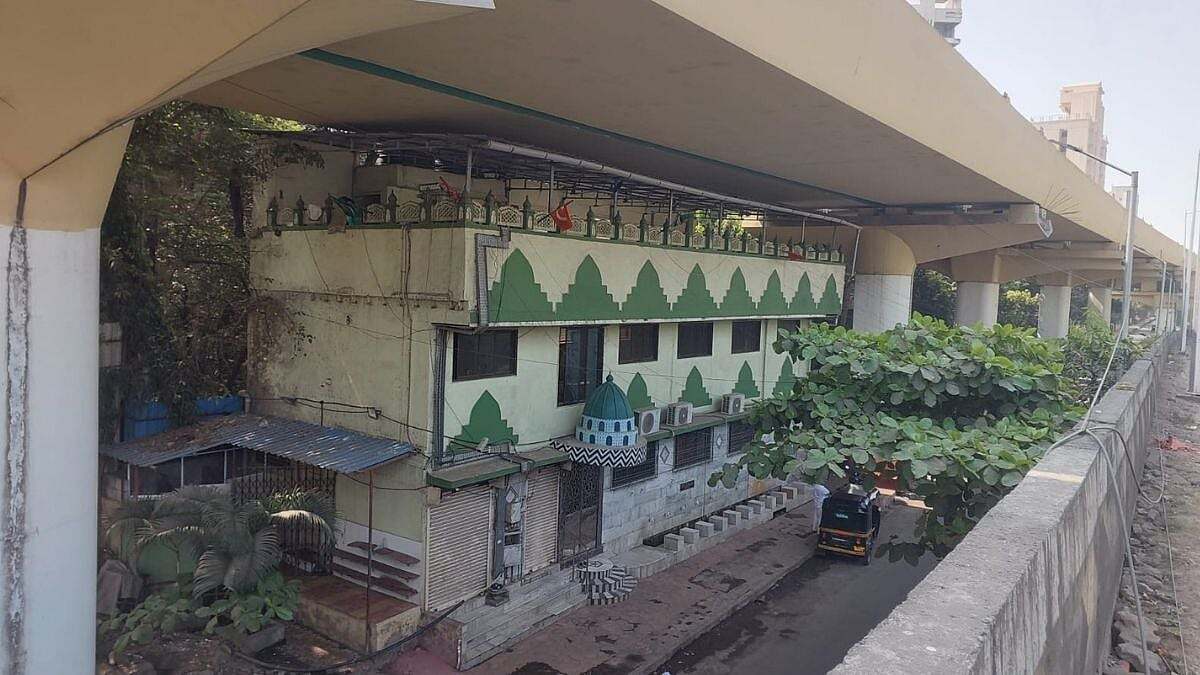
As Mumbai prepares to operationalise a new stretch of its suburban metro network, safety concerns have surfaced around a section of Mumbai Metro Line 2B in Chembur, where an existing religious structure stands directly beneath an elevated viaduct. The issue has prompted questions about last-mile risk management and the readiness of urban infrastructure ahead of passenger services.
The corridor, implemented by the Mumbai Metropolitan Region Development Authority, is expected to play a key role in reducing road congestion and lowering transport emissions along Mumbai’s eastern suburbs. However, urban planners and local residents point out that the physical proximity between the elevated metro girder and the structure below raises concerns that go beyond engineering design, touching on public safety, emergency response, and access control once trains begin running. According to civic observers, the vertical clearance between the viaduct and the building is minimal, making it possible to reach the metro infrastructure from ground level. In a dense neighbourhood such as Chembur, this has implications not only for metro passengers but also for those using the space below on a daily basis. Transport safety experts note that elevated corridors are typically designed with clear buffer zones to limit unauthorised access and reduce vulnerability to accidental or deliberate incidents.
The situation has renewed scrutiny of how land-use conflicts are handled during large infrastructure projects. Over the years, the alignment and detailed project reports for Metro Line 2B have undergone multiple revisions to navigate existing buildings, utilities, and social infrastructure. While such adjustments are often unavoidable in built-up cities, urban policy specialists argue that unresolved ground-level risks should be addressed before commercial operations commence, rather than deferred. The issue gains urgency as Phase 1 of the corridor has already received statutory clearance from the Commissioner of Metro Rail Safety, paving the way for passenger services in the coming weeks. While certification focuses primarily on structural integrity, signalling, and operational safety, planners stress that station-area security and surrounding land use are equally critical to safe metro operations in high-density cities.
From a broader urban development perspective, the debate reflects the growing complexity of building climate-friendly mass transit systems in crowded neighbourhoods. Metro projects are central to Mumbai’s zero-carbon mobility goals, but their success depends on integrating transport design with local planning, enforcement, and community safety. Failure to resolve such conflicts can undermine public confidence in sustainable transport investments. As the city moves closer to launching services on this corridor, attention is expected to turn to whether additional safeguards, access restrictions, or redesign measures are required at sensitive locations. For Mumbai’s expanding metro network, the challenge lies not only in delivering kilometres of track, but in ensuring that infrastructure growth remains safe, inclusive, and resilient at street level.
Mumbai Metro Line 2B Faces Ground Risk Review