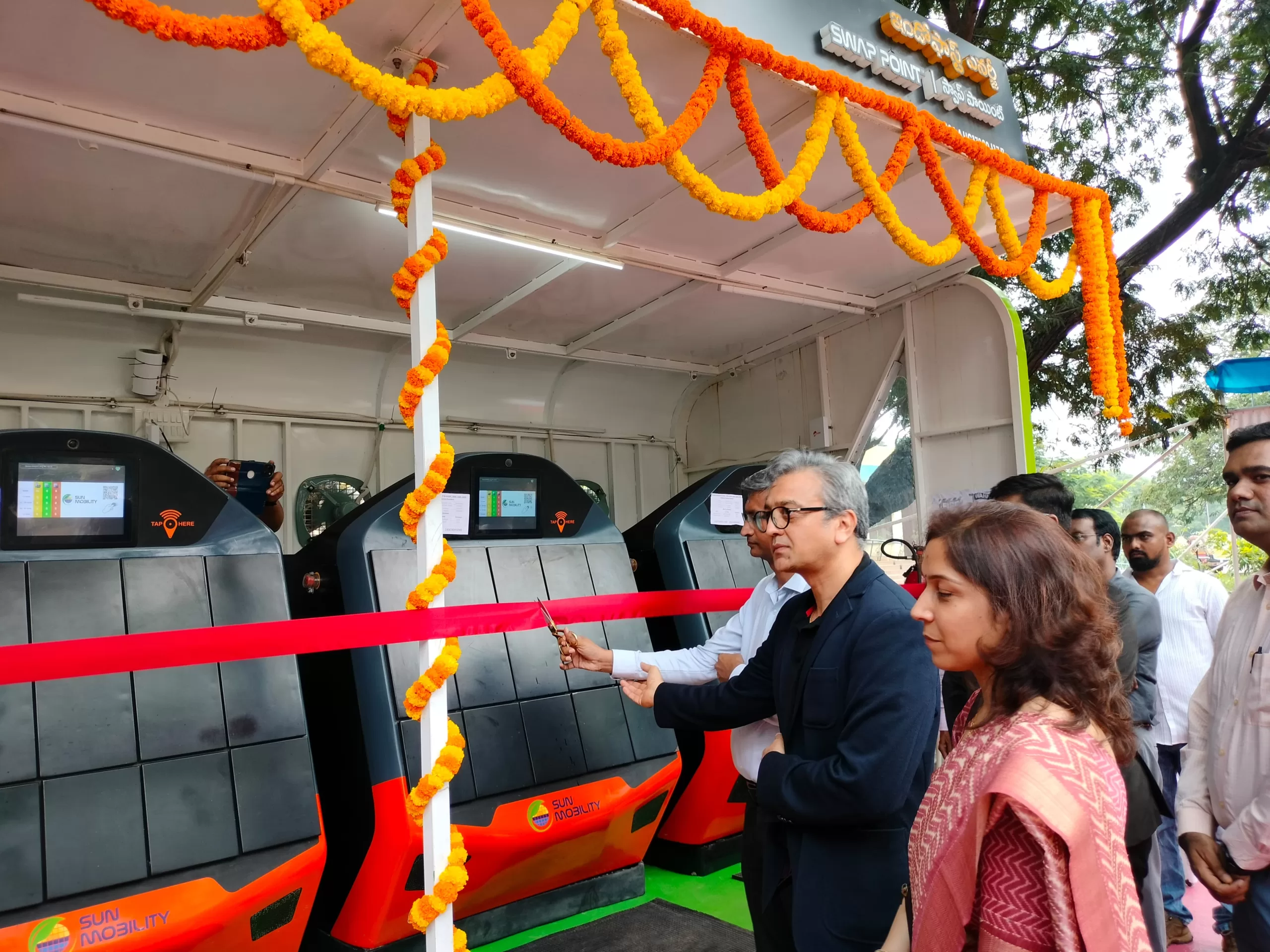
Mumbai’s newest underground transit corridor is quietly becoming a testing ground for how mass rapid transport and electric mobility can work as a single urban system. Along the Aqua Line 3 route, a large-scale battery-swapping network is set to be embedded within metro station precincts, signalling a shift in how cities plan for last-mile movement in dense, transit-dependent regions.
Under a partnership between a battery-swapping operator and the city’s metro authority, 23 swapping stations will be rolled out across eight strategically located stations on the north–south corridor. These include hubs serving commercial districts, employment clusters, and mixed-use neighbourhoods, where daily travel demand is highest and dependence on short-distance motorised trips remains significant. Urban planners note that this alignment is deliberate, designed to integrate electric two-wheelers, three-wheelers, and small cargo vehicles directly with public transport. For Mumbai, where first- and last-mile connectivity often determines whether commuters choose public transport or private vehicles, the move addresses a persistent gap. While Metro Line 3 promises faster cross-city travel, its impact depends on how easily people can reach stations without adding congestion or emissions at street level. Battery swapping, which allows discharged batteries to be exchanged for charged ones in minutes, removes waiting times associated with conventional charging and reduces pressure on urban electricity infrastructure.
Industry experts point out that locating Mumbai Metro battery swapping facilities within station zones also lowers operational risks for electric mobility users. Range anxiety and downtime remain barriers for gig economy workers, delivery fleets, and shared mobility operators. A dense, predictable network along a single transit spine offers a degree of reliability that standalone roadside chargers often fail to provide. The development also carries wider economic implications. Mumbai’s informal and semi-formal transport economy — including couriers, market suppliers, and service workers — stands to benefit from lower fuel costs and reduced maintenance associated with electric vehicles. Analysts say that when combined with high-capacity rail, such systems can make low-emission transport financially viable for workers who cannot absorb high upfront costs.
From a climate perspective, the initiative aligns with the city’s broader efforts to decarbonise urban transport without relying solely on private electric cars. Metro-linked EV infrastructure encourages shared and lightweight vehicles, which urban researchers identify as critical to reducing per-capita emissions in land-constrained cities. According to sector data, the battery-swapping operator already runs a significant footprint in Mumbai and nationally, with millions of swaps completed and substantial emissions avoided. The Line 3 rollout, however, marks a qualitative shift — from scattered installations to planned, transit-oriented infrastructure.
As Mumbai Metro battery swapping scales up along Aqua Line 3, attention will turn to execution: ensuring safety standards, equitable access, and smooth integration with station design. If managed well, the corridor could offer a replicable model for Indian cities seeking people-first, low-carbon mobility anchored around public transport rather than private vehicles.
Mumbai Metro Adds Battery Swapping Hubs