


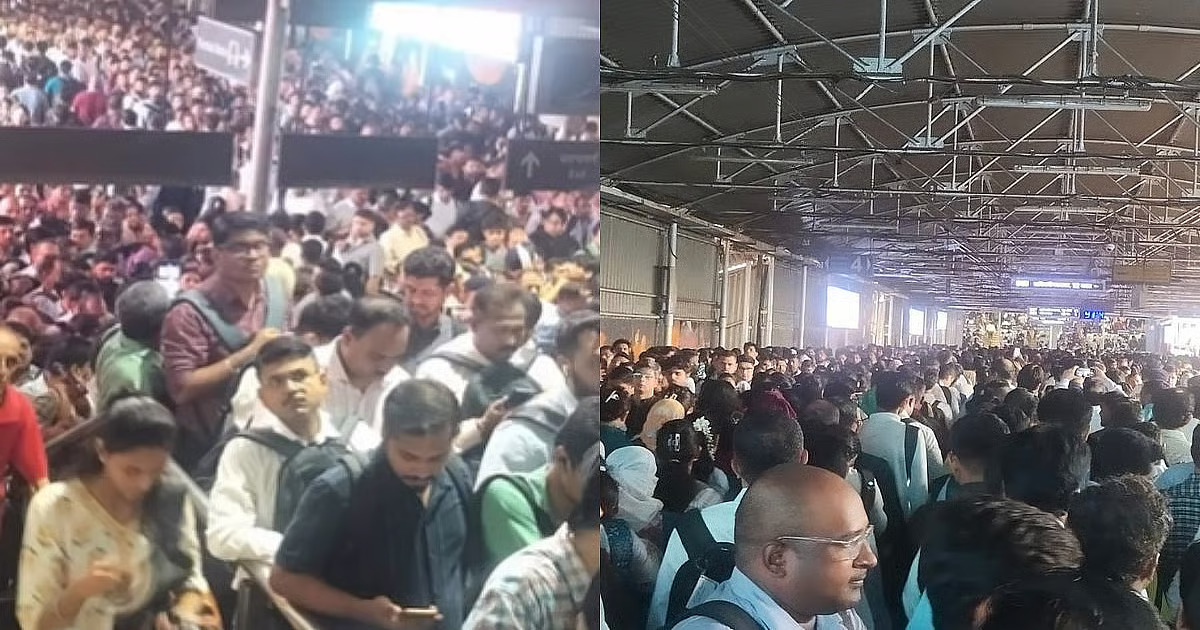
A major disruption on Wednesday morning left thousands of Mumbai Metro commuters stranded for nearly five hours after a technical snag crippled operations on Line 7. The breakdown, which began during the peak travel window, once again raised serious concerns about the reliability of the city’s expanding metro network.
The problem originated during a trial run on the under-construction Line 9 when a train transitioning onto Line 7 encountered a fault at Dahisar East. The issue forced services between Gundavali and Aarey to operate on a single track, creating long delays and forcing passengers to wait indefinitely at stations such as Dindoshi and Ovaripada. Many were stopped from entering without clear communication on when services would resume. While services between Dahisar East and Andheri West continued with reduced frequency, passengers on the affected stretch bore the brunt of the disruption. It was not until noon that trains began operating normally again. By then, however, office-goers had already endured significant delays, with many resorting to crowded buses, autos, and carpooling to reach workplaces.
Civic transport officials later explained that the snag was linked to a minor technical fault near a point section. While they maintained that the situation was managed swiftly, commuters expressed frustration on social media, criticising both the lack of information and the mounting frequency of glitches. The episode followed closely on the heels of a separate disruption on Metro Line 1 the previous evening, when a door malfunction delayed services. With two back-to-back breakdowns in less than 12 hours, questions are growing about operational readiness and maintenance practices across the network.
Ridership on Mumbai’s metro system has been rising steadily, with Lines 2A and 7 together carrying over three lakh passengers a month as of August. Commuters have come to rely on the system as a cleaner, faster alternative to road travel. However, experts caution that repeated breakdowns risk eroding public confidence, undermining years of investment in mass transit infrastructure designed to reduce congestion and carbon emissions. Transport analysts suggest that greater transparency, proactive communication, and faster technical interventions will be critical in ensuring that the metro becomes the sustainable backbone of urban mobility that Mumbai urgently requires. For now, frustrated commuters see reliability as the biggest gap in a system otherwise poised to transform the city’s transport landscape.
Also Read: BMC Considers Two Alternative Tanks To Support Malabar Hill Reservoir Repair Works
