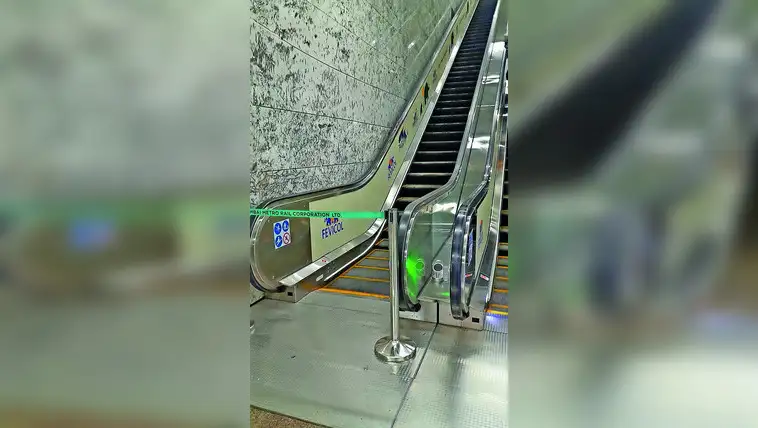
Mumbai’s landmark underground Metro Line 3, designed to improve mobility across some of the city’s most congested corridors, is drawing rising criticism from commuters who say that basic accessibility features are failing to keep pace with passenger needs. Reports from early users indicate that long walking stretches, non-functional escalators, limited lifts and inadequate last-mile connectivity are making daily travel particularly difficult for senior citizens, women, and people with reduced mobility.
Passengers travelling on the Aqua Line say that the problem is no longer occasional but systemic. Regular users report that escalators are frequently shut for maintenance, often during active service hours, forcing travellers to climb steep staircases that can run over a hundred steps. According to daily commuters, these closures occur even late in the evening, despite having non-operational hours available for routine servicing. Several travellers said that this practice has turned what should be a seamless, barrier-free journey into an exhausting physical challenge. Accessibility gaps inside stations are adding to the burden. Commuters highlight the absence of two-way escalators at several entry points, selective installation of lifts, and poor placement of essentials such as restrooms. At busy interchanges, passengers have reported walking nearly half a kilometre to find a washroom — a particular strain for elderly users, women, or anyone requiring immediate facilities. Urban planners say that these issues reflect inconsistent station design standards and a lack of universal accessibility planning, which should have been central to a line built to global metro specifications.
At stations such as CSMT, Azad Maidan, and Siddhivinayak, travellers describe long vertical commutes involving multiple staircases and extended underground walks. Industry experts argue that such design outcomes overlook the principles of inclusive mobility, which call for seamless access for differently abled users and those carrying luggage — especially at airport-connected stations. They add that reliable escalators and lifts are not add-ons but essential infrastructure for a sustainable, gender-neutral and equitable transport system. The challenges extend beyond station premises. Commuters travelling to hubs such as the Bandra-Kurla Complex say that last-mile linkages remain weak. With limited bus availability, scarce taxis and an environment where shared autos are not always safe or comfortable for all commuters, many are forced to walk up to three kilometres through traffic-heavy stretches. Transport experts note that improving feeder services is critical to ensuring that a metro line can reduce carbon emissions and private vehicle dependency — both key goals for Mumbai’s mobility transition.
The Mumbai Metro Rail Corporation stated that all systems comply with prescribed standards and that feedback is being reviewed to enhance accessibility and intermodal connections. Urban mobility specialists say that consistent maintenance, universal design upgrades and stronger last-mile networks will be essential for Line 3 to deliver on its mission of building a more inclusive, sustainable transport system for the city.
Mumbai Metro 3 Commuters Face Long Treks Between Gates