


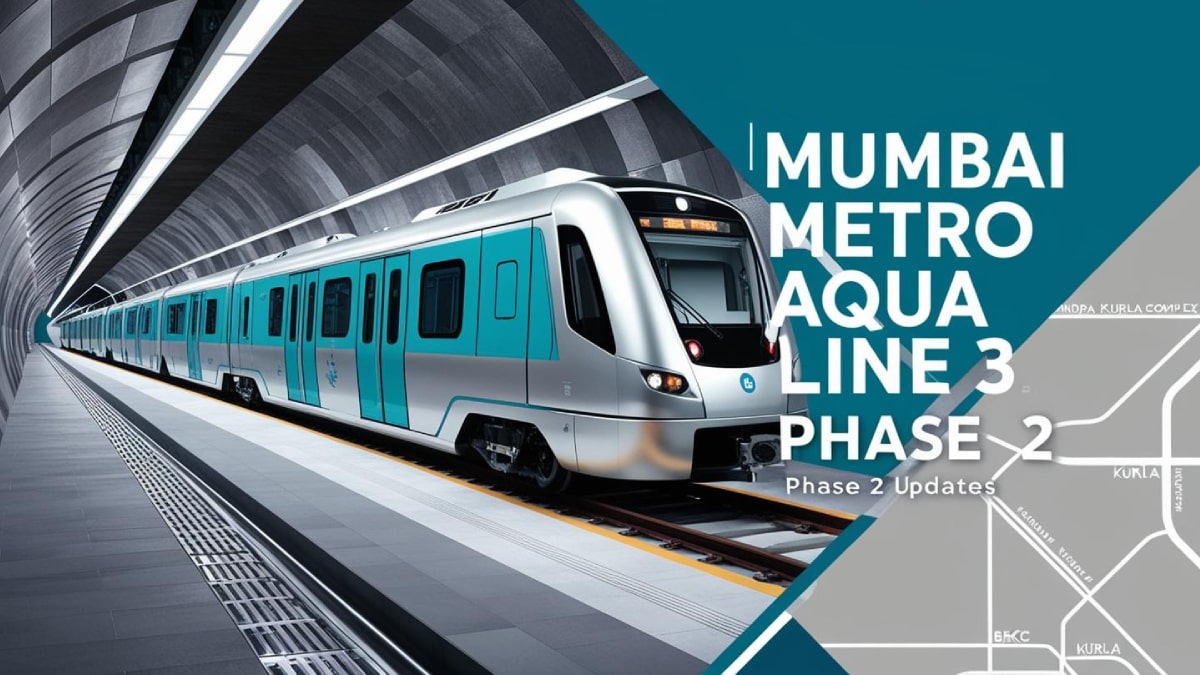
Mumbai’s Metro-3, also known as the Aqua Line, is rapidly reshaping the city’s urban mobility landscape. Spanning 33.5 km from Cuffe Parade (Colaba) to Aarey, the fully underground corridor features 27 stations and integrates central business districts, cultural hubs, and airport terminals, offering a seamless, time-efficient alternative to road travel for office-goers and daily commuters alike.
The project has been implemented in phases to optimise operational efficiency and connectivity. Phase 1, covering Aarey Colony to Bandra-Kurla Complex (BKC), opened in October 2024, linking 10 key stations including SEEPZ, Marol Naka, and airport terminals T1 and T2. This segment alone has cut approximately 6.5 lakh car trips daily, reducing road congestion by 35 percent and saving over 3.5 lakh litres of fuel each day. Phase 2A, connecting BKC to Worli, became operational in May 2025, serving six stations including Dharavi, Dadar, and Siddhivinayak Temple. Within days, it transported over 32,000 passengers daily, underscoring the line’s immediate relevance for professionals commuting between business hubs. The final stretch from Worli to Cuffe Parade, covering major landmarks such as CSMT, Churchgate, and Vidhan Bhavan, is expected to open by August 2025. Upon completion, Metro-3 will serve an estimated 13 lakh passengers daily, delivering a substantial impact on travel times, air quality, and urban congestion.
Metro-3 operates high-capacity eight-coach trains capable of carrying 2,500 passengers per trip, with designed speeds of 85 km/h and an average operational speed of 35 km/h. Peak-hour services run every 6–7 minutes, while non-peak intervals extend to 15–20 minutes. Timings are structured to support office schedules, with weekday services from 6:30 AM to 10:30 PM and Sunday operations beginning at 8:30 AM. The line’s underground alignment allows commuters to bypass surface traffic, avoid monsoon disruptions, and enjoy direct access to critical business districts, residential hubs, and cultural landmarks. Key stations facilitate interchanges with other metro lines and suburban rail, enhancing multimodal connectivity. Planned connections include Marol Naka with Metro-1, BKC with Metro-2B, and future interchanges at Dadar, CSMT, and Churchgate, alongside airport integration for swift transfers.
Ticketing is designed for convenience and interoperability. Passengers can use station counters, vending machines, the MetroConnect3 app, or the RuPay National Common Mobility Card (NCMC), branded as Mumbai 1, which operates across multiple metro lines and BEST buses. Fares currently range from Rs 10 to Rs 50 for Phase 1, rising to an estimated Rs 70 for the full corridor upon completion. Metro-3 exemplifies sustainable urban transit, reducing reliance on private vehicles, lowering carbon emissions, and offering an equitable solution for commuters. By connecting peripheral suburbs to central business districts, airport terminals, and cultural hubs, the Aqua Line is not only a transport upgrade but a strategic infrastructure intervention that supports Mumbai’s vision of a greener, more efficient, and commuter-friendly city.
Also Read : Mumbai Metro-13 Red Line Planned To Boost Northern Suburbs Connectivity
