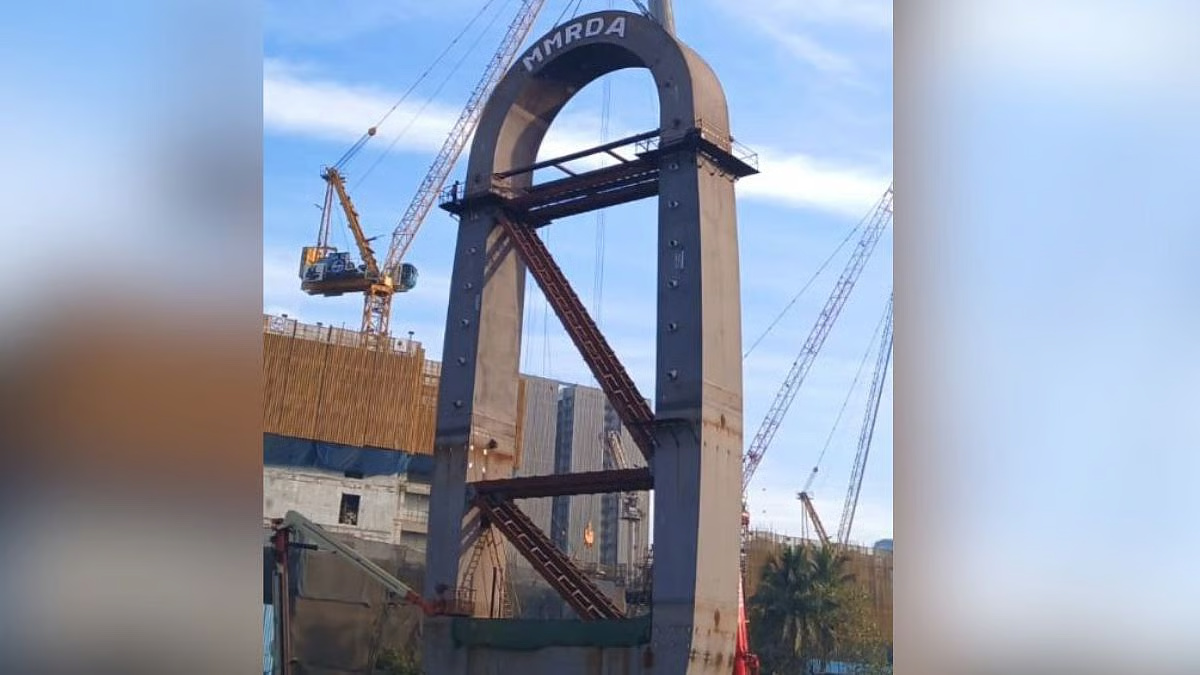
Mumbai’s east–west transit corridor has reached a visible turning point with the completion of the defining structural element of a new cable-stayed bridge on Metro Line 2B. The finishing of the bridge’s central pylon marks a key milestone for a corridor expected to reshape daily travel patterns between the western suburbs and the eastern waterfront.
Located along the DN Nagar–Mandale stretch, the structure, widely referred to as the Shunya Bridge, now stands fully articulated with its distinctive zero-inspired form. Transport officials say the milestone brings one of the most complex engineering components of Metro Line 2B into its final construction phase, improving clarity on timelines for testing and commissioning. The bridge spans roughly 130 metres and crosses the Vakola Nalla, a sensitive urban drainage channel that has historically constrained road and rail expansion in the area. Its central steel pylon rises to about 40 metres, supporting an 80-metre main span designed to minimise the number of foundations within the waterway. Urban infrastructure specialists note that such design choices reduce long-term maintenance risks while improving flood resilience, an increasing priority for Mumbai’s climate-vulnerable corridors.
The Shunya Bridge Metro 2B structure has been assembled using prefabricated steel elements, allowing most fabrication to take place off-site. This approach reduced disruption in surrounding neighbourhoods and improved construction precision. Engineers involved in the project highlight that the assembly process demanded extensive on-site welding across multiple orientations, reflecting the technical demands of cable-stayed construction in dense urban settings. Beyond engineering, the bridge is intended to serve as a symbolic marker within the metro network. Drawing inspiration from the concept of zero, it reflects an effort to embed cultural reference points into public infrastructure without compromising function. Urban designers argue that such elements help public transport projects achieve broader civic acceptance, particularly when elevated structures pass through established residential and commercial districts.
From a mobility perspective, Metro Line 2B is expected to play a critical role in easing pressure on arterial roads and the suburban rail network. By improving east–west connectivity, the corridor will shorten travel times for workers commuting between employment hubs, residential clusters and intermodal transfer points. Planners also see the line as supporting more balanced urban growth, reducing the need for long-distance car travel. Work is also progressing on the stations along this stretch, with several nearing readiness for operational clearances. Once statutory safety approvals are secured, passenger services can be introduced in phases, subject to systems testing and integration with the wider metro network.
As Mumbai continues to invest in high-capacity public transport, the completion of the Shunya Bridge Metro 2B structure underscores the city’s shift towards infrastructure that combines efficiency, resilience and thoughtful urban design. The next focus will be on timely commissioning and ensuring last-mile connectivity so that the benefits reach everyday commuters.
Mumbai Metro 2B Shunya Bridge Nears Completion