


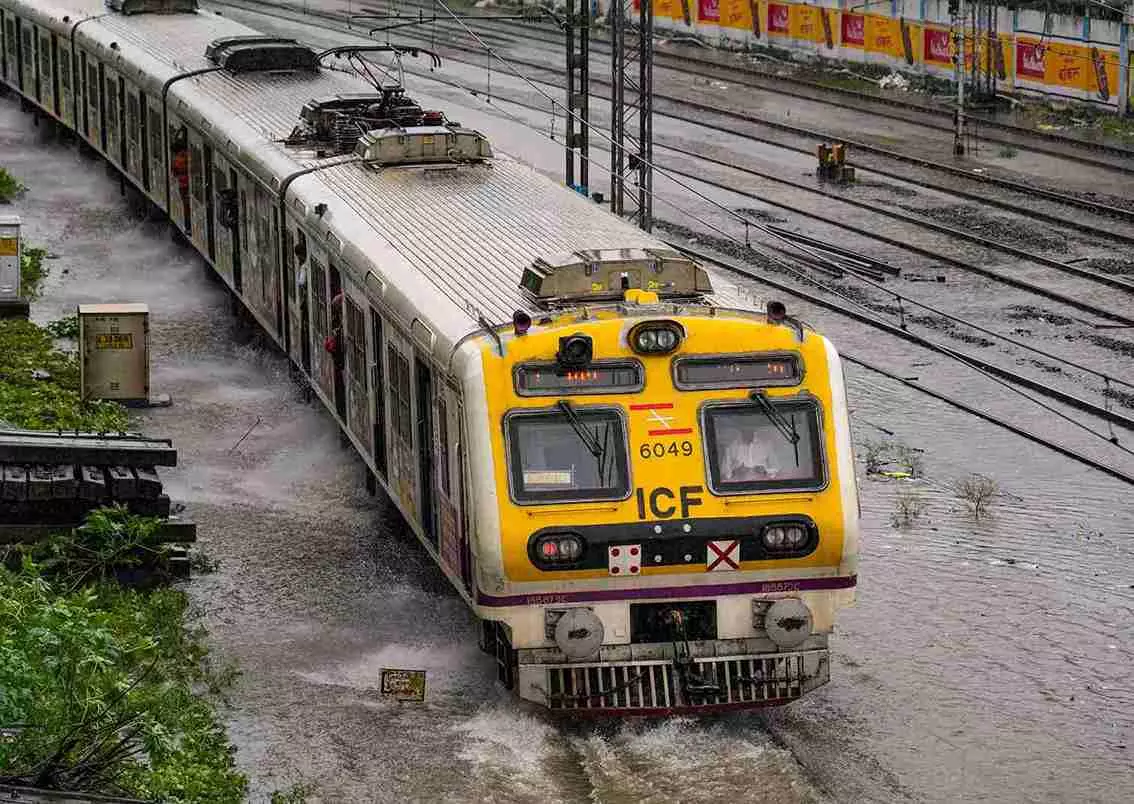
Mumbai’s famed suburban rail network once again demonstrated its resilience on Monday, operating despite heavy rainfall that left large stretches of tracks waterlogged across the city. While hundreds of services were delayed or cancelled, officials confirmed that train operations continued through the day, keeping the city moving when much of its road transport had ground to a halt.
Sections of the central, western, and harbour lines witnessed the heaviest impact. Tracks between Sion and Kurla on the central line, Matunga and Mahim on the western line, and low-lying stretches near Mankhurd, Govandi, Kurla and Tilak Nagar on the harbour line were inundated following hours of incessant rainfall. Railway officials attributed much of the flooding to the overflowing Dharavi nullah, which was clogged and unable to drain water efficiently into the Arabian Sea, causing spillage onto adjoining tracks. Authorities confirmed that while Western Railway managed with fewer cancellations, Central Railway bore the brunt, with more than 100 services scrapped. Delays across the network ranged between 15 and 30 minutes. “Water levels on the lines rose sharply due to continuous rainfall, but timely pumping ensured services did not stop,” an official stated.
To combat the downpour, Western Railway deployed a mix of high-capacity pumps, including multiple 30-horsepower and 50-horsepower units installed in partnership with the Brihanmumbai Municipal Corporation. In addition, 110 dewatering pumps were pressed into service alongside staff tasked with clearing drains of plastic waste and debris. Despite these efforts, water receded only gradually, prolonging delays across the network. The city remained under a red alert for heavy rainfall, with areas such as Dadar, Matunga, Sion, Kurla, Vikhroli, Mankhurd, Panvel and Mulund identified as particularly vulnerable. Officials stressed that suburban trains are engineered to function even with up to 100 millimetres of water on the tracks, and while conditions tested the system, safety protocols allowed continued operation.
Commuters, though inconvenienced by long waits and overcrowding at stations including Kurla, Chembur and Tilak Nagar, acknowledged the railways’ efforts. On the ground, staff monitored water levels manually, standing on the tracks to ensure real-time safety assessments. Many passengers noted that while roads across the city were paralysed, suburban trains—despite delays—remained the only lifeline. The disruptions have once again highlighted the vulnerability of Mumbai’s rail infrastructure to intense monsoon showers, a challenge that is expected to intensify under changing climate patterns. Urban experts emphasise that sustained investment in drainage, pumping technology, and eco-sensitive planning will be crucial to ensure the reliability of public transport while building towards a climate-resilient, sustainable city.
Also Read : Indian Railways Installs First Removable Solar Panel System Between Tracks For Sustainability
