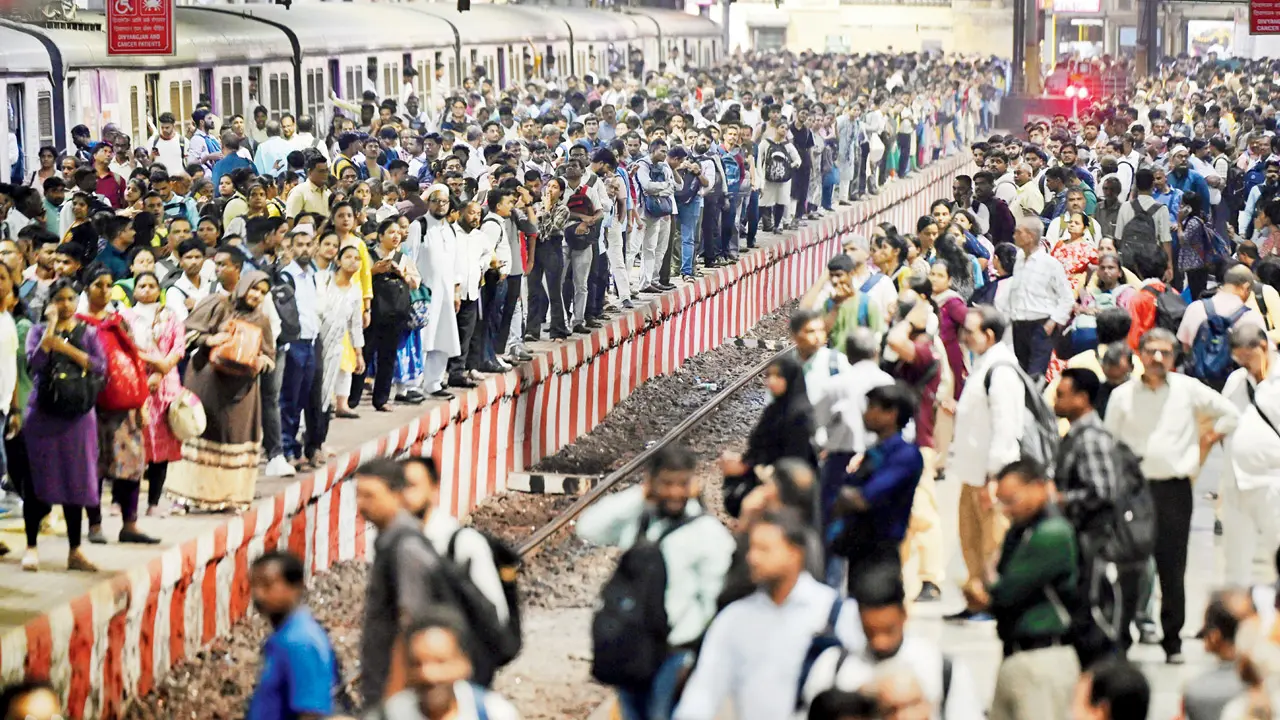
Mumbai’s suburban railway system is nearing a daily ridership of one crore, underscoring its enduring role as the city’s primary transport backbone despite expanding metro lines, bus networks, and app-based mobility options. Latest figures indicate that Central Railway now carries an average of 62 lakh weekday passengers, while Western Railway services transport 31 lakh commuters, reflecting a significant surge over previous years and raising urgent operational and safety concerns.
Urban mobility experts note that rapid population growth and the expansion of residential townships across the Mumbai Metropolitan Region (MMR) are key drivers of the rising suburban railway demand. “Affordable housing is increasingly located in distant suburbs, yet residents rely heavily on trains for daily commutes, intensifying crowding,” said a senior transport analyst. The cost-effectiveness and speed of suburban trains continue to make them the preferred choice for daily commuters. For instance, a second-class ticket from Chhatrapati Shivaji Maharaj Terminus (CSMT) to Kalyan, covering approximately 51 km, costs around ₹15 and takes 75 to 80 minutes. Extended routes to Karjat or Kasara, exceeding 100 km, remain accessible for ₹30–₹50, while season passes can reduce per-trip costs to mere rupees. Road alternatives, constrained by traffic congestion, are significantly slower and more expensive, while metro coverage still does not extend to many outlying townships.
Data from Mumbai’s metro network highlights the scale of the suburban railway advantage. Across four operational lines, the metro carries roughly 9 lakh passengers daily, including 4.5–5 lakh on Line 1, 2.5–3 lakh on Lines 2A and 7 combined, and 1.3–1.6 lakh on the partial Line 3. Even combined, metro ridership represents less than 10% of suburban train usage, reinforcing the railway system’s centrality in daily urban mobility. Peak commuter volumes present operational challenges. On January 5, 2026, the busiest day on record, Central Railway transported over 72 lakh passengers and Western Railway 52 lakh. Officials warn that rising passenger density contributes to overcrowded platforms, commuter injuries, conflicts, and mounting pressure on train frequency and capacity. Transport planners emphasise that weekday-only ridership data now provides a more accurate reflection of demand than historical averages that included weekends.
Urban planners and public policy specialists argue that the figures reflect broader socio-economic pressures, including the housing affordability crisis in Mumbai. With residential growth outpacing expansion of rail alternatives, the suburban railway remains both the most practical and socially inclusive mobility solution. Strategic interventions—such as increasing train frequency, enhancing safety measures, and coordinating urban housing development with transport infrastructure—are seen as essential to sustain the city’s mobility ecosystem. As Mumbai’s population and urban sprawl continue to grow, the suburban railway network remains indispensable, highlighting the need for integrated planning that aligns housing, transport, and safety imperatives while maintaining efficiency and inclusivity.
Mumbai Local Trains Approach One Crore Daily Riders