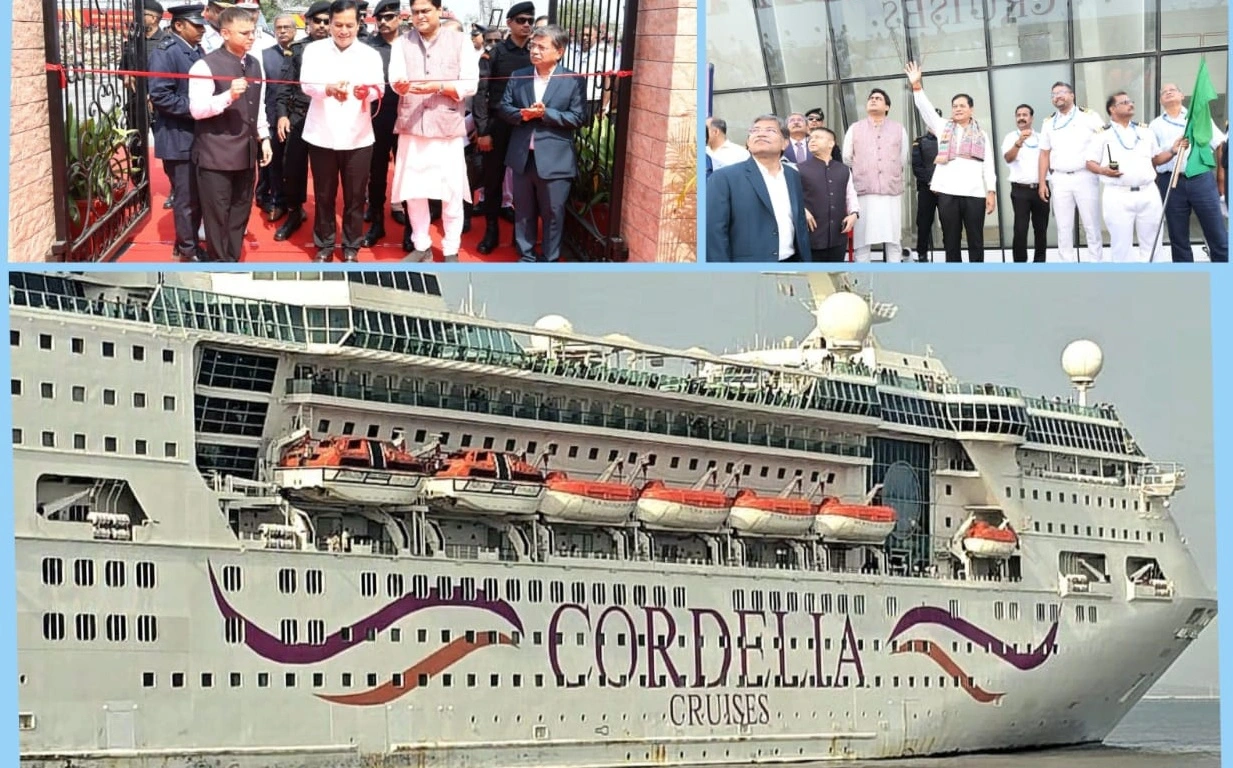
Mumbai took a major leap towards becoming a global cruise tourism destination and sustainable maritime hub as officials from the Union Ministry of Ports, Shipping and Waterways inaugurated India’s first International Cruise Terminal (MICT) at Ballard Pier.
The newly launched facility, developed with an investment of ₹556 crore, is positioned to handle up to 1 million passengers annually and marks a key milestone in the country’s port-led development strategy. Spread across a built-up area of 4.15 lakh square feet, the terminal includes extensive passenger facilities with 72 immigration and check-in counters over two floors. The structure is designed to accommodate five cruise ships simultaneously, with capabilities to dock vessels up to 300 metres in length and with a draft of 11 metres. With commercial areas planned on upper floors and parking space for over 300 vehicles, the terminal is expected to substantially improve passenger convenience and enhance the global image of Mumbai as a cruise-friendly city.
The launch also witnessed the inauguration of several infrastructure and heritage revitalisation projects, signalling a balanced focus on both economic development and cultural preservation. Restored colonial-era structures such as the Port House at Ballard Estate and Evelyn House in Colaba were formally reopened, each enhanced with façade lighting to highlight Mumbai’s rich architectural legacy. A memorial at Victoria Docks, dedicated to Mumbai Port Fire Services personnel and themed ‘Golden Tears’, was also inaugurated in homage to those lost in a past tragedy. In line with India’s commitment to decarbonisation and environmental leadership, the port administration introduced a “Shore to Ship Electric Supply” system. As part of the broader Green Port Initiative, this system enables berthed vessels—including tugboats and Coast Guard ships—to draw electricity directly from the port grid rather than relying on fossil fuel-powered auxiliary engines. The move is expected to reduce emissions, minimise noise pollution, and improve energy efficiency—a step that places Mumbai Port in alignment with global best practices for sustainable port operations.
The urban landscape also saw a major ecological improvement with the reopening of Sagar Upvan, a restored botanical garden in Colaba. The project, supported by philanthropic trusts and urban ecology experts, has equipped the space with a 25,000 KLD sewage treatment plant, infrastructure for caretakers, and landscape enhancements. With over 500 plant species and panoramic views of the Arabian Sea and Sassoon Docks, the rejuvenated green space is now a sanctuary for students, naturalists, and residents seeking sustainable urban leisure. Complementing these civic upgrades, new investments were announced to boost port infrastructure. Memorandums of Understanding (MoUs) worth ₹5,700 crore were signed for the upcoming Vadhavan Port development. These include a ₹4,200 crore terminal to handle diverse cargo types, a ₹1,000 crore bulk and liquid cargo terminal, and a ₹500 crore facility with a liquid cargo jetty and tank farm capable of managing 3 lakh cubic metres of liquefied chemicals. These developments are expected to significantly expand India’s port handling capacity and drive maritime sector competitiveness.
According to senior officials, the deep draft, all-weather greenfield port at Vadhavan is envisioned as a game-changer for the country’s maritime economy. It is anticipated to position India among the top global players in port infrastructure, and significantly enhance regional trade flows across the Indian Ocean. Further administrative developments were also part of the launch event. Key land parcels were formally transferred to support maritime governance and social welfare. These included a plot at Malet Bunder for a new headquarters of a major port authority, a plot at Reay Road allocated for community welfare initiatives, and the strategic handing over of E Shed at Mumbai Port to a logistics operator to strengthen port-led logistics.
The culmination of these efforts signals a paradigm shift in how Mumbai is shaping its waterfront—moving towards a future that embraces climate-responsive infrastructure, promotes heritage-based tourism, and reinforces India’s growing influence in the global maritime sector. While the cruise terminal serves as the face of modern maritime hospitality, the focus on sustainable operations and inclusive development highlights a strategic balance of economic ambition and civic responsibility.
Mumbai Launches India First Cruise Terminal