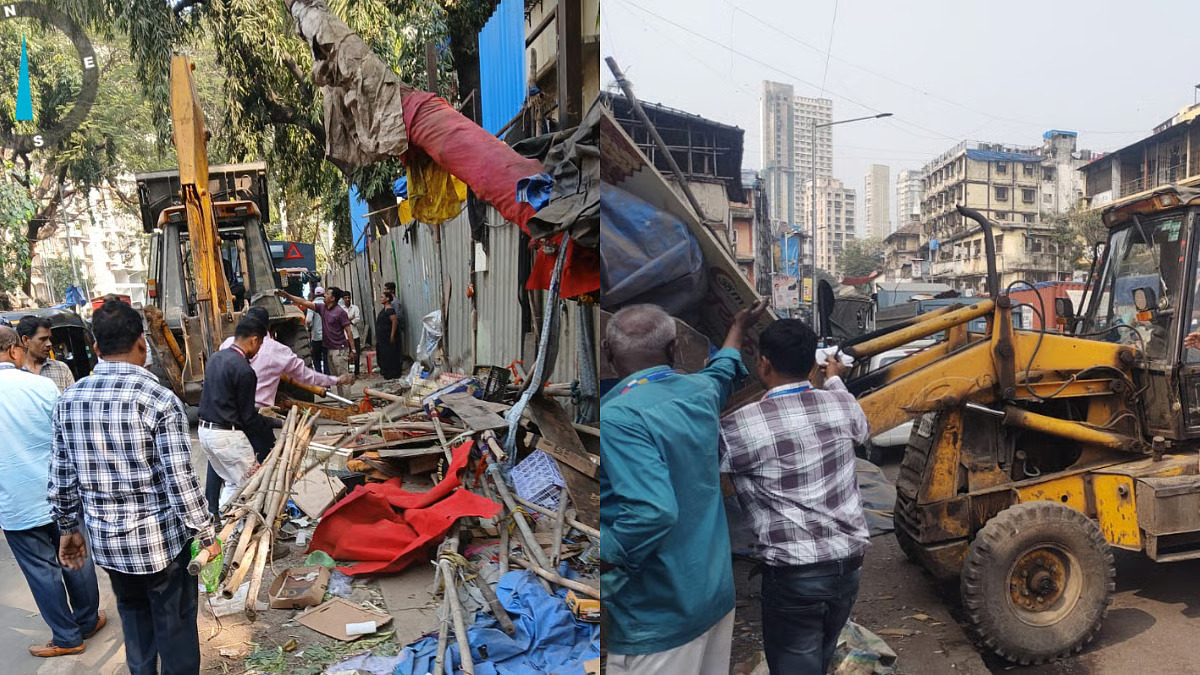
Municipal authorities in Mumbai have intensified enforcement against illegal street encroachments after an anti-hawker eviction operation in Kandivali West escalated into violence, prompting a high-level inspection and renewed directives to continue clearing public spaces. The incident has brought attention to the city’s ongoing challenge of balancing street-level livelihoods with the need for safe, accessible pedestrian infrastructure in rapidly growing neighbourhoods.
The confrontation occurred during a municipal operation targeting unauthorised hawkers occupying footpaths and roadside spaces near a busy junction in Kandivali. According to civic officials, enforcement teams attempting to remove illegal structures were confronted by a group of individuals who allegedly attacked staff members and damaged municipal vehicles. Police later detained several individuals in connection with the incident. Officials said the enforcement team was forced to temporarily withdraw from the location due to the sudden escalation, with some members reportedly seeking shelter in nearby establishments.
A senior civic administrator visited the area shortly after the incident to assess the situation and meet personnel who were injured during the operation. During the inspection, municipal departments were directed to maintain enforcement against illegal street vending and other forms of encroachment obstructing public spaces. Authorities emphasised that clearing footpaths and road margins is essential to maintaining safe pedestrian movement and reducing traffic bottlenecks in dense suburban corridors. Urban mobility experts note that the Kandivali hawker eviction drive reflects a broader effort by the municipal corporation to reclaim pedestrian infrastructure across Mumbai.
Many footpaths in the city have gradually been occupied by informal vending, temporary stalls and parked vehicles, leaving limited space for walkers. Urban planners argue that ensuring unobstructed pedestrian pathways is central to creating inclusive and people-centric cities, particularly in neighbourhoods with high population density and heavy commuter traffic. During the inspection, officials also reviewed other local congestion points, including vehicles parked in ways that restricted road movement. Civic teams were instructed to remove illegally parked vehicles and take action against establishments that contribute to traffic obstruction.
Urban governance specialists say the Kandivali hawker eviction drive highlights the complex intersection between informal economies and urban mobility planning. Street vendors form an essential part of local commerce in many Indian cities, yet their presence on narrow pavements often creates safety challenges for pedestrians, cyclists and emergency services. Experts suggest that long-term solutions require more structured vending zones, better street design and stronger coordination between municipal authorities, traffic departments and local communities. Creating organised vending spaces while preserving footpath accessibility is increasingly seen as a key step toward equitable urban development.
For Mumbai’s civic administration, the immediate priority remains restoring order in areas where enforcement teams faced resistance. Officials have indicated that anti-encroachment drives will continue across multiple wards as part of the city’s wider effort to improve mobility and reclaim public space. Urban planners say such actions must ultimately be paired with inclusive policies that recognise both pedestrian rights and informal livelihoods, ensuring that future street management strategies contribute to safer and more sustainable city environments.
Mumbai Kandivali Hawker Eviction Drive Continues After Violence