


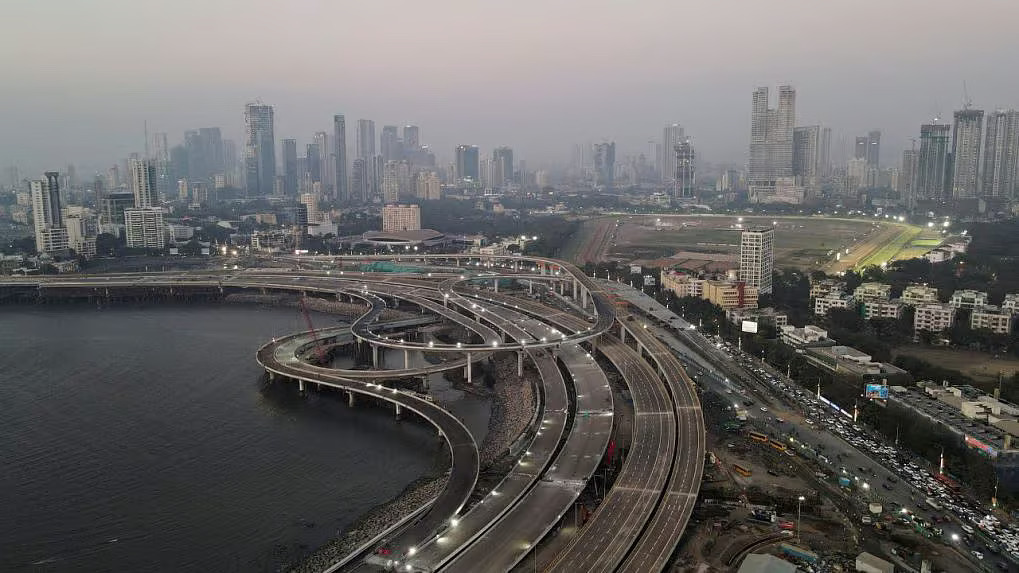
The Mumbai Metropolitan Region Development Authority (MMRDA) has unveiled an ambitious mobility plan aimed at transforming daily commuting across the Mumbai Metropolitan Region (MMR) by 2041. The proposal envisions that any journey within the region — covering over 6,300 square kilometres — could be completed within 59 minutes. Backed by an estimated investment of ₹5 lakh crore, the plan seeks to create an integrated, sustainable, and equitable transport ecosystem for India’s financial capital and its expanding suburbs.
The blueprint covers nine municipal corporations, nine municipal councils, 48 census towns, and over 1,400 villages that collectively make up MMR. Currently, the region’s transport network includes a 450-kilometre suburban rail system, a 20-kilometre monorail, and 80 kilometres of metro lines. By 2041, these are expected to expand to 682 kilometres of suburban rail and 487 kilometres of metro corridors. Planners also aim to develop 1,100 kilometres of new highways and over 570 kilometres of Bus Rapid Transit (BRT) or Exclusive Bus Lanes (EBL) to reduce congestion. Officials say the plan is built on the principle of “universal accessibility” — ensuring that no commuter should wait more than a minute for public transport. This “One Minute Waiting” concept will underpin premium BRT systems and microbus networks designed to provide last-mile connectivity to metro and suburban rail stations. The idea is to make short-distance travel as efficient and predictable as metro services, encouraging people to leave their private vehicles behind.
However, transport experts caution that realising this vision requires more than just infrastructure. “Unless last-mile connections are reliable, safe, and affordable, car dependency will persist,” said an urban mobility researcher. At present, the city continues to struggle with rising vehicle ownership — over 26 lakh cars and 105 lakh two-wheelers — despite expanding metro and suburban rail networks. The plan also proposes a tiered fare structure that balances affordability with operational sustainability. While premium BRT and aggregator taxi services may charge higher rates, regular BRT and microbus services will remain accessible for lower-income commuters. To discourage excessive car use, MMRDA has suggested introducing congestion fees during peak hours, expecting that nearly two-thirds of car users would shift to public modes if convenience and connectivity improved.
Digital integration will be key to execution. A proposed mobile app will allow commuters to plan trips, compare routes by time and cost, and purchase QR-coded tickets for seamless transfers between buses, metros, and microbuses. If implemented effectively, the 59-minute mobility vision could redefine how the Mumbai region moves — from a car-clogged metropolis to a networked, low-carbon, and commuter-centric urban ecosystem where every citizen enjoys equal access to mobility.
Also Read: Mumbai Commuters Demand BEST Feeder Buses Across All Metro 3 Station Routes
