Mumbai Housing Supply Driven By Small Unit Launches
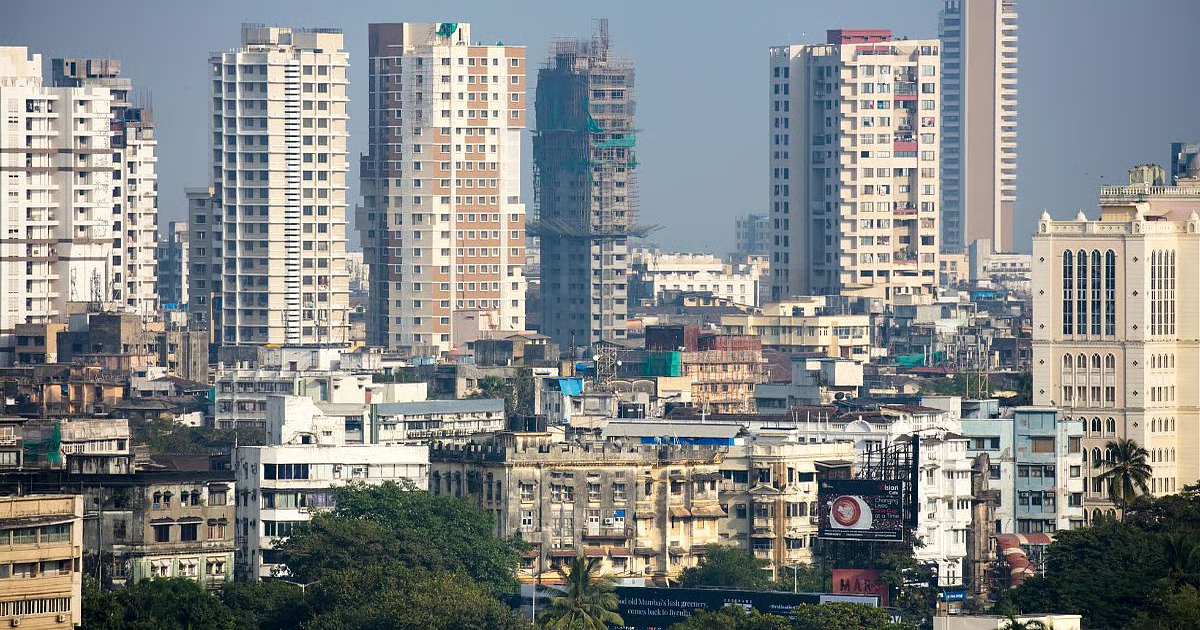
Compact housing formats dominated new residential supply in the city during 2025, with studios, 1-BHK and 2-BHK units constituting nearly 60 per cent of all new launches, according to fresh data from the Maharashtra Real Estate Regulatory Authority (MahaRERA). This skew towards smaller units highlights persistent affordability pressures and evolving urban living patterns in India’s most expensive housing market. For homebuyers navigating rising prices and limited space, the trend has far-reaching implications for urban inclusivity and the broader real estate ecosystem.
MahaRERA data shows that out of approximately 42,643 units launched in Mumbai in calendar year 2025, roughly 25,061 were either studio, one-bedroom or two-bedroom apartments — capturing the lion’s share of the housing rollout. Larger units, including 2.5 BHK and above configurations, made up the balance of non-commercial launches. The relatively small proportion of larger apartments suggests market responsiveness to constrained household budgets and shifting buyer preferences. Urban housing analysts attribute this supply mix to persistent affordability challenges. With home prices in Mumbai’s core and suburban sub-markets remaining elevated relative to incomes, developers appear to be prioritising products that align with the financial capacity of first-time buyers, young professionals and smaller family units. Compact homes also allow builders to maximise unit counts on finite land parcels — a critical consideration in a city where developable land is scarce and cost-intensive.
“Smaller units are not just a product choice — they’re an economic imperative in Mumbai,” says a property economist, pointing to the high cost per square foot that has pushed many aspirational buyers into smaller configurations. The prevalence of 1 BHK and 2 BHK launches echoes recent trends in property registration data, which have shown a sustained preference for sub-650 square-foot formats among end users. However, the trend also underscores deeper urban planning challenges. Compact housing, while more affordable at point of purchase, can strain living conditions if not accompanied by commensurate investment in infrastructure, community spaces and transit connectivity. Smaller units reduce private living space but intensify reliance on shared public amenities — from parks to public transport — for quality of life. Urban observers warn that without integrated planning, the rise of micro homes could accentuate spatial inequities between affluent and emerging middle-income neighbourhoods.
Real estate developers note that macroeconomic conditions also shaped launch patterns in 2025. With interest rates remaining higher than historic lows and input costs elevated by global supply chain pressures, builders have favoured mid-segment products that balance profitability with predictable absorption rates. Areas such as Malad West, Kandivali West and Mulund West emerged as hotspots for new launches, reflecting connectivity and amenity-driven demand among mid-income buyers.
Market watchers believe that the prevailing focus on smaller homes may persist into 2026, particularly if regulatory incentives for affordable housing and enhanced infrastructure delivery accelerate. For the city’s millions of residents seeking homeownership, the sustained availability of well-designed, compact units could be a key enabler of inclusive urban growth — provided they are supported by broader investments in mobility, green spaces and social infrastructure.