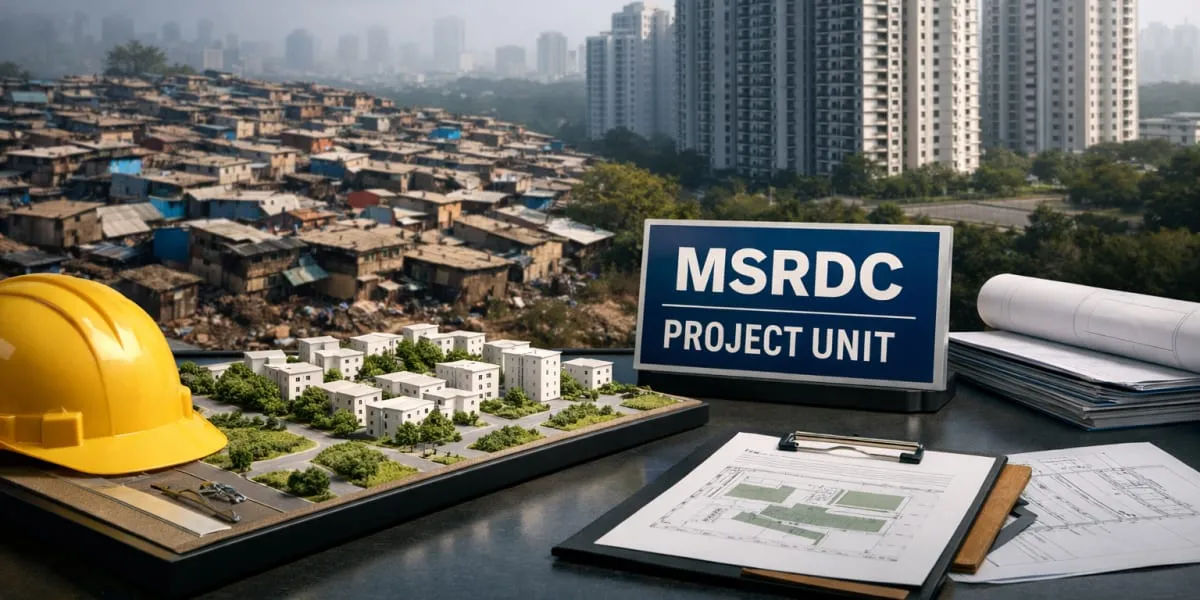
The Maharashtra State Road Development Corporation (MSRDC) is preparing to establish a dedicated project unit aimed at accelerating slum redevelopment efforts across Mumbai, signalling a renewed push by the state to address one of the city’s most persistent housing challenges. The proposed unit is expected to streamline planning, approvals and project execution as authorities attempt to scale up the Mumbai slum redevelopment programme in a city where informal settlements continue to house a large share of the population.
Officials involved in urban housing policy indicate that the move reflects growing recognition within the state government that fragmented institutional processes have slowed redevelopment projects in the past. By creating a focused project structure within MSRDC, policymakers hope to improve coordination between infrastructure agencies, municipal departments and private developers engaged in rehabilitation housing projects. Mumbai’s slum clusters remain deeply intertwined with the city’s economic geography. Many settlements are located near transport corridors, employment centres and industrial zones, making redevelopment both socially and logistically complex. Urban planners note that accelerating the Mumbai slum redevelopment agenda is essential not only to improve housing conditions but also to unlock land for infrastructure upgrades and more resilient urban planning.
The planned project unit is expected to examine redevelopment opportunities along major road and infrastructure corridors managed by MSRDC. Such areas often contain high-density informal settlements that have grown alongside highways, flyovers and transport links over decades of rapid urbanisation. By integrating housing rehabilitation with road and transport planning, authorities hope to avoid the common problem of infrastructure expansion displacing vulnerable communities without adequate resettlement planning. Housing policy experts say the initiative could also support broader efforts to improve the quality of urban living in Mumbai by replacing unsafe or environmentally vulnerable settlements with formal housing equipped with sanitation, water supply and climate-resilient design features. Informal settlements are often located in flood-prone or environmentally sensitive zones, making residents particularly vulnerable during extreme rainfall events that have become more frequent in the region.
For developers and investors in the real estate sector, a more coordinated redevelopment mechanism could help reduce uncertainty that has historically slowed large rehabilitation projects. The involvement of a state infrastructure agency like MSRDC may also improve project financing structures by aligning transport infrastructure, land redevelopment and housing rehabilitation within a single planning framework. Urban economists point out that redevelopment initiatives of this scale have implications beyond housing supply. Well-planned rehabilitation projects can reshape neighbourhoods by improving public infrastructure, supporting local businesses and expanding access to transit networks that connect residents to employment across the Mumbai Metropolitan Region.
However, experts caution that successful implementation will depend on transparent project design, fair rehabilitation policies and sustained engagement with affected communities. Past redevelopment initiatives have faced delays due to legal disputes, land ownership complexities and concerns among residents about relocation terms. If implemented effectively, the creation of a dedicated MSRDC unit could mark an important shift in how the state approaches Mumbai slum redevelopment moving from fragmented interventions towards more integrated urban transformation strategies. As the city continues to grow, balancing infrastructure expansion with inclusive housing solutions will remain central to shaping a more equitable and climate-resilient metropolitan future.
Mumbai Housing Push Gets MSRDC Project Unit