


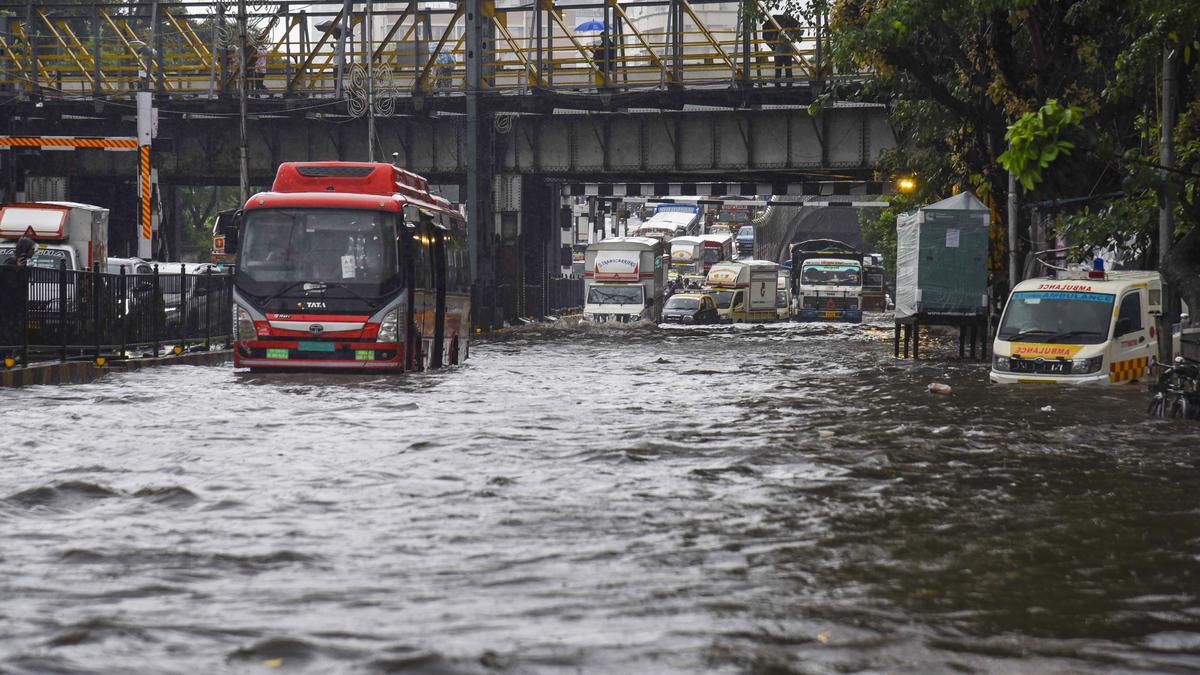
Mumbai witnessed an unseasonal and record-breaking weather event on Monday as the southwest monsoon made its earliest onset in over seven decades, delivering more than 200 mm of rain in several parts of the city within hours.
The India Meteorological Department (IMD) issued a red alert for Mumbai, Thane, Raigad, and Ratnagiri, warning of intense downpours, thunderstorms, and gusty winds. The unusually early arrival of the monsoon—more than 10 days before its typical onset of June 11—has triggered heavy disruption across the city. The downpour, which began late Sunday night, led to water-logging in multiple areas, affected suburban railway services, and forced temporary suspension of a Metro line after an underground station reported severe flooding.
According to data from the Brihanmumbai Municipal Corporation (BMC), several automated weather stations recorded exceptional rainfall between midnight and mid-morning on Monday. Nariman Point saw the highest with 252 mm, followed by Byculla at 213 mm, Colaba at 207 mm, and Do Taki station at 202 mm. Localities like Marine Lines, Memonwada, and Worli also received over 170 mm of rainfall, significantly higher than typical May averages. This early monsoon spell has already made May 2025 the wettest on record in south Mumbai’s Colaba area, where total rainfall so far this month has touched 295 mm. This surpasses the previous May high of 279.4 mm recorded in 1918, according to officials from the IMD.
The IMD’s nowcast has forecast sustained heavy rainfall over the next 24 hours, accompanied by gusty winds reaching speeds of up to 40 kmph. Experts attribute the unusually intense rainfall to strong monsoon currents aligned with an active low-pressure system off the Konkan coast, enhanced by elevated moisture inflow from the Arabian Sea. Elsewhere in Maharashtra, the weather impact has been widespread. Satara district recorded 163 mm of rainfall in the last 24 hours, while Shrigonda in Ahmednagar received 139 mm. In Phaltan, the rainfall touched 135 mm, and several talukas around Pune reported over 100 mm. The state as a whole has recorded an average of 140 mm rainfall in May so far—sharply higher than the historical monthly average of just 17.7 mm.
This early arrival of the monsoon, just one day after it advanced over Kerala, marks the fastest northward progression across the Indian subcontinent since 2009. The normal timeline for the monsoon’s advance across India typically spans from June 1 in Kerala to July 8 over the northwestern frontier. Its early onset has now raised hopes of improved water availability across the drought-prone regions of Maharashtra, but also heightened concerns over urban preparedness and climate volatility. City planners and urban infrastructure experts have flagged this event as another indicator of climate instability, pointing to the urgent need for future-proofing Mumbai’s civic systems. Several low-lying zones experienced repeat flooding incidents even before the formal monsoon season, raising questions about drainage efficiency, real-time flood warning systems, and resilient urban planning.
Environmental experts warn that the city must treat this event as a wake-up call to strengthen climate adaptation strategies. The increasing frequency of extreme weather events in the pre-monsoon window, they argue, reflects shifting monsoon dynamics—an outcome of rising sea surface temperatures, altered wind patterns, and long-term global warming. Despite being India’s financial capital, Mumbai continues to face infrastructure stress under sudden weather shocks. Inadequate drainage, dense built-up zones, and the absence of natural water buffers compound the problem, particularly in informal housing clusters and old urban cores.
While the red alert remains in force for the next 24 hours, authorities have deployed extra pumps in flood-prone areas, suspended outdoor school activities, and asked residents to remain indoors during peak rain hours. Urban mobility services, including BEST buses and suburban trains, were reported to be operating with delays or partial suspensions in some corridors. With the monsoon now firmly arrived and rainfall levels already breaching monthly records, civic agencies are under pressure to ensure uninterrupted service delivery, swift water clearance, and public safety. Urban governance experts suggest that monsoon preparedness must no longer be treated as a reactive measure but a key part of annual planning cycles for climate-resilient cities.
As the city navigates this intense start to the monsoon, questions around sustainable development, decentralised drainage systems, and equitable infrastructure coverage are once again at the fore. For a city battling sea level rise, surging population, and legacy drainage networks, this early rain event underscores the need for bold, climate-smart urban strategies.
Also Read : Week Long Rains Trigger Red Alert in Karnataka
