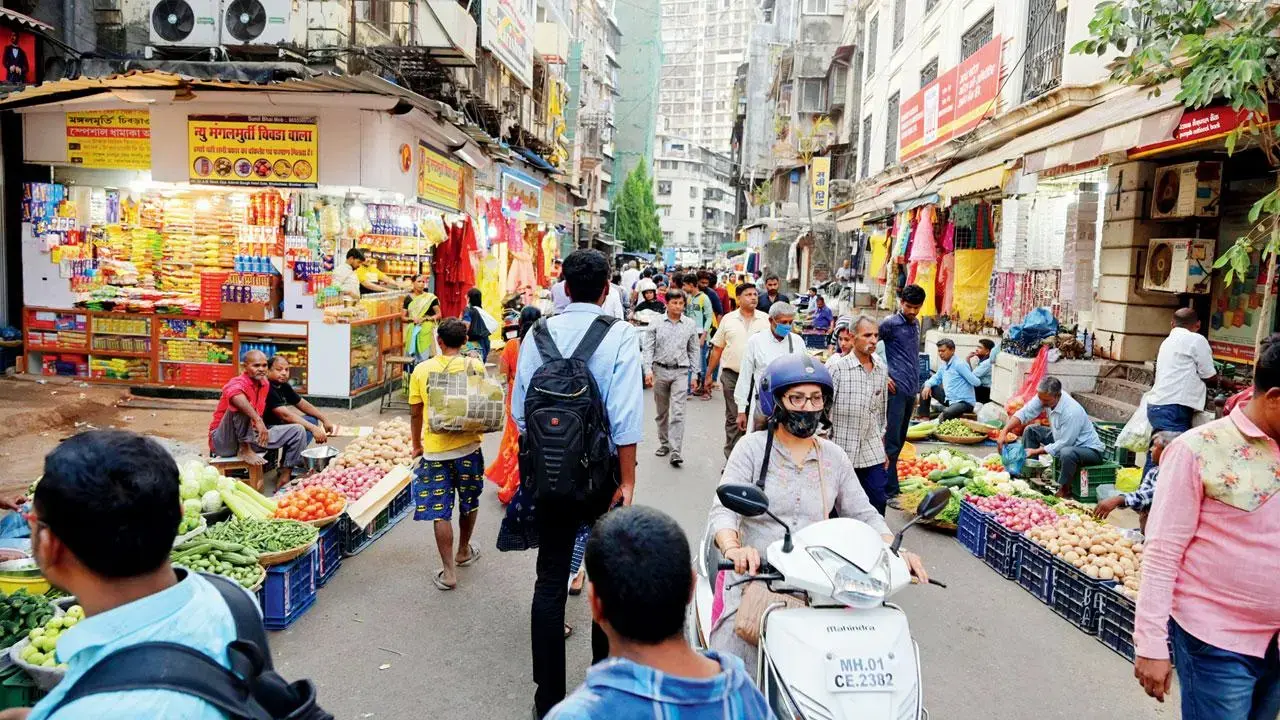
As Mumbai prepares for upcoming civic elections, a long-unresolved urban governance challenge has resurfaced sharply on the city’s streets: widespread encroachment of footpaths and carriageways by informal vendors. Across the island city and suburbs, pedestrians continue to navigate narrowed walkways and spillover traffic, raising safety risks and underscoring the absence of a comprehensive Mumbai hawker policy nearly a decade after a national law mandated it.
Civic records estimate that just over 32,000 hawkers are officially recognised in Mumbai. However, vendor associations and urban researchers place the actual number several times higher, reflecting the city’s dependence on informal livelihoods and the limited availability of regulated vending zones. With Mumbai’s footpath network spanning roughly 4,000 kilometres, civic officials acknowledge that more than half is functionally inaccessible due to unregulated occupation, forcing pedestrians onto roads and intensifying accident risks. The regulatory gap traces back to the Street Vendors legislation enacted nationally in 2014, which required cities to identify vending zones, allocate pitches, and constitute local Town Vending Committees to balance livelihoods with public space management. Mumbai received close to one lakh applications from vendors seeking legal recognition, but the process stalled amid administrative delays, pandemic disruption, and the prolonged absence of an elected civic body.
Urban planners argue that the failure to operationalise a Mumbai hawker policy has left enforcement agencies with blunt tools: periodic eviction drives that offer temporary relief but no lasting resolution. “Without formal zoning and registration, removals simply displace the problem,” said an urban governance expert, noting that vendors often return within weeks to the same high-footfall locations. The issue carries economic as well as civic consequences. Informal vending supports thousands of low-income households and provides affordable services close to transit hubs and workplaces. At the same time, unchecked encroachment undermines walkability, affects access for women, elderly citizens, and people with disabilities, and erodes the effectiveness of investments in public transport and street redesign.
Judicial directions in recent years have urged the civic administration to initiate the formation of vending committees and restart policy work. Officials, however, maintain that final decisions on pitch allocation and enforcement frameworks require political approval from an elected council, given the social and spatial trade-offs involved. Candidates preparing to enter the civic body have signalled that regulating street vending will be a priority, particularly in high-density commercial corridors where pedestrian movement is most constrained. Policy specialists caution that success will depend on data-driven mapping, transparent criteria, and integration with broader street design and mobility plans, rather than standalone enforcement.
As Mumbai pursues ambitions of safer streets and people-first urban design, the unresolved question of how public space is shared remains central. Whether the next civic term can translate legal mandates into an operational Mumbai hawker policy will shape not only walkability, but also the city’s ability to reconcile informal livelihoods with equitable and climate-resilient urban growth.
Mumbai Hawker Policy Uncertainty Disrupts Streets