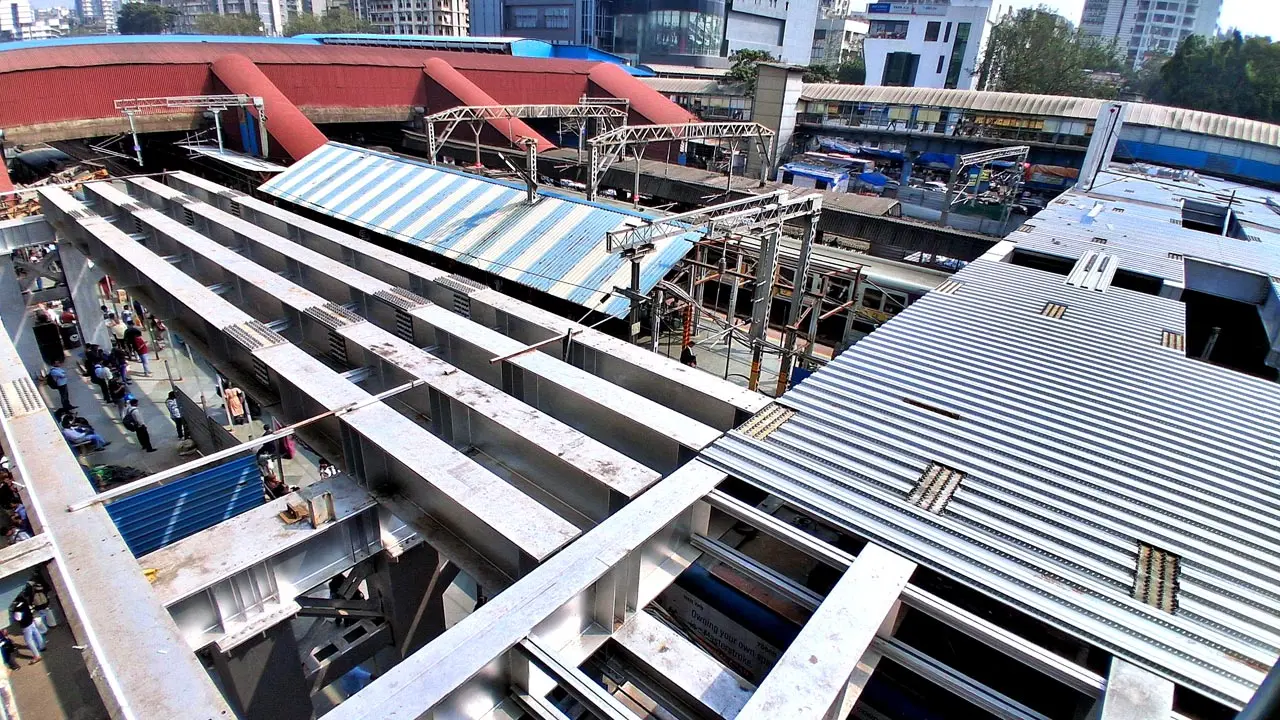
A long-delayed pedestrian infrastructure upgrade at Mumbai’s Ghatkopar transit hub is finally moving into visible construction, offering potential relief at one of the city’s most congested interchange points. An elevated deck linking the Metro corridor with the suburban rail network has entered an advanced execution stage, marking a significant step towards easing chronic crowding and improving commuter safety.
Ghatkopar serves as a critical interchange between the east–west Metro corridor and the Central Railway suburban line, handling exceptionally high passenger volumes throughout the day. Despite this, circulation space at the Metro-facing end of the station has remained constrained for years, resulting in daily bottlenecks during peak hours. Urban planners have long flagged the mismatch between passenger demand and pedestrian infrastructure at the location. Recent site progress indicates that structural work across the rail tracks at the city-bound end of the station has been completed, with decking and surface work now underway. The elevated structure is positioned alongside an existing municipal skywalk, forming part of a broader attempt to rationalise pedestrian movement between different transport modes and surrounding neighbourhoods.
At the opposite end of the station, groundwork has commenced for additional sections of the deck. Preliminary foundation activity is underway following the removal of older service structures, allowing the project footprint to expand towards the suburban side. Officials monitoring the site indicate that the sequencing of work has been designed to minimise disruption to live rail operations, a key constraint in dense urban environments. Transport experts view the development as a corrective measure rather than an expansion. Ghatkopar’s interchange evolved rapidly after the Metro became operational, but pedestrian infrastructure did not keep pace. As a result, the area became a case study in the risks of under-designed transfer spaces within multimodal networks. The new deck is expected to improve dispersal, reduce conflict points, and create safer walking conditions, particularly for women, older commuters, and persons with disabilities.
Beyond crowd management, the project carries wider urban implications. Efficient interchange design supports public transport usage by reducing travel stress and transfer times. In a city pursuing lower-emission mobility outcomes, strengthening last-mile and interchange infrastructure is increasingly seen as essential to sustaining ridership growth without adding road traffic. From a real estate and economic perspective, smoother connectivity at Ghatkopar is likely to reinforce the area’s role as a commercial and residential node in eastern Mumbai. Improved pedestrian access can enhance footfall distribution, reduce informal congestion, and support more orderly street-level activity around the station precinct.
While timelines for full commissioning are yet to be formally announced, the visible progress has raised expectations among daily commuters who have navigated constrained conditions for years. Urban infrastructure specialists caution that timely completion, integration with surrounding walkways, and ongoing maintenance will be critical to ensuring the deck delivers its intended benefits. As Mumbai continues to retrofit its older transit hubs for higher passenger loads, the Ghatkopar project underscores a broader lesson: mobility systems are only as effective as the spaces that connect them. The coming months will determine whether this long-pending intervention finally brings lasting improvement to one of the city’s busiest gateways.
Mumbai Ghatkopar Transit Node Advances Long Pending Upgrade