


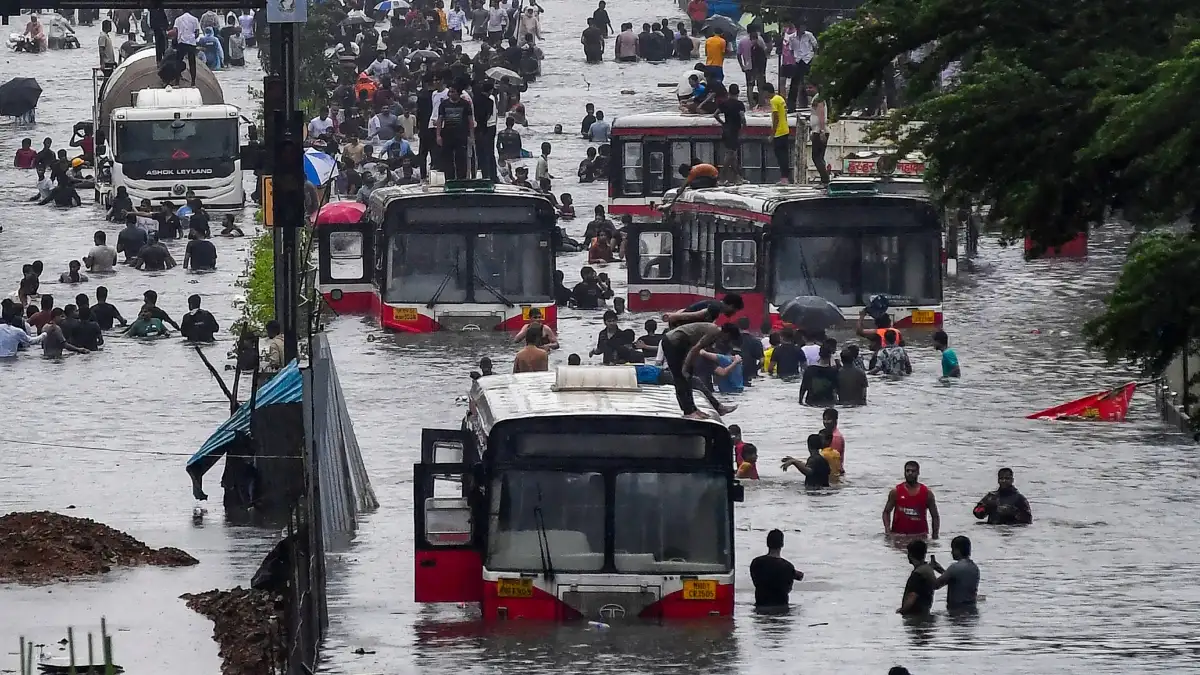
Mumbai’s monsoon preparedness is once again under scrutiny after relentless rainfall over the last two days inundated several low-lying neighbourhoods and disrupted rail services between Sion and Kurla. Despite a series of stormwater projects, upgraded holding tanks and new pumping systems, civic measures appear unable to match the intensity of changing rainfall patterns.
The Brihanmumbai Municipal Corporation (BMC) has invested heavily in flood mitigation over the past decade, including underground water-holding tanks at Hindmata, Dadar West and Parel. While these tanks, constructed in 2021, have offered some relief, they remain limited in capacity. Designed to manage up to 55 mm of rainfall an hour, they buckled under the latest cloudburst, which far exceeded this threshold. Civic officials admitted that the storage facilities—together holding 64.8 million litres after recent upgrades—were insufficient against the scale of the downpour. To accelerate water clearance, the civic body has experimented with localised solutions such as sump pits and high-capacity pumps at flood-prone junctions. Officials claim these interventions helped water recede faster than in earlier years. Yet, residents across Hindmata, King Circle and Gandhi Market experienced familiar flooding, exposing the gap between infrastructure planning and ground realities.
The crisis spilled over to the city’s lifeline—its suburban rail network. As the Mithi River swelled above danger levels, floodwaters collected on tracks between Kurla and Sion, paralysing rail traffic. Though BMC deployed multiple pumps to drain water, residents from nearby slum clusters resisted the effort, fearing that diverted water would worsen flooding in their homes. Police intervention was required to restart pumping once river levels fell, allowing train operations to resume. Urban planners argue that Mumbai’s flood woes are less about absence of infrastructure and more about a mismatch between design assumptions and evolving climate realities. Extreme rainfall events, which were once rare, are becoming frequent under the influence of climate change. Experts caution that civic investments must shift from incremental measures to resilient, city-wide systems that prioritise ecological restoration alongside engineered solutions.
The limitations of tanks and pumps underline the need for broader approaches—restoring natural floodplains, desilting rivers, and integrating climate forecasts into urban planning. Without this shift, the city risks repeating the cycle of disruption each monsoon, despite growing expenditure on mitigation. As trains resume and water recedes, the monsoon yet again delivers its reminder: piecemeal interventions may reduce temporary inconvenience, but long-term flood resilience demands holistic, eco-friendly, and sustainable solutions that match the scale of Mumbai’s climate future.
Also Read : Mumbai Monorail Faces Shutdown As Experts Recommend Scrapping Failing Transit System Permanently
