


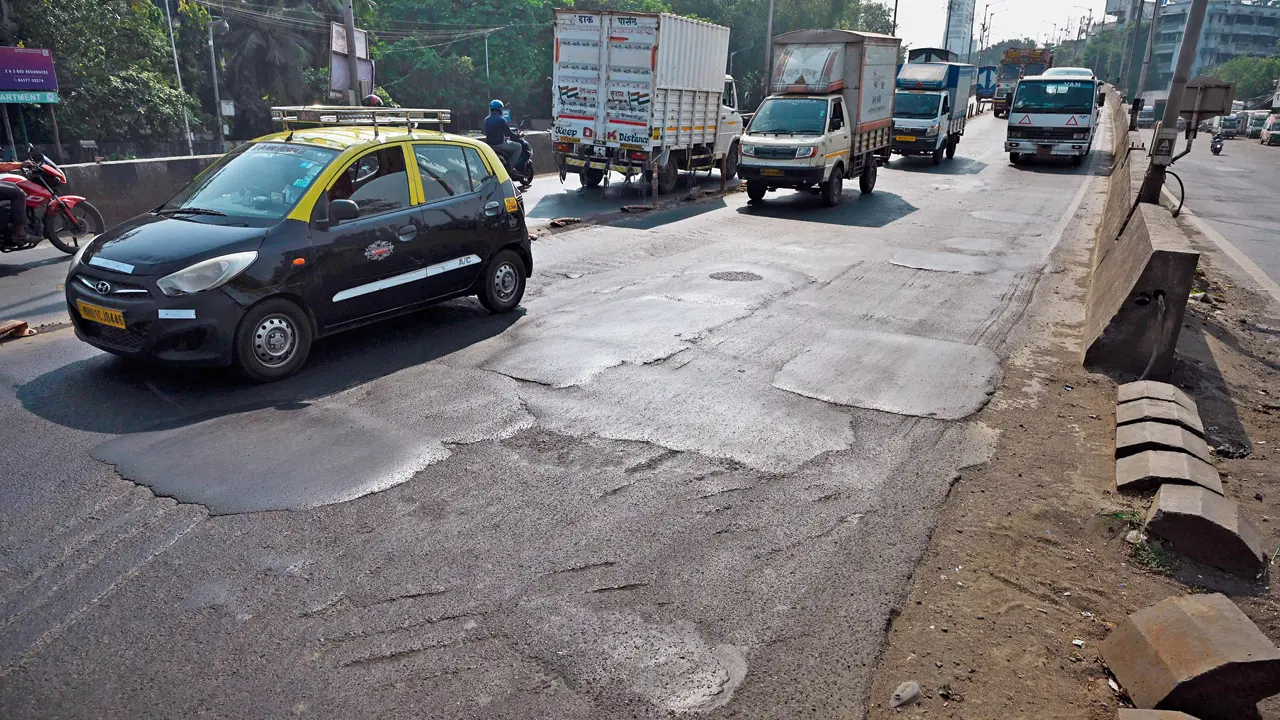
Mumbai’s Eastern Express Highway (EEH) has come under renewed scrutiny as commuters continue to report uneven and bumpy road surfaces, particularly along bridges between Everard Nagar and Matunga Circle. The issues have emerged barely months after the monsoon repair cycle, prompting the Brihanmumbai Municipal Corporation (BMC) to initiate temporary milling works while acknowledging that only full resurfacing will offer a lasting solution. The condition has once again raised questions about the quality of seasonal repairs and the broader need for climate-resilient, long-life road infrastructure in a rapidly growing city.
According to civic officials, the patches were created by the extensive use of mastic asphalt—a quick-fix material commonly deployed during the monsoon to plug potholes. While effective for short-term closures, mastic asphalt often swells upon drying, resulting in raised humps that create discomfort and safety hazards, particularly for two-wheeler users. The civic administration has now directed its road engineering teams to undertake milling to shave the top surface of these mounds and reduce the gradient difference. Officials, however, caution that this measure will only provide interim relief.
A senior civic representative explained that the nature of mastic asphalt requires meticulous levelling while still wet, failing which the surface becomes uneven once cured. The official added that several locations repaired in haste during heavy rains could not be rolled adequately due to traffic restrictions and weather conditions. As a result, the road has developed a patchwork of uneven squares, especially visible on bridges and elevated sections. The corporation maintains that comprehensive resurfacing of these structures is the only permanent fix, but such works must be timed outside the monsoon and traffic-peak periods.
Residents and road-users in Matunga, Sion, and the eastern suburbs have voiced concern over the deteriorating ride quality. Commuter groups argue that uneven surfaces increase the risk of skidding, particularly during late-evening traffic when visibility is low. Citizen representatives have also highlighted that heavy vehicles, including municipal compactors, continue to ply on stretches where restrictions are meant to be enforced. Urban mobility experts note that repeated damage on the EEH underscores the city’s dependence on short-term road repairs instead of adopting high-durability materials and sustainable construction methods suited to monsoon-prone regions.
Advocates for safe mobility emphasise that Mumbai’s major arterial roads must transition towards long-life, climate-resilient surfaces as part of a sustainable urban infrastructure programme. A stronger focus on preventive maintenance—combined with stricter enforcement of vehicle movement rules on bridges—could help reduce recurring damage. As milling work begins, commuters are hoping for smoother rides, but also expect the city to prioritise long-term planning over seasonal firefighting.
Also Read: Mumbai Approves Construction Of Promenade Link Connecting Lotus Jetty And Baroda Palace
