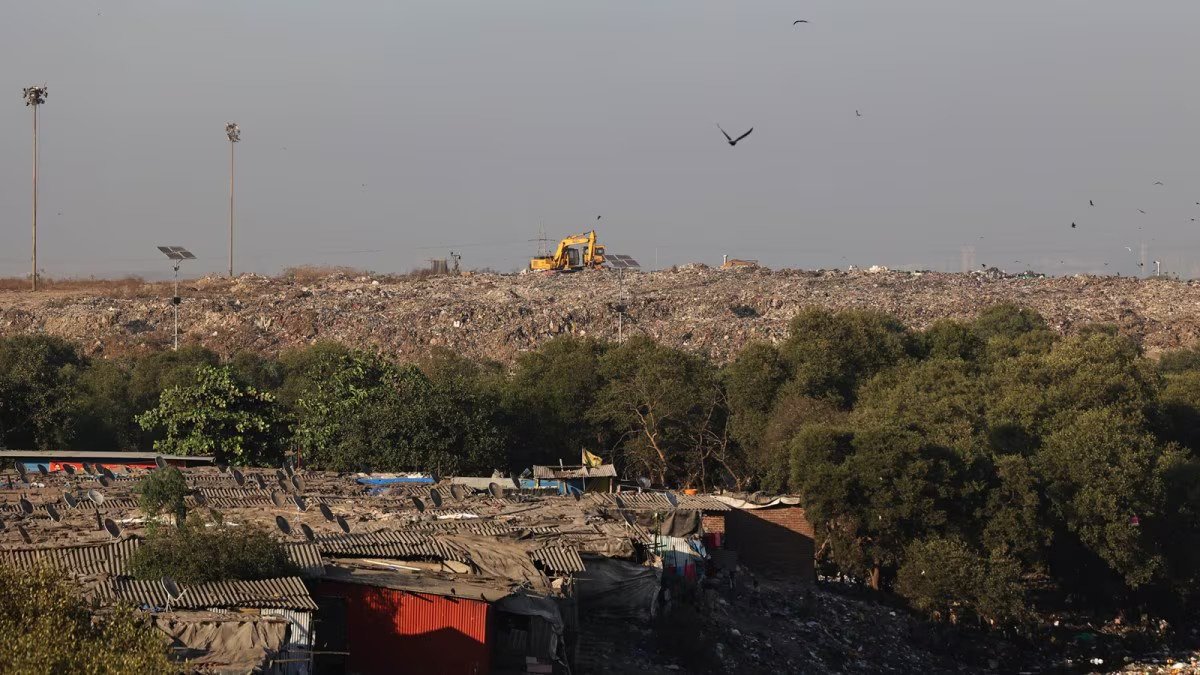
Mumbai’s long-delayed effort to remediate the Deonar landfill has taken a decisive step forward after securing coastal regulatory clearance, unlocking the next phase of one of India’s most complex urban environmental projects. The approval enables preparatory work to advance on the large-scale legacy waste removal plan, which is central to improving air quality, land use, and public health in the eastern suburbs.
The clearance, granted under coastal protection norms, allows only the scientific extraction and processing of accumulated waste within regulated zones, while mandating that all operational infrastructure be located outside sensitive coastal areas. The Deonar landfill, spread across roughly 120 hectares, falls partly within ecologically fragile zones due to its proximity to creeks and mangrove ecosystems, making regulatory compliance a critical prerequisite. Officials indicate that while this clearance removes a major bottleneck, the project still requires judicial approval and additional environmental permissions before full-scale execution can begin. Once these are secured, on-ground work could commence ahead of the monsoon window, although heavy rainfall is expected to limit active remediation due to increased moisture content in waste.
At the core of the project is a biomining approach—an engineered process that involves excavating decades-old waste, segregating recyclable material, stabilising inert fractions, and reclaiming land. Urban environmental experts view this as essential for cities like Mumbai, where legacy dumping grounds continue to emit methane, generate toxic leachate, and pose fire hazards. The Deonar landfill has been in continuous use since the early 20th century, and despite partial containment efforts in recent years, it remains a significant source of environmental stress. Periodic fires and persistent odour issues have affected nearby communities, while runoff from the site has raised concerns about contamination of surrounding water bodies.
Regulators have imposed stringent safeguards as part of the clearance framework. These include strict prohibitions on any disturbance to mangroves, requirements for zero discharge of untreated waste, and the need for dedicated treatment systems to handle leachate generated during processing. Continuous environmental monitoring by independent experts has also been mandated to track air, water, and soil quality throughout the project lifecycle. From an urban planning perspective, the Deonar remediation is more than a waste management intervention—it represents a shift towards reclaiming degraded land for potential future use. Experts suggest that successful execution could open pathways for converting such sites into green buffers, renewable energy zones, or other public infrastructure aligned with low-carbon urban development goals.
The project timeline spans multiple years, reflecting both the scale of accumulated waste and the complexity of operating within a dense, environmentally sensitive urban setting. As Mumbai grapples with mounting waste generation and shrinking landfill capacity, the Deonar cleanup could serve as a model for similar interventions across India. The next phase will hinge on regulatory coordination and timely execution. If implemented effectively, the project has the potential to transform a long-standing environmental liability into a more sustainable urban asset, while reinforcing the importance of climate-resilient infrastructure planning in rapidly growing cities.
Mumbai Deonar Cleanup Moves Ahead With CRZ Clearance